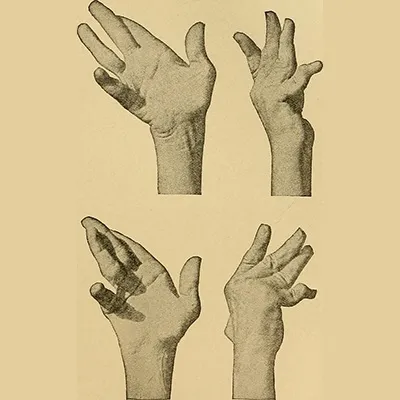
Alien Hand Syndrome
Neuropsychiatric Disorder Case
CLASSIFICATION: Unknown
LOCATION
Unknown
TIME PERIOD
Unknown
VICTIMS
0 confirmed
Alien hand syndrome (AHS) is a neuropsychiatric disorder characterized by involuntary movements of a limb, typically the left hand, which appears to act independently of the individual's conscious control. This condition is most commonly documented in patients who have undergone surgical procedures to sever the corpus callosum, often as a treatment for severe epilepsy. AHS can also arise from brain injuries, strokes, infections, or neurodegenerative diseases such as Alzheimer's. The affected individuals may find themselves needing to physically restrain the "alien" hand, which may engage in actions contrary to their intentions, leading to a disconnection between thought and action. Currently, AHS remains a subject of ongoing research in neurology and psychiatry, with no definitive cure but various management strategies being explored.
There is speculation that alien hand syndrome could be a contributing factor in certain true crime cases, particularly when the perpetrator displays erratic or uncontrollable behavior that seems disconnected from their conscious intentions. Some believe that individuals experiencing this condition may commit acts of violence or crime without full awareness or control, raising questions about accountability. Additionally, there are theories suggesting that neurological disorders like alien hand syndrome could be misinterpreted as malicious intent by investigators or the public.
The Enigma of Alien Hand Syndrome: A True Crime of the Mind
The Mysterious Case of Alien Hand Syndrome
Imagine waking up one day to find that your hand has developed a mind of its own—acting without your consent, moving with a will that seems entirely separate from your own. This is the unsettling reality for those afflicted with Alien Hand Syndrome (AHS), sometimes referred to as Dr. Strangelove syndrome. This neuropsychiatric disorder manifests when a person's limb, most commonly the left hand, behaves independently, often engaging in actions that bewilder and distress its owner.
The syndrome first captured medical interest when it was documented in patients whose brain hemispheres had been surgically separated. These procedures were typically performed to alleviate severe epilepsy or epileptic psychosis, particularly cases involving temporal lobe epilepsy. Yet, the phenomenon isn't limited to surgical interventions. AHS has also been observed in individuals after brain surgeries, strokes, infections, tumors, aneurysms, migraines, and progressive neurodegenerative conditions such as Alzheimer's disease, corticobasal degeneration, and Creutzfeldt–Jakob disease. The disorder is intricately linked with damage to the brain's frontal, occipital, and parietal lobes.
Signs and Symptoms
AHS is characterized by "alien behavior," distinct from reflexive actions in its purposeful nature. Victims may not realize what the alien hand is doing until it performs an action that demands attention. The afflicted hand is often perceived as "wayward" or "disobedient," acting against the individual's will. A particularly perplexing scenario arises in patients with damage to the corpus callosum, the structure connecting the two cerebral hemispheres, where the hands can appear to be in conflict with one another.
French neurologist François Lhermitte described a related syndrome, utilization behavior, where patients compulsively interact with objects in their environment. This condition, often resulting from extensive bilateral frontal lobe damage, is sometimes considered a form of "bilateral" alien hand syndrome. Here, the environment dictates the patient's actions, leading to "environmental dependency syndrome," where the individual loses self-directed agency.
Some people with AHS cope by personifying their rogue limb, assigning it names that range from playful to menacing. For instance, a patient might affectionately dub their hand "baby Joseph," instructing it to cease its mischief when it pinches or grabs inappropriately. Such personification is thought to be more common in individuals with flamboyant personalities.
The Anatomy of Alien Hand Syndrome
Neuroimaging studies reveal that lesions in the frontal lobe, particularly the corpus callosum, are frequent culprits in alien hand syndrome. These brain regions are crucial for motor planning and the execution of actions. The callosal variant of AHS involves sophisticated motor acts by the non-dominant hand, often resulting in "intermanual conflict." A classic example involves a patient who, while using her dominant hand to put a cigarette in her mouth, found her non-dominant hand removing and discarding it. Another patient experienced her alien hand unbuttoning her blouse while her controlled hand buttoned it up.
The Cause and Mechanism
Alien hand syndrome arises when the primary motor cortex, responsible for hand movement, becomes isolated from the premotor cortex, which influences movement planning. A 2009 fMRI study illuminated the normal sequence of brain activation during voluntary movement, involving a cascade from the supplemental motor area to the primary motor cortex, followed by the parietal cortex. This coordination is essential for a sense of agency over one's movements. In AHS, this orderly progression is disrupted, and the primary motor cortex acts independently, creating a sensation of movements being externally controlled.
Another fMRI study in 2007 highlighted that alien movements uniquely activate the primary motor cortex in the damaged hemisphere, unlike typical movements that involve a complex network of brain regions. This autonomous activity may lead to misinterpreting self-generated movements as externally driven, resulting in the "alien" perception.
The Disconnection Theory
The disconnection theory posits that AHS results from a breakdown in communication between brain regions responsible for movement and those generating a conscious sense of control. This dissociation leads to a loss of agency, where movements feel externally imposed. Recent studies have explored the neural basis of this phenomenon, suggesting abnormalities in differentiating between re-afferent and ex-afferent signals, the latter being sensory feedback from externally imposed movements.
In summary, alien hand syndrome is a compelling testament to the brain's complex orchestration of movement and self-awareness. The drama of a limb acting independently captivates not only medical professionals but also anyone fascinated by the mysterious depths of the human mind.
Sources
For a comprehensive exploration, visit the original Wikipedia article: Alien Hand Syndrome.
No Recent News
No recent news articles found for this case. Check back later for updates.
No Evidence Submitted
No evidence found for this case. Be the first to submit evidence in the comments below.
Join the discussion
Loading comments...
Alien hand syndrome (AHS) is a neuropsychiatric disorder characterized by involuntary movements of a limb, typically the left hand, which appears to act independently of the individual's conscious control. This condition is most commonly documented in patients who have undergone surgical procedures to sever the corpus callosum, often as a treatment for severe epilepsy. AHS can also arise from brain injuries, strokes, infections, or neurodegenerative diseases such as Alzheimer's. The affected individuals may find themselves needing to physically restrain the "alien" hand, which may engage in actions contrary to their intentions, leading to a disconnection between thought and action. Currently, AHS remains a subject of ongoing research in neurology and psychiatry, with no definitive cure but various management strategies being explored.
There is speculation that alien hand syndrome could be a contributing factor in certain true crime cases, particularly when the perpetrator displays erratic or uncontrollable behavior that seems disconnected from their conscious intentions. Some believe that individuals experiencing this condition may commit acts of violence or crime without full awareness or control, raising questions about accountability. Additionally, there are theories suggesting that neurological disorders like alien hand syndrome could be misinterpreted as malicious intent by investigators or the public.
The Enigma of Alien Hand Syndrome: A True Crime of the Mind
The Mysterious Case of Alien Hand Syndrome
Imagine waking up one day to find that your hand has developed a mind of its own—acting without your consent, moving with a will that seems entirely separate from your own. This is the unsettling reality for those afflicted with Alien Hand Syndrome (AHS), sometimes referred to as Dr. Strangelove syndrome. This neuropsychiatric disorder manifests when a person's limb, most commonly the left hand, behaves independently, often engaging in actions that bewilder and distress its owner.
The syndrome first captured medical interest when it was documented in patients whose brain hemispheres had been surgically separated. These procedures were typically performed to alleviate severe epilepsy or epileptic psychosis, particularly cases involving temporal lobe epilepsy. Yet, the phenomenon isn't limited to surgical interventions. AHS has also been observed in individuals after brain surgeries, strokes, infections, tumors, aneurysms, migraines, and progressive neurodegenerative conditions such as Alzheimer's disease, corticobasal degeneration, and Creutzfeldt–Jakob disease. The disorder is intricately linked with damage to the brain's frontal, occipital, and parietal lobes.
Signs and Symptoms
AHS is characterized by "alien behavior," distinct from reflexive actions in its purposeful nature. Victims may not realize what the alien hand is doing until it performs an action that demands attention. The afflicted hand is often perceived as "wayward" or "disobedient," acting against the individual's will. A particularly perplexing scenario arises in patients with damage to the corpus callosum, the structure connecting the two cerebral hemispheres, where the hands can appear to be in conflict with one another.
French neurologist François Lhermitte described a related syndrome, utilization behavior, where patients compulsively interact with objects in their environment. This condition, often resulting from extensive bilateral frontal lobe damage, is sometimes considered a form of "bilateral" alien hand syndrome. Here, the environment dictates the patient's actions, leading to "environmental dependency syndrome," where the individual loses self-directed agency.
Some people with AHS cope by personifying their rogue limb, assigning it names that range from playful to menacing. For instance, a patient might affectionately dub their hand "baby Joseph," instructing it to cease its mischief when it pinches or grabs inappropriately. Such personification is thought to be more common in individuals with flamboyant personalities.
The Anatomy of Alien Hand Syndrome
Neuroimaging studies reveal that lesions in the frontal lobe, particularly the corpus callosum, are frequent culprits in alien hand syndrome. These brain regions are crucial for motor planning and the execution of actions. The callosal variant of AHS involves sophisticated motor acts by the non-dominant hand, often resulting in "intermanual conflict." A classic example involves a patient who, while using her dominant hand to put a cigarette in her mouth, found her non-dominant hand removing and discarding it. Another patient experienced her alien hand unbuttoning her blouse while her controlled hand buttoned it up.
The Cause and Mechanism
Alien hand syndrome arises when the primary motor cortex, responsible for hand movement, becomes isolated from the premotor cortex, which influences movement planning. A 2009 fMRI study illuminated the normal sequence of brain activation during voluntary movement, involving a cascade from the supplemental motor area to the primary motor cortex, followed by the parietal cortex. This coordination is essential for a sense of agency over one's movements. In AHS, this orderly progression is disrupted, and the primary motor cortex acts independently, creating a sensation of movements being externally controlled.
Another fMRI study in 2007 highlighted that alien movements uniquely activate the primary motor cortex in the damaged hemisphere, unlike typical movements that involve a complex network of brain regions. This autonomous activity may lead to misinterpreting self-generated movements as externally driven, resulting in the "alien" perception.
The Disconnection Theory
The disconnection theory posits that AHS results from a breakdown in communication between brain regions responsible for movement and those generating a conscious sense of control. This dissociation leads to a loss of agency, where movements feel externally imposed. Recent studies have explored the neural basis of this phenomenon, suggesting abnormalities in differentiating between re-afferent and ex-afferent signals, the latter being sensory feedback from externally imposed movements.
In summary, alien hand syndrome is a compelling testament to the brain's complex orchestration of movement and self-awareness. The drama of a limb acting independently captivates not only medical professionals but also anyone fascinated by the mysterious depths of the human mind.
Sources
For a comprehensive exploration, visit the original Wikipedia article: Alien Hand Syndrome.
No Recent News
No recent news articles found for this case. Check back later for updates.
No Evidence Submitted
No evidence found for this case. Be the first to submit evidence in the comments below.
Join the discussion
Loading comments...