ANALYZING EVIDENCE
Processing case files...
Processing case files...
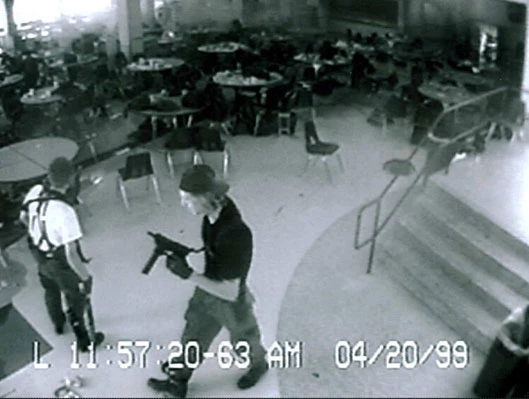
1999 Colorado School Massacre
CLASSIFICATION: Mass Murder
LOCATION
Columbine, Colorado, United States
TIME PERIOD
April 20, 1999
VICTIMS
16 confirmed
On April 20, 1999, at Columbine High School in Columbine, Colorado, seniors Eric Harris and Dylan Klebold carried out a planned bombing and shooting attack that killed 13 students and one teacher and wounded dozens before the perpetrators died by suicide. The attack involved firearms, improvised explosive devices (including propane- and pipe-bombs) and extensive pre-attack planning documented in journals and video "basement tapes." Two coworker/suppliers were later prosecuted and convicted for providing weapons to the minors, but the primary perpetrators are deceased and therefore not criminally convicted. Key evidence includes the perpetrators' journals and tapes, surveillance footage, recovered firearms and multiple unexploded bombs.
Some believe the massacre was part of a larger conspiracy or “false flag” operation—claims range from antisemitic theories (pointing to Klebold’s Jewish heritage) to Alex Jones-style assertions that the U.S. government “perpetrated” or staged Columbine. Investigators, commentators, and the media have alternatively speculated that motive lay in revenge for bullying or membership in subcultures (e.g., the so-called Trench Coat Mafia/goth scene), while other debates emphasize influences such as violent video games, Internet communities, antidepressant use, or a desire for notoriety (the “fame-seeking” hypothesis), and family- and official-response critics have alleged slow police action or cover-up-like failures in pre-incident interventions.
On Tuesday, April 20, 1999, violence erupted inside Columbine High School in unincorporated Jefferson County, Colorado. [1]
Two of the school’s own students, Eric Harris and Dylan Klebold, turned their weapons on classmates and staff in a shooting rampage that left 12 students and one teacher dead and 24 others wounded. [1]
Before anyone could put them on trial or ask them why, Harris and Klebold ended the attack by killing themselves. [1]
© Mapbox © OpenStreetMap
In the years since, the name of the school—set in the census-designated place of Columbine near Denver and Littleton—has become inseparable from the event. [1]
The massacre remains one of the deadliest high school shootings in the United States and is the third-deadliest school shooting in U.S. history, after the 1966 University of Texas massacre and the 2007 Virginia Tech massacre. [1]
Columbine High School stood in a suburban stretch of Jefferson County, part of a landscape of neighborhoods tied to Denver and nearby Littleton. [1]
On that Tuesday, it was supposed to be an ordinary school day.
Instead, two students—Eric Harris and Dylan Klebold—brought weapons to campus and began a shooting rampage inside their own school. [1]
In a place built for assemblies, sports, and exams, gunfire cut across classrooms and hallways.
What followed was chaos and terror contained within the school’s walls. By the time the attack ended, 12 students and one teacher were dead. [1]
Two dozen more people were wounded, their lives permanently marked by physical injury and trauma. [1]
The two perpetrators, still teenagers and still legally students of the school they had just devastated, then died by suicide. [1]
The attack halted only when there was no one left to arrest.
Numbers are a blunt instrument for describing loss, but at Columbine they became a grim shorthand.
Columbine fbi diagram 0009.jpg
Wikimedia Commons· Public domain
Twelve students who had arrived that morning for class never came home. [1]
A teacher died trying to do the work of education and care inside a building that had suddenly become a crime scene. [1]
Twenty‑four others survived with gunshot wounds. [1]
The victims included both students and staff, and among the wounded were people who would carry scars and lasting medical needs into adulthood. [1]
Families, friends, and a school community were left to navigate funerals, hospital visits, and long recoveries.
The two people behind the massacre, Harris and Klebold, removed themselves from the legal system when they took their own lives after the shooting. [1]
Their suicides meant there would be no trial, no cross‑examinations, and no formal courtroom record of motive or planning—only the undeniable facts of the dead and the injured.
Even in a country familiar with gun violence, Columbine stood out.
The massacre is still counted as one of the deadliest high school shootings ever to occur in the United States. [1]
Across all educational levels, it ranks as the third-deadliest school shooting in U.S. history, behind only the 1966 University of Texas tower shooting and the 2007 Virginia Tech massacre. [1]
That ranking is a measure of lethal scale—of how many lives were taken in a single event.
But it also hints at how Columbine quickly became a reference point in national conversations about schools and safety. The attack involved students targeting their own high school, a scenario that struck at the idea of school as a protected space.
Columbine fbi diagram 0001.jpg
Wikimedia Commons· Public domain
In Jefferson County, the loss could be measured in specific families and classrooms. Across the country, Columbine became a name invoked any time parents, students, and educators grappled with the fear that violence could erupt in their own hallways.
In the wake of the massacre, grief and shock were immediate. Behind them came more complicated, enduring questions: how to prevent another attack, how to understand why it had happened, and how to talk about it without turning the perpetrators into dark celebrities.
Those questions have not been limited to Columbine. In the decades surrounding 1999, the United States experienced a series of mass shootings—some at schools, many in other public and semi-public spaces. Researchers began to look at patterns not only of lethality, but of attention and notoriety.
One study assembled a dataset of 189 mass shootings that occurred from 1966 through 2021. [1]
Each incident in the dataset was categorized by the type of people targeted—known as the “target group”—and by the shooting location. [1]
The authors introduced a concept they called “surprisal,” drawing on information theory’s idea of Shannon information content, to quantify how unusual a particular target group or location was compared with past attacks. [1]
Fame, in this context, was not a metaphor. The researchers measured it directly, using traffic to Wikipedia pages as a proxy for how much public attention each shooting received. [1]
They also distinguished between shooters described as “fame‑seeking” and those who were not, using 27 fame‑seeking cases and 161 non‑fame‑seeking cases in some of their comparisons. [1]
Their results suggested that mass shootings tied to fame‑seeking motives tended to involve more surprising, unexpected combinations of victims and locations. Surprisal scores—how statistically “unusual” a target group or site was—were significantly higher in fame‑seeking cases than in other shootings. [1]
Even when they controlled for how many people were killed or injured, there was still a strong, positive association between the fame a shooting received and how surprising its target group and location were. [1]
Statistically, the link between fame and target group surprisal showed a Spearman correlation of ρ = 0.3895 (P = 0.0006), and between fame and shooting location surprisal a correlation of ρ = 0.4229 (P = 0.0002). [1]
Fame and lethality were also intertwined: more famous shootings tended to have more people killed and injured, with fame correlating with fatalities (ρ = 0.5238, P < 0.0001) and with the number of injured victims (ρ = 0.4957, P < 0.0001). [1]
The study’s authors visualized some of this with scatter plots and daily counts of Wikipedia page visits for the three most famous mass shootings from January 1, 2008, to April 7, 2022. [1]
They framed their work with keywords like aggression, fame‑seeker, information theory, mass shooting, and surprisal, and reported their research as being supported by non‑U.S. government and U.S. government non‑P.H.S. funding, with no declared competing interests. [1]
Taken together, the findings highlight a dangerous feedback loop: the deadlier and more unusual a shooting is, the more public attention it draws—attention that some perpetrators appear to crave. [1]
Columbine sits inside that broader landscape of American mass shootings, part of the backdrop against which researchers now try to understand the links between notoriety, surprise, and violence.
The Columbine High School massacre was, in raw numbers, an attack that killed 13 people at a single school—12 students and a teacher—while injuring 24 others. [1]
It was carried out by two of the school’s own students, who then died by suicide rather than face arrest or trial. [1]
Measured by fatalities, it remains one of the deadliest high school shootings in the country and the third‑deadliest school shooting in U.S. history. [1]
President Clinton's Remarks Regarding Columbine HS Shooting (1999).webm
Wikimedia Commons· Public domain
Behind those facts are lives cut short, survivors whose injuries never fully fade, and a community that had to rebuild around an absence.
Beyond Jefferson County, Columbine reshaped how people think about what can happen inside a school—and how the story of a shooting is told, retold, and studied in the hope that it might one day become less likely to happen again.
Adapted from Wikipedia: Columbine High School massacre.
This case file is an original Bloody Likely narrative synthesis based on the cited sources. Article © Bloody Likely. All rights reserved. Source materials remain the property of their respective owners. Facts, public records, quotations, and cited references are used for reporting, research, commentary, and documentation. Bloody Likely content license
Audio narration © Bloody Likely. All rights reserved. The audio player is provided for personal streaming/listening only.
No recent news articles found for this case. Check back later for updates.
No evidence found for this case. Be the first to submit evidence in the comments below.
Join the discussion
Loading comments...
Brooks Brown's parents viewed Eric Harris's website and contacted the Jefferson County Sheriff's Office about Harris's violent writings and bomb-making
Eric Harris and Dylan Klebold were arrested for breaking into a van and stealing tools and computer equipment and were placed in a 12-month juvenile diversion
Harris and Klebold made the 'Hitmen for Hire' video (recorded as a school project) depicting them with fake guns and themes later echoed on the day of the
At approximately 11:19 a.m. MDT, Harris and Klebold initiated their attack on campus, detonating some devices, throwing bombs, and shooting students and staff
Between roughly 11:29 and 11:36 a.m., the gunmen entered the library and killed ten people there while wounding many others before temporarily leaving the room.
By 12:08 p.m. both Eric Harris and Dylan Klebold had killed themselves in the library; gunfire from the school ceased shortly before that time.
Bomb squads cleared the school; an official death toll (excluding later secondary deaths) was released and the cafeteria bombs were discovered the following
Mark Manes and Philip Duran pled guilty to supplying a handgun to a minor and possession of an illegally sawed-off shotgun and received prison sentences.
A permanent memorial honoring the victims of the April 20, 1999 shootings was opened to the public in Clement Park.
Anne Marie Hochhalter, a survivor who had been paralyzed in the attack, died; her death certificate listed sepsis and was officially ruled a homicide,