ANALYZING EVIDENCE
Processing case files...
Processing case files...
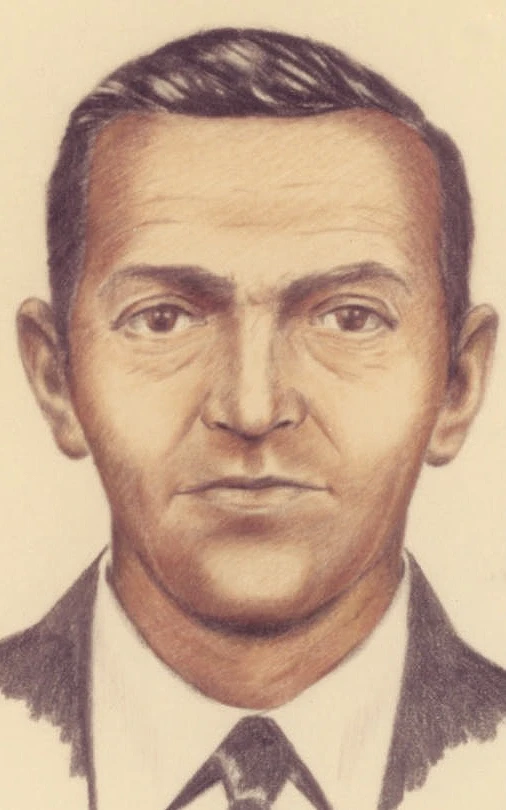
Unsolved 1971 plane hijacking
CLASSIFICATION: Cold Case
LOCATION
Seattle, Washington
TIME PERIOD
Nov. 24th 1971
VICTIMS
36 confirmed
On November 24, 1971, an unidentified man using the name Dan Cooper hijacked Northwest Orient Flight 305 between Portland and Seattle, demanded $200,000 and four parachutes, released the passengers in Seattle, and then parachuted from the aft airstair into southwest Washington. The suspect was never positively identified or captured; physical evidence recovered from the aircraft included a clip-on tie, tie clip, cigarette butts and parachute material, and a portion of the ransom ($5,800) was found on the Columbia River in 1980. The FBI investigated actively for 45 years, compiled a large file, developed composite sketches and suspects, and officially suspended active investigation in 2016 while preserving the evidence. Key forensic leads include particles on the tie and partial DNA profiles, but no forensic match has produced a conviction or identification of the hijacker.
Some investigators and the FBI have long speculated that Cooper did not survive the jump—citing dark, inclement weather, rough forested terrain, unsuitable clothing and an instruction parachute that could not be steered, and the 1980 find of a small cache of the ransom bills as consistent with death in the wilderness. The FBI and others also explored and publicly debated specific suspect theories (for example, Richard Floyd McCoy was at one point a leading suspect who was later ruled out) and hundreds of tips suggesting individuals who suddenly acquired unexplained wealth. Amateur sleuths and commentators have advanced alternate explanations—including claims by private researchers (e.g., Tom Colbert) asserting they identified the hijacker, and more skeptical theories that the event was a hoax or that other parties (including possible inside collusion) have not been fully disclosed—though none of these alternate theories have produced definitive proof.
On the night before Thanksgiving 1971, a man calling himself Dan Cooper boarded a short Northwest Orient hop from Portland to Seattle, quietly hijacked the Boeing 727, extorted $200,000 in cash and four parachutes, then vanished out the back of the plane into the dark over the Pacific Northwest. [1]
Half a century later, the FBI still does not know who he was or what became of him. [1]
On November 24, 1971, a middle‑aged man described later as a white male in his mid‑40s with dark hair and brown eyes walked up to a Northwest Orient ticket counter at Portland International Airport and asked for a one‑way ticket to Seattle. [1][2] He paid $20 in cash and gave his name as “Dan Cooper.” [1][3]
Revised Composite Sketch B.jpg
Wikimedia Commons· Public domain
He carried no luggage, only a black attaché case and a brown paper bag. [1][2] He went directly to the boarding gate and took a seat in the rear of the aircraft, a Boeing 727‑100 configured for 89 passengers but carrying just 36 that day. [1][2]
Cooper chose a seat in the last row, a few feet in front of the rear door and built‑in airstair that could be lowered in flight—a design quirk of the 727 that would become central to his escape. [1][2] Flight 305 left Portland on schedule at 2:50 p.m. Pacific time. [1]
At some point he ordered a bourbon and 7‑Up. [1] Around him, other passengers settled in, unaware that the most famous hijacking in U.S. history was already underway. [2][4]
A flight attendant, Florence Schaffner, took the folding seat in the rear of the cabin as the jet climbed away from Portland. [2][5] Sometime after takeoff—by then the 727 was airborne—Cooper handed her a note. [1][2]
Schaffner initially slipped it into her purse, assuming it was a phone number or a routine flirtation. [1] Cooper leaned toward her and said he had a bomb. [1][6]
The note, written in all capital letters, stated that he had a bomb in his briefcase and wanted her to sit beside him. [1][3] When she did, Cooper opened the attaché case. Inside she saw what she believed to be a bomb: a large cylindrical battery with wires attached to two neat rows of four red cylinders, which she assumed were sticks of dynamite. [1] Authorities later described the device as highway flares wired together. [2]
Cooper was calm and specific. He told Schaffner to write down his demands: $200,000 in used bills in a knapsack, two back (main) parachutes, two chest‑mounted reserve parachutes, that no police be involved, that the plane be refueled in Seattle, that passengers be freed after refueling, and that they be ready to take off again by 5 p.m. [1][2]
He wanted the cash in negotiable American currency, in unmarked $20 bills. [1][2] By asking for both front and back parachutes, he implied he might force a hostage to jump with him—an insurance policy, investigators later believed, against authorities sabotaging the gear. [1][5]
Schaffner relayed the message to the cockpit. [1] Captain William A. Scott informed Northwest’s flight operations that they were dealing with a hijacking and that Cooper wanted $200,000 and four parachutes delivered in Seattle by 5 p.m. [1][5] Officials told Cooper the demands would be met. [2]
For roughly two hours, Flight 305 circled Puget Sound while law enforcement and airline officials scrambled on the ground. [1] Northwest Orient’s president, Donald Nyrop, authorized payment of the ransom and ordered employees to cooperate. [1]
The FBI and local authorities began assembling $200,000 in $20 bills and locating parachutes. [1] At Seattle–Tacoma International Airport, airline representative Al Lee was tapped to bring the money and parachutes to the plane; he changed out of his airline uniform into civilian clothes to do it. [1][2]
On board, most of the 35 other passengers remained unaware anything was wrong. [1][2] Cooper smoked filter‑tipped Raleigh cigarettes—later counted as eight butts in the armrest ashtray—and waited. [1]
Flight 305 finally landed in Seattle, where police and FBI agents kept their distance per Cooper’s instructions. [2][5] The money and parachutes were brought to the aircraft, which was also refueled. [2]
Flight attendant Tina Mucklow went to the front door, retrieved the bag containing the ransom, and carried it back to Cooper in the last row. [1] He inspected the bundles, then handed her a packet of bills; she returned it, telling him company policy prohibited accepting gratuities. [1]
Once the ransom and parachutes were aboard, Cooper released the 36 passengers and two of the flight attendants at Seattle. [1][2][3] Only Cooper and the crew remained when the doors closed again.
Here, the record splits. Some accounts state that Cooper and all six crew members stayed aboard. [1] Others, including a later Salon reconstruction, describe only four crew—Captain Scott and three others—remaining with him. [5] The discrepancy has never been fully reconciled in public records.
On the ground at Seattle, Cooper spelled out his next set of instructions. He told the crew to plot a course toward Mexico—some accounts say specifically Mexico City—with a refueling stop in Reno, Nevada. [1][4]
July 2016 D.B. Cooper Plane Ticket (28379315406).jpg
Wikimedia Commons· Public domain
He ordered an unusually slow and low flight profile: southeast at minimum airspeed without stalling, around 100 knots, at a maximum altitude of 10,000 feet. [1] He wanted the landing gear down, flaps at 15 degrees, and the cabin left unpressurized. [1]
Cooper also refused to allow anyone to accompany him in the cabin. According to a Los Angeles Times summary, he insisted on being alone back there when the 727 lifted off again. [6]
Flight 305 took off from Seattle around 7:40 p.m., with Cooper, flight attendant Tina Mucklow, Captain Scott, First Officer William Rataczak, and flight engineer Harold Anderson known to have been aboard. [1] Two F‑106 fighter jets from McChord Air Force Base and a Lockheed T‑33 trainer shadowed the airliner as it headed south. [1]
At one point, Cooper complained that the ransom had been delivered in a cloth bag rather than the knapsack he had requested. [1] He opened one of the reserve parachutes, cut three shroud lines from its canopy, and used the empty parachute bag to stuff in bundles of cash. [1]
Sometime after departure, he instructed Mucklow to go forward to the cockpit and to have the cabin lights turned off. [2] She complied, leaving him alone in the darkened rear of the 727. [2][6]
Around 8:00 p.m., a cockpit warning light flickered on, indicating that the airstair at the back of the plane had been deployed. [1] At approximately 8:13 p.m., the crew felt the aircraft’s tail section suddenly pitch upward, forcing the pilots to trim and level the jet. [1]
On the earlier experimental reenactment of the flight, investigators shoved a 200‑pound sled out the rear stairs and reproduced that same upward motion of the tail, reinforcing their belief that the 8:13 p.m. event marked Cooper’s jump. [1]
The flight continued toward Reno, where it landed at 11:02 p.m. local time. [1] When the crew inspected the rear of the cabin, they saw the airstair was still down. [1] Reno police and federal agents quickly surrounded the aircraft and searched it. Cooper was gone. [1][5]
What he left behind became the FBI’s most famous set of orphaned clues. On the seat identified as 18‑E, agents recovered a black clip‑on tie and mother‑of‑pearl tie clip. [1] They lifted 66 latent fingerprints from various surfaces. [1] Two of the four parachutes were found aboard, one of them a reserve canopy that had been opened, with three shroud lines cut away. [1]
Agents also found a single brown Caucasian head hair on the seat’s headrest, a limb hair on the seat itself, and eight Raleigh cigarette butts in the ashtray built into Cooper’s armrest. [1] For a time, those small items of trash and shedding looked like the best path to a name.
The FBI codenamed the case NORJACK—short for “Northwest Hijacking”—and threw resources at it on a scale that reflected both the embarrassment and the danger of an unsolved skyjacking. [5]
Within days, agents interviewed witnesses and produced composite sketches, eventually issuing two principal versions known as Composite A and Composite B. [1] Eyewitnesses described Cooper as a man in his mid‑40s with an olive complexion, dark hair, brown eyes, a dark suit, white shirt, thin black tie, raincoat, and brown shoes. [1][3]
To understand exactly where he might have gone, the FBI and the military did something unprecedented: on December 6, 1971, an SR‑71 Blackbird reconnaissance plane flew the Portland‑to‑Seattle‑to‑Reno route, trying to photograph the 727’s flight path and conditions. [1] Poor visibility scuttled the photography, but the effort underscored the urgency.
On the ground, search teams fanned out in Clark and Cowlitz counties in southwest Washington, concentrating on an initial computer‑generated landing zone a few miles southeast of Ariel, near Lake Merwin. [1] They went door‑to‑door, patrolled Lake Merwin and neighboring Yale Lake by boat, and scoured forest and farmland on foot and by helicopter. [1]
An aerial sweep flown along the entire air corridor, known as Victor 23 (or Vector 23), searched the suspected route from Seattle to Reno for any trace of a parachute, body, or money. [1]
Initial calculations placed Cooper’s probable landing zone in a narrow band beginning near Woodland, Washington, and stretching about 20 miles south toward Portland along the Columbia River. [2] Northwest director of flight operations‑technical Paul Soderlind later flew the same aircraft in a reenactment and said that radio conversations during the original hijacking had been interrupted by pressure bumps when the rear ramp was lowered and slammed shut—a quirk that let investigators calculate the plane’s position at the moment of the jump with unusual precision. [2]
As more data came in, including wind information from a nearby Continental Airlines flight piloted by Tom Bohan, the FBI adjusted its estimate. The likely drop zone, they concluded, was actually over the Washougal River watershed, east of the original search area. [1]
None of it turned up Cooper. The intensive search lasted for days, then weeks. There was not a single confirmed physical trace of the man or most of his money. [2][3]
If Cooper had survived, he faced an immediate problem: laundering 10,000 marked $20 bills. The FBI compiled lists of the ransom serial numbers and, about a month after the hijacking, mailed them to financial institutions, casinos, racetracks, businesses, and law enforcement agencies across the region. [1]
In early 1973, The Oregon Journal republished the serial numbers and even offered a $1,000 reward to the first person who turned in a ransom bill to the paper or an FBI office. The offer stayed open until Thanksgiving 1974. [1]
D.B.- a novel (cover).jpg
Wikimedia Commons· Public domain
No one ever surfaced with a spendable Cooper twenty. [3] In 1975, Northwest Orient’s insurer, Global Indemnity Co., paid the airline’s $180,000 claim on the still‑missing ransom, a settlement ordered by the Minnesota Supreme Court. [1]
The FBI, meanwhile, was building a forensic picture from the hijacker’s abandoned seat. Agents determined the tie had been sold exclusively at JCPenney and had been discontinued in 1968. [1] By late 2007, they had extracted a partial DNA profile from samples found on the tie, but acknowledged there was no proof that the DNA belonged to Cooper rather than some earlier owner or a factory worker. [1][3]
The rest of the physical evidence proved maddeningly fragile. The limb hair from the seat was destroyed during examination, and although the head hair was preserved, it was later lost. [1] The eight Raleigh cigarette butts—potentially rich in DNA—were sent to the FBI Crime Lab but later disappeared while in the custody of the Las Vegas field office in 1998. [1][3]
Agents also found numerous partial fingerprints on an in‑flight magazine, but they could not say with certainty that any of them belonged to Cooper, who had been careful to reclaim his ransom note from the flight attendants. [3]
By 1976, according to later reporting, the FBI had run down more than 800 suspects, dismissing them all. [5] When the Bureau finally suspended active work on the case decades later, it would say it had investigated and cleared 1,053 individuals, four of them ruled out through DNA testing. [6]
Eight years after Cooper vanished, an eight‑year‑old boy from the other side of Washington state bent down to level a patch of sand for a campfire and tugged on something buried at Tina Bar, a stretch of beach on the Columbia River near Vancouver. [2]
Brian Ingram pulled out a packet of $20 bills. Two more packets lay buried beside the first. [2] In all, there were three bundled stacks totaling about $5,800. [1][2]
The Ingram family contacted the FBI. [2] Technicians confirmed the bills were part of the Cooper ransom: they were $20s, bundled and ordered exactly as the money had been handed over in Seattle, with serial numbers matching the recorded list. [1][2]
It was the first—and remains the only—recovery of Cooper cash from the wild. [3]
The discovery raised almost as many questions as it answered. Officials believed the bundles had somehow entered the Columbia River and floated downstream to Tina Bar, but Cooper’s money bag was never found. [2]
Years later, paleontologist Tom Kaye would estimate that the Tina Bar find site was about 20 miles upriver (east) of what he believed to be the 727’s flight path, concluding the packets could not have arrived there without “mechanical or human intervention.” [3] Geological and diatom analysis suggested the bills had entered the river months after the hijacking, not immediately in November 1971. [1]
In 1986, an agreement among the Ingram family, the FBI, Northwest Orient and its insurer allowed Brian to keep $2,760 of the recovered money; the rest went to the insurer, with 14 bills retained by the FBI as evidence. [1][2]
The Tina Bar money became the focus of a small scientific cottage industry. Kaye, then at the University of Washington’s Burke Museum, helped lead a team that examined the sediment and micro‑organisms on the recovered cash, trying to determine how long it had been in the river and where it might have traveled. [3] Their conclusion—that the money entered the Columbia months after the hijacking and turned up somewhere upstream of the likely flight path—only deepened the mystery. [1][3]
Later, a group of private researchers calling themselves the Cooper Research Team turned their attention to a different artifact: Cooper’s discarded tie. [1] Beginning in 2009, they analyzed hundreds of microscopic particles caught in the fabric. [1]
Coopermap.png
They found unalloyed titanium and other metallic particles that, they argued, might point to specific industrial environments—aircraft fabrication, chemical manufacturing, or certain metal‑production facilities where such contaminants would have been common in the late 1960s. [1][3] One Associated Press account suggested the titanium finding could, at least in theory, narrow the suspect pool from millions of Americans to mere hundreds who worked in those fields. [3]
None of these scientific efforts produced a name. But they kept the case alive in laboratories and at the growing number of Cooper conferences and symposia, where independent sleuths compared notes on everything from wind charts to obscure French comics. [3]
Over the years, hundreds of people have been suggested as the real D. B. Cooper. Most were quickly ruled out. Others lingered in the gray zone of tantalizing but unproven. None has ever been confirmed. [1]
One of the more publicized late‑breaking tips came from an Oklahoma woman named Marla Cooper. [3][4] She told ABC News she believed her uncle, a man named Lynn Doyle “L.D.” Cooper, was the hijacker. [4]
Marla said that as an eight‑year‑old she watched L.D. and another uncle in Sisters, Oregon, using expensive walkie‑talkies and planning something secretive under the guise of a turkey‑hunting trip. [4] She recalled that Northwest Orient Flight 305 was hijacked a day after the uncles left, and that L.D. returned home bloodied and bruised, claiming he had been in a car accident. [4]
© Mapbox © OpenStreetMap
According to her account, she overheard talk about money and remembered one uncle saying, “we did it, our money problems are over, we hijacked an airplane,” though she later concluded there had been no money for the family and came to believe her uncle lost much of the cash while crashing to earth under a parachute. [4]
Marla Cooper gave the FBI a leather guitar strap she said her uncle had made, along with a photograph showing him with the same strap, hoping investigators could lift fingerprints and compare them to prints from the hijacked jet. [4] The FBI did not comment publicly on the details but said that DNA from the hijacker’s tie did not match her uncle’s profile, while cautioning that this did not definitively rule him out. [3][4]
L.D. Cooper remains one of many proposed Coopers—intriguing to some, unpersuasive to others—whose cases live mostly in books, documentaries and message‑board threads. [3]
Even the hijacker’s alias is a product of confusion. Authorities originally identified him as using the name Dan Cooper. [1][6] An early wire‑service report misidentified him as “D. B. Cooper,” and that name stuck in the public imagination. [1][3]
Decades later, Oregon journalist James Long came forward to say that the famous error had been his. [6] Long told the Los Angeles Times he had been working at The Oregon Journal on the day of the hijacking when, on deadline, he wrote down “D.B.” instead of “Dan,” either because he misheard a source or because of a bad phone connection. [6] United Press International reporters in the same newsroom, he said, frequently grabbed duplicate copies of the Journal’s typewritten stories, rewrote them, and sent them out on the wire. [6]
According to Long, that is likely how “D. B. Cooper” escaped a single garbled note and went global. [6] The FBI itself, he said, later issued a press release clarifying that the hijacker had used the name Dan Cooper, but the mythic initials had already taken root. [1][6]
From the beginning, investigators have been split on a basic question: did Cooper live through his jump? [3]
Ralph Himmelsbach, the FBI’s lead agent on the case until his 1980 retirement, was firmly in the “no” camp. [3] He and many others pointed to the conditions Cooper faced: a nighttime jump into a rainstorm from a 727 traveling around 170–175 mph, at 10,000 feet, with a temperature of 7 degrees below zero and an estimated windchill of minus 70. [3]
Even if Cooper had landed alive, Himmelsbach argued, he likely came down in the freezing Columbia River or in rugged, heavily wooded mountains at the onset of winter, with no visible outdoor gear. [2][3] Retired agent Richard Tosaw, who devoted much of his post‑Bureau life to searching for Cooper, came to a similar conclusion. [2] He believed Cooper had parachuted into the Columbia with a 22‑pound money bag tied to his waist and “went down like a greased anvil.” [2]
Tosaw theorized that the three recovered packets of cash had been in Cooper’s pocket because the hijacker had earlier attempted to tip flight attendants with some of the twenties; when the tip was refused, he pocketed those bundles, which later separated from the rest of the money in the river. [1][2]
More recently, Special Agent Larry Carr, who led the FBI’s Cooper team from 2006 until the investigation was dissolved in 2016, wrote that no experienced parachutist would have chosen to jump in pitch‑black night, in the rain, into a 172‑mph wind while wearing loafers and a trench coat. [5] He also noted that Cooper appeared not to recognize that one of his reserve parachutes was an unusable training chute sewn shut for classroom demonstrations. [1][5]
To Carr, these facts suggested that Cooper was likely not a professional parachutist—and that he may not have survived. [5]
Yet not everyone agreed. Paleontologist Tom Kaye, who studied the Tina Bar money, has publicly suggested his findings point to Cooper having lived, though he has not produced direct proof. [3] Some local police who searched the suspected drop zone in the 1970s reportedly said they hoped he had gotten away. [3]
The FBI has conceded only that it could not find evidence that anyone conveniently disappeared that holiday weekend. [5] The remains of the man the media called D. B. Cooper have never been found. [5]
In 2011, on the case’s 40th anniversary, one Associated Press piece summed up the stalemate plainly: “No one has been able to solve the case or determine whether Cooper survived his jump.” [3]
If Cooper’s real identity is unknown, his cultural one is anything but. Over the decades he has become—depending on whom you ask—America’s most notorious air pirate, a working‑class folk hero, or an empty vessel for fantasies about the “perfect crime.” [2][5]
Part of the legend’s durability is in the crime’s profile. Cooper took his money from a large corporation during an economic downturn and physically harmed no one on the plane. [5] That combination has fueled a cottage industry of books, films, novelties, and barroom theories. [2][3][6]
The community of Ariel, Washington, near one of the primary early search camps, embraced the mystery with an annual D. B. Cooper party on the jump’s anniversary. [2] The celebration featured parachute demonstrations, music, beer, a Cooper look‑alike contest, and repeated renditions of a local ballad, “D. B. Cooper, Where Are You?” [2] Visitors came from as far away as Australia to attend. [2]
Composite Sketch created by the FBI of the unknown hijacker (alias Dan Cooper or D.B. Cooper) of Northwest Orient Flight 305
Wikimedia Commons· Public domain
Elsewhere, a restaurant and bar called D. B. Cooper’s operated for several years on North Carolina’s Outer Banks, trading on the outlaw glamour of a man who bought a drink, wrote a note, and walked off the edge of a 727. [1][2]
On screen, Cooper’s story has been mined repeatedly—from the 1981 feature film The Pursuit of D.B. Cooper to a long list of television shows and documentaries, including the 2020 HBO film The Mystery of D.B. Cooper. [2][5] In 2021, the Disney+ series Loki gave the legend a Marvel twist, depicting the Norse trickster god hijacking a plane, demanding a ransom, leaping into the storm, and being whisked back to Asgard by the Bifrost—an in‑universe explanation for why no one ever found the real Cooper. [5]
The hijacker’s blank biography—no confirmed childhood, no clear motive, not even his real first name—lets each new generation project onto him what it wants: rebel, criminal mastermind, desperate man who miscalculated. [5]
On July 8, 2016, nearly 45 years after Flight 305, the FBI announced it was suspending active investigation of the Cooper hijacking. [1] The Bureau said it would preserve its 66‑volume case file for historical purposes and make evidence from the case available to the public. [1]
Local field offices, the Bureau added, would still accept legitimate physical evidence directly related to the parachutes or the ransom money, but agents would no longer chase down every new uncle, deathbed confession, or bar‑stool story. [1] When it announced the move, the FBI emphasized how exhaustive the hunt had been: 1,053 suspects investigated and cleared, four via DNA. [6]
Two weeks later, the Los Angeles Times published the piece in which James Long finally claimed his part in birthing the “D. B.” name that had overshadowed the original “Dan Cooper.” [6] By then, the myth had long since overtaken the man.
Today, the FBI notes that remaining physical clues may have been destroyed outright in the 1980 eruption of Mount St. Helens, which blanketed parts of the original search area in ash and remade the landscape. [1]
The Bureau’s conclusion is both unsatisfying and honest: the real identity and fate of the man who called himself Dan Cooper remain unknown. [1][4] The NORJACK file is closed, but the story belongs now to history, to science, and to the people who still look up into the autumn sky over southwest Washington and imagine a suited figure disappearing into the rain.
This case file is an original Bloody Likely narrative synthesis based on the cited sources. Article © Bloody Likely. All rights reserved. Source materials remain the property of their respective owners. Facts, public records, quotations, and cited references are used for reporting, research, commentary, and documentation. Bloody Likely content license
Audio narration © Bloody Likely. All rights reserved. The audio player is provided for personal streaming/listening only.
No recent news articles found for this case. Check back later for updates.
No evidence found for this case. Be the first to submit evidence in the comments below.
Join the discussion
Loading comments...
Man using the name Dan Cooper buys a one-way ticket in Portland and boards Northwest Orient Flight 305 bound for Seattle.
Cooper shows a note claiming he has a bomb, demands $200,000 and four parachutes, and directs the flight crew to Seattle.
Flight 305 lands at Seattle-Tacoma International Airport; passengers are handed the ransom and released per Cooper's demands.
After refueling and receiving parachutes, the aircraft takes off toward Mexico City with Cooper aboard; the aft airstair is deployed and Cooper jumps from the
FBI Director J. Edgar Hoover approves use of an SR-71 Blackbird to retrace and photograph Flight 305's path to search for evidence.
A Portland grand jury returns an indictment in absentia against 'John Doe, a.k.a. Dan Cooper' for air piracy and Hobbs Act violations.
A Boeing 727 aft airstair instruction placard is discovered near Castle Rock, Washington, within Flight 305's basic flight path.
Eight-year-old Brian Ingram discovers three packets of the ransom money (~$5,800) buried in the Columbia River bank at Tina Bar near Vancouver, Washington.
Materials recovered from Cooper's clip-on tie are sampled and partial DNA profiles are developed (samples later discussed in public reports).
A Cooper Research Team of citizen scientists begins a modern reinvestigation analyzing the tie and other evidence using contemporary techniques.
The FBI announces suspension of active investigation into the Cooper hijacking after 45 years, preserving the case file and evidence but reallocating resources.