ANALYZING EVIDENCE
Processing case files...
Processing case files...
Fatal Vending Machine Accidents USA
CLASSIFICATION: Unknown
LOCATION
Unknown
TIME PERIOD
1978 6-1995 (documented period); warnings since late 1980s 1990s onward
VICTIMS
37 confirmed
A series of accidental deaths and injuries occurred when heavy vending machines were rocked or tilted and toppled onto victims. Documented incidents span at least from 1978 to 1995 with the U.S. Consumer Product Safety Commission recording at least 37 deaths and 113 injuries; the U.S. military and manufacturers subsequently began applying warning labels in the late 1980s and 1990s. The victims were overwhelmingly male and incidents typically involved attempts to obtain product, change, or free items. There is no single perpetrator; this is an ongoing public safety/accident hazard addressed through labeling and industry warnings.
Some believe most vending-machine deaths result from people rocking or tilting machines to get free products, release stuck items, or retrieve change, a risky practice that lawmakers and safety experts say was predictable and widely known especially in military barracks and schools. Others argue responsibility lies with manufacturers, distributors, and property owners for not bolting or stabilizing heavy units, pointing to lawsuits and an industry-wide voluntary labeling campaign as evidence of disputed corporate and operational accountability. Debate also persists over how the risk is framed in popular discussion — comparisons to rare hazards like shark attacks or Powerball odds may exaggerate perception even as safety advocates call for mandatory anchoring and clearer warnings.
On a Tuesday night in February 1995, a 13‑year‑old boy named Jason Beggs ended up beneath an 1,800‑pound Coke machine outside a Kmart. [1]
Three men managed to lift the vending unit off his body. [1] He was airlifted to Bayfront Medical Center in St. Petersburg, but he died soon after arriving at the hospital. [1]
Detectives found no evidence of foul play and no one who had actually seen the machine go over. [1] With no eyewitnesses, investigators could only speculate how a machine that massive ended up on top of a teenager. [1]
Vending machines at hospital.jpg
The Orlando Sentinel called accidents like this “rare but not unheard of.” [1] Jason’s death was neither a freak one‑off nor a deliberate crime. It belonged to a quiet category of fatalities with an almost surreal cause: people and vending machines, and what happens when the machines fall.
A full‑size vending machine is less an appliance than a metal wardrobe packed with bricks. News coverage has put their weight at around 1,000 pounds, and sometimes more. [2] The Coke machine that fell on Jason weighed roughly 1,800 pounds. [1]
When that much steel and product tips forward, the human body is outmatched. Between 1985 and 1989 alone, 16 people were killed and 72 seriously injured by toppling vending machines, according to federal data cited in the Sentinel. [1] And those were only the cases that made it into official tallies.
Why do people get close enough to be crushed? An attorney who later worked a vending‑machine death case put it bluntly: almost everyone knows the irritation of feeding coins into a machine and getting nothing back, a frustration that often leads to kicking or jostling the unit. [2] He argued that manufacturers and distributors should expect that kind of real‑world abuse, even if they don’t intend it. [2]
On at least one American military base overseas, soldiers believed that abuse paid off. A police investigation into one vending‑machine death found it was “common knowledge in the barracks” that a particular machine would dispense a free soda if rocked vigorously. [3]
© Mapbox © OpenStreetMap
In reality, what most of these machines dispense when rocked is blunt‑force trauma.
By the late 1980s, the pattern had become impossible for some in medicine to ignore.
In 1988, Dr. Michael Q. Cosio, then at Walter Reed Army Medical Center in Washington, DC, published a paper in the Journal of the American Medical Association titled “Soda Pop Vending Machine Injuries.” [3] He had collected 15 cases, all men between 15 and 24 years old, who were injured after rocking soda machines. [3]
Mary Ann Brown Patten.jpg
Wikimedia Commons· Public domain
In each of those incidents, the machine fell onto the person. [3] The injuries read like a catalog of ways the human body can fail under a ton of steel: fractured skulls, partial toe amputations, ripped‑out nerves, punctured bladders, and a spread of broken legs and torn ligaments. [3] Three of the 15 young men died; the remaining 12 had to be hospitalized. [3]
Every case in that initial series came from American military bases in Germany and Korea. [3] Cosio didn’t just abstract numbers. He examined medical reports and newspaper accounts and personally interviewed most of the survivors, some relatives of those who died, and many of the medical professionals involved. [3]
The individual stories were brutal. One man was found by his wife, trapped under a machine so heavy it took four people to wrench it off him. [3] Another victim ended up pinned to a wall, the machine resting on his neck. [3] In a third case, a friend tried to hold the machine up, but when he couldn’t any longer, the victim was crushed. [3]
Cosio’s cases were the tip of a much larger pileup.
A later medical review analyzed 64 injuries caused by people being crushed by soda machines. [4] Victims ranged in age from five to 39, with an average age of 19.8 years. [4] All but one were male. [4] Thirteen suffered multiple trauma, meaning more than one serious injury at the same time. [4] Fifteen victims in that review died. [4]
The authors didn’t mince words: soda vending machine tipping was “a dangerous behavior” capable of causing lethal or crippling injuries. [4]
The U.S. Consumer Product Safety Commission (CPSC), the federal agency tasked with protecting the public from unreasonable risks associated with consumer products, [5] had its own numbers. By the mid‑1990s, the CPSC said it was aware of at least 37 deaths since 1978 and at least 113 injuries tied specifically to consumers rocking or tilting soda vending machines. [5]
Those figures sit uneasily beside Cosio’s tally of 15 deaths. [3][5] The counts cover different sets of cases, and their overlap is unclear. Whatever the exact denominator, the trend line ran in one direction: up.
The Sentinel reported that in 1993 alone, the CPSC received 1,355 reports of vending‑machine accidents of all types. [1] Between 1985 and 1989, 16 people were killed and 72 seriously injured by machines that toppled over. [1]
These were not one‑in‑a‑billion flukes; they were a small but stubborn slice of consumer‑product carnage.
Jason Beggs’ death outside that Kmart was one of the most haunting of the 1990s. A 13‑year‑old, alone with a machine that weighed nearly a ton. [1] No eyewitnesses. [1] No hint of foul play. [1] Only the fact that three bystanders had to heave the machine off him and that he died shortly after arriving at Bayfront Medical Center in St. Petersburg. [1]
Tijdschrift Het Leven Man bij krantenautomaat van Het Leven in het Americain-hotel te Amsterdam, SFA022813121.jpg
Wikimedia Commons· Public domain
The Sentinel noted that investigators were still trying to figure out how the 1,800‑pound machine had toppled. [1] They could only guess, based on the physics and on patterns now well documented in other cases. [1]
That same year, 1995, the CPSC received reports of at least two other consumers who died after soda machines they were rocking fell on them. [5] It also logged at least one consumer who was severely injured in the same way. [5]
By November, the agency had decided enough was enough. On November 2, 1995, it announced a national warning‑label campaign with seven major soda‑vending manufacturers. [5] The participating companies were Cavalier Corporation; Dixie Narco; R.O. International; Rowe International; Royal Vendors; Vendo Company; and The Wittern Group, based in cities from Chattanooga to Fresno. [5]
For the first time, the industry as a whole agreed to blanket its machines with explicit warnings. While some companies had already been using caution labels, this was the first coordinated, industry‑wide effort. [5]
Under the deal, manufacturers would put warning labels on new machines, [5] and also make labels available for about 1.7 million units already in the field. [5] One version of the label was blunt:
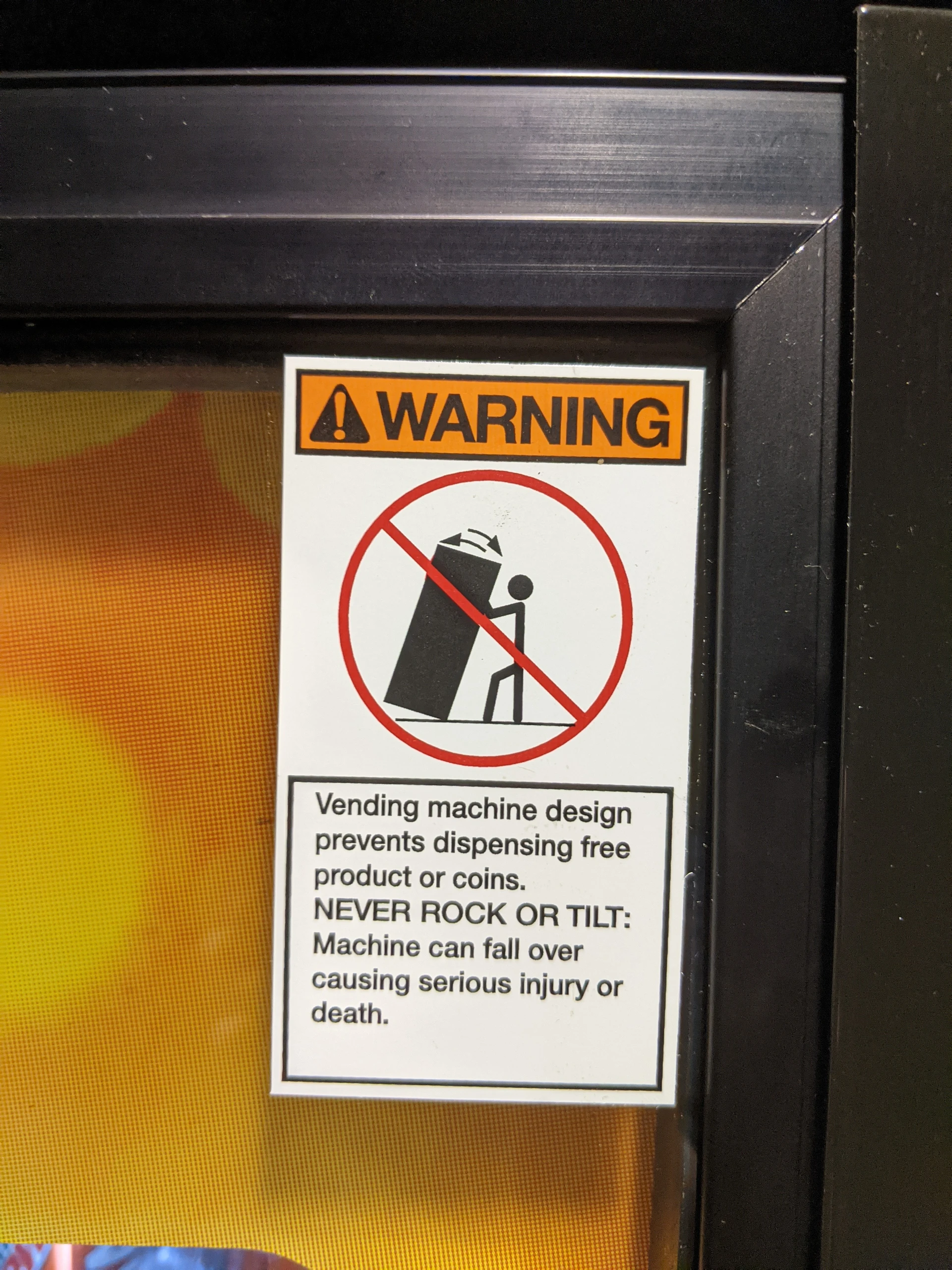
“Warning! Never rock or tilt. Machine can fall over and cause serious injury or death. Vending machine will not dispense free product.” [5]
Other labels delivered similar messages and included graphics showing the machines tipping over. [5]
CPSC Chairman Ann Brown framed the campaign as a model of how industry could work with regulators “without costly and time‑consuming litigation” to improve consumer safety. [5] It wasn’t a forced recall; federal law bars selling products under commission‑ordered or negotiated voluntary recall, [5] but in this case the machines stayed put. Only the stickers changed.
For some families, warning labels came too late. Their only remaining leverage was the civil courts.
One father whose 27‑year‑old son was crushed by a soda vending machine filed a $500,000 wrongful‑death lawsuit. [2] According to court filings described in news reports, the son had apparently rocked the machine; it tipped, pinned him against a wall, and crushed his chest. [2] The suit named the soda company and the companies that manufactured and serviced the machine. [2]
The same coverage sketched out other cases that echoed through safety debates:
The article also noted that three years earlier, seven manufacturers had kicked off an industry‑wide warning‑label campaign to highlight these dangers—an effort mirroring the CPSC partnership. [2]
The emotional resonance of these deaths reached beyond legal filings. In September 1998, syndicated advice columnist Ann Landers devoted a column to the hazard. She argued that every vending machine should be required by law to be bolted to a wall, [2] and suggested that readers post a copy of her warning next to machines in their buildings, in the hope it “might help save a life.” [2]
Part of the tragedy in these cases lies in the clash between how machines are actually used and how they were intended to be used.
Manufacturers generally describe vending machines as safe. [1] And under ideal conditions, many are. Banks of machines are often bolted together, which makes them nearly impossible to move. [2] But stand‑alone units may only be bolted to a nearby wall—if at all—and owners aren’t required to secure them. [2]
That leaves tall, heavy cabinets with a high center of gravity standing unsecured in public spaces, often in corners or along walls where leverage is easy.
Layer frustration on top of that. As the wrongful‑death attorney pointed out, it’s routine to see people kick or shake a machine that’s swallowed their money. [2] When users know—or think they know—that rocking might produce a free soda, as on that military base, the temptation rises. [3]
La Machine de Marly. 143 - estampe - btv1b6949110g.jpg
Wikimedia Commons· Public domain
Machines can weigh a thousand pounds or more. [2] The people who die under them are often teenagers and young adults, disproportionately male, typically somewhere in the five‑to‑39 age range, with an average age just under 20. [4] Some are as young as ten or thirteen, as the Arizona boy and Jason Beggs were. [1][2]
Nearly all of the time, the machine wins.
Public‑health researchers studying soda‑machine crush injuries have watched the arc of the problem from the 1980s onward. In their review of 64 cases, they concluded that tipping vending machines “continues to be a dangerous behavior” that can lead to lethal or permanently disabling injuries. [4]
But they also saw reasons for cautious optimism. The same abstract reports that increased public awareness, combined with support from government and private industry, helped drive a sharp decline in the number of new accidents and improved public safety overall. [4]
Regulators and manufacturers had finally aligned, at least on the basics. The CPSC’s labeling campaign made the core message unavoidable: these machines will not give out free product when rocked, and they can kill. [5]
Still, the Orlando Sentinel’s phrase holds. Vending‑machine accidents are rare—but not unheard of. [1] With millions of units in circulation, even a tiny failure rate means real people die or are maimed. Whether the total lives lost is closer to Cosio’s 15 confirmed vending‑machine deaths [3] or the 37 deaths since 1978 cited by the CPSC, [5] each case leaves a permanent absence.
Outside that Kmart, the scene cleared. The Coke machine was upright again. Jason Beggs was gone. There were no suspects to arrest, no malicious actor to blame—only a toppled appliance, some grim physics, and a hole where a 13‑year‑old used to be. [1]
Detectives could reconstruct possibilities, but not certainty. [1] Was it a shake for a stuck drink? An attempt to move the machine? A slip while standing too close? The record doesn’t say. What it does show, in case after case, is how ordinary frustration can intersect with bad design and inadequate safeguards to produce something that looks, from the outside, like an absurd footnote: “killed by a vending machine.”
A warning sticker attached to a vending machine, advising the user to refrain from tilting or rocking the machine.
Wikimedia Commons· CC BY-SA 4.0
For the families left behind, there is nothing absurd about it.
The warnings now pasted on soda machines may save others from joining the list. The machines haven’t changed; gravity hasn’t changed. What has shifted is awareness—etched in red and black on the front of the metal cabinets, and in the memories of people like the Beggs family, who learned too late what one angry shove can cost. [1][5]
Adapted from Wikipedia: Death by vending machine.
This case file is an original Bloody Likely narrative synthesis based on the cited sources. Article © Bloody Likely. All rights reserved. Source materials remain the property of their respective owners. Facts, public records, quotations, and cited references are used for reporting, research, commentary, and documentation. Bloody Likely content license
Audio narration © Bloody Likely. All rights reserved. The audio player is provided for personal streaming/listening only.
No recent news articles found for this case. Check back later for updates.
No evidence found for this case. Be the first to submit evidence in the comments below.
Join the discussion
Loading comments...
Beginning of the period during which falling-vending-machine incidents were later tallied by regulators.
JAMA article 'Soda Pop Vending Machine Injuries' highlights the injury risk from vending machines.
U.S. military begins placing warning labels on vending machines after multiple incidents on installations.
Journal of Orthopaedic Trauma publishes an update on soda vending machine injuries, documenting continued harm.
U.S. Consumer Product Safety Commission reports at least 37 deaths and 113 injuries from 1978 to 1995 due to falling vending machines.
Newspaper reports of a teenager crushed under a vending machine, illustrating ongoing fatal incidents.
Additional newspaper coverage (Toledo Blade) keeps attention on vending machine hazards and incidents.
Chicago Tribune article warns the public not to jiggle vending machines and discusses manufacturer warnings.
San Francisco Chronicle runs a feature describing large appliances like vending machines as hazardous to health.
Media pieces (NPR and others) compare the statistical odds of death by vending machine to rare events like winning the lottery, bringing renewed attention.