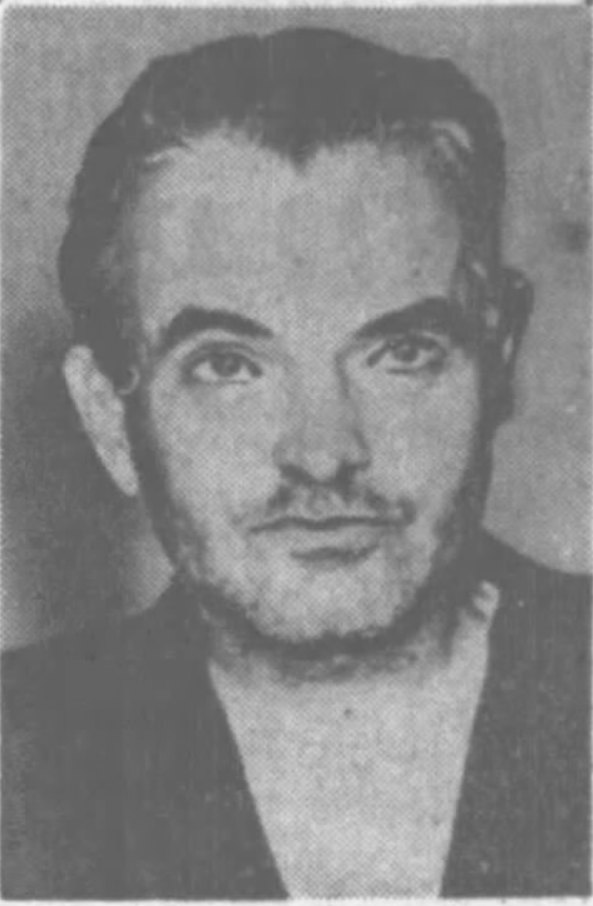
Frederick Charles Wood
American Serial Killer Case
CLASSIFICATION: Serial Homicide
LOCATION
New York, New York
TIME PERIOD
1926-1960
VICTIMS
5 confirmed
Frederick Charles Wood, an American serial killer, committed five murders across New York from 1926 to 1960, beginning at the age of 14. He was apprehended for the final time on July 3, 1960, and was subsequently convicted of two murders, leading to his execution by electrocution at Sing Sing Prison on March 21, 1963. This case is considered solved, as Wood was held accountable for his crimes and executed.
Theories surrounding Frederick Charles Wood's early life suggest that his troubled upbringing may have contributed to his criminal behavior, particularly his first murder at the age of 14, which he claimed was motivated by jealousy. There is speculation about the accuracy of the coroner's report regarding his girlfriend's death, which raises questions about whether Wood's actions were initially overlooked due to a lack of evidence or misdiagnosis. Additionally, Wood's lack of remorse and the pattern of his crimes over decades lead to theories about his psychological state and the potential influence of environmental factors on his development as a serial killer.
Frederick Charles Wood
Overview
Frederick Charles Wood (1911 – March 21, 1963) was an American serial killer whose gruesome spree of violence spanned three decades and claimed five lives across New York. Wood began his life of crime at a young age, committing his first murder at just 14. Described as a habitual criminal with a chilling lack of remorse, he was ultimately sentenced to death and executed at Sing Sing Prison, marking him as the penultimate individual to face execution in New York before a de-facto abolition of capital punishment.
Quick Facts
- Born: 1911, Elmira, New York, U.S.
- Died: March 21, 1963 (aged 51), Sing Sing Prison, Ossining, New York, U.S.
- Cause of Death: Execution by electrocution
- Other Names: John Walker, George Elwood, George Christian
- Convictions:
- Second degree murder (Lowman)
- First degree murder x2 (Rescigno and Sess)
- Criminal Penalty:
- 20 years to life (Lowman)
- Death (Rescigno and Sess)
- Victims: 5 (3 convictions)
- Crimes Span: 1926–1960
- Date Apprehended: July 3, 1960
Early Life and First Crimes
Born into a middle-class working family in Elmira, New York, Frederick Wood's early childhood remains largely shrouded in mystery. However, as he entered adolescence, he began dabbling in petty crimes, skillfully evading the consequences until they escalated into something far more sinister. Wood claimed that his first murder occurred in 1926, when he was just 14 years old. In a tragic act of jealousy, he poisoned his 16-year-old girlfriend, Cynthia Longo, in Hornell. Fearing she was seeing another boy, he laced cream puffs with arsenic and offered them to Longo and two friends. Tragically, Longo died, but an autopsy erroneously attributed her death to "dilation of the heart caused by excessive vomiting," and she was misidentified as being 22 years old—a grievous error that would haunt the investigation.
After a turbulent first year of high school, Wood dropped out, causing a rift with his father. This led to a two-month examination at the Binghamton State Hospital, where psychiatrists assessed his IQ as "about average" at 99. Following his discharge, Wood faced charges for grand larceny linked to an automobile theft, receiving a ten-year suspended sentence. In an attempt to reform him, his father sent him to a private school in Dobbs Ferry. However, upon reaching adulthood, Wood broke the terms of his sentence by robbing a man of 25 cents, landing himself in the Elmira Reformatory. His time there was marked by further infractions, including public intoxication and harassment of women.
Murder of Pearl Robinson
In a chilling turn of events in 1933, Wood, embittered by a venereal disease contracted from a prostitute, developed a dangerous hatred towards women. This rage culminated on July 5, when he encountered 33-year-old Pearl D. Robinson in a suburban backyard. In a frenzied attack, he strangled her with a rope, stabbed her an astonishing 142 times with a knife, and ultimately crushed her skull with an iron bar. The brutality of this crime sent shockwaves through the community, prompting an immediate police investigation. Initially, investigators believed Robinson knew her killer, which led them to overlook Wood as a suspect.
Soon after, Wood was arrested for harassing a woman named Grace Hunsinger, which resulted in a conviction and a seven-year prison term at a local reformatory.
Lowman Murder
After his release in February 1940, Wood returned to Elmira, where he soon became embroiled in another violent confrontation. In 1942, he invited 42-year-old local carpenter John E. Lowman to a rooming house under false pretenses. When Lowman allegedly insulted Wood’s girlfriend, a drunken Wood struck him over the head with a beer bottle. Once Lowman was incapacitated, Wood unleashed his rage, stomping on his head and viciously slashing him with a knife.
In a gruesome attempt to dismember the body, Wood stuffed Lowman's remains under a couch. Despite initially confiding in his girlfriend about the murder, he only revealed the body to his father after a heated argument. This led to his arrest for disorderly conduct and, shortly after, for Lowman's murder when his girlfriend discovered the body. Wood pleaded guilty to the disorderly conduct charge and was sentenced to a meager five days in jail. However, the discovery of Lowman's body swiftly escalated the situation, and Wood was convicted, receiving a 20-year to life sentence. Notably, he attempted suicide by slashing his wrists the day before sentencing. During his trial, Justice Bertram L. Newman famously stated that Wood should "never be released from prison."
Double Murder and Arrest
Fast forward to June 2, 1960: despite the vehement protests from judges, prosecutors, and the public, the Parole Board approved Wood's release, under the condition that he relocate to Albany. He found employment at a local laundry but was forced to quit due to high blood pressure. Disillusioned and feeling the insatiable pull of his violent impulses, he broke the terms of his parole just weeks later by traveling to New York City.
On July 3, while panhandling on Broadway, Wood encountered 62-year-old World War I veteran John Rescigno. After sharing a bottle of wine and heading back to Rescigno's Astoria apartment, an argument erupted over what Wood claimed was an "indecent proposal." Enraged, Wood struck Rescigno with a beer bottle, causing him to collapse. He then viciously cut Rescigno's throat and bludgeoned him to death with a coal shovel.
In a disturbing twist, Wood rifled through Rescigno's pockets, stealing $7, before moving on to the adjacent room, where he found Rescigno's roommate, 78-year-old Frederick Sess, sleeping. When Sess awoke to the chaos, Wood killed him too with the broken beer bottle. In a bizarre display of arrogance, he left behind two handwritten notes—one expressing mock apology for the murders and another sarcastically praising the Parole Board's intelligence.
Following the murders, Wood frequented a nearby tavern, casually explaining away the blood on his hands as the result of a bar fight. Meanwhile, Michael J. Morgan, a news director at WELM radio, recognized the similarities between these murders and those of Lowman years prior. This revelation prompted him to tip off the police, leading to Wood's eventual confession of all his crimes, including those of Longo and Robinson. The public outrage was palpable, and the Parole Board was thrust into a scandal, with its chairman publicly acknowledging the decision to parole Wood as a "mistake."
Trial, Imprisonment, and Execution
In the months following his arrest, Wood faced trial for the murders of Rescigno and Sess. Defiant and brazen, he took the stand, declaring his sanity and expressing a twisted pride in his actions. His courtroom demeanor was chilling; he cracked jokes and displayed a flippant attitude, even referring to himself as a "wine sampler." In a swift deliberation lasting less than 75 minutes, the jury found him guilty on all counts.
At the sentencing phase on December 8, 1961, Justice Albert H. Bosch handed down a death sentence by electric chair. Wood, alternating between laughter and gratitude, thanked the judge for what he called "shock treatment" for his schizophrenia.
In the years that followed, Wood's execution was stayed multiple times as various attorneys and civil rights groups argued for his sentence to be commuted due to insanity. However, Wood dismissed these efforts, expressing a desire to "ride the lightning."
On March 21, 1963, he was led to the execution chamber at Sing Sing. His defiance remained intact as he joked with witnesses, stating he had a speech about the effects of electricity on Wood. With a cigarette in hand, he took his seat in the electric chair and, still smiling, awaited his fate. Minutes later, he was electrocuted, marking him as one of the last individuals to face capital punishment in New York state.
See Also
- Capital punishment in New York (state)
- List of people executed in New York
- List of serial killers in the United States
Sources
- "Wanted to 'Ride the Lightning', Killer Executed in Electric Chair." Racine Journal Times. March 22, 1963.
- "Former Elmiran Arrested For Murder." The Evening Times. July 6, 1960.
- Gerald Kessler and Henry Lee. "Paroled Killer of 5 Trod Murder Trial, Starting at Age 14." New York Daily News. July 7, 1960.
- Fred R. Bresse. "Murderer Still At Large; Search Continues for Man Who Quarreled with Victim." Star-Gazette. July 10, 1933.
- "Police Hunt Man Who Knew Woman Slain At Elmira." The Evening Times. July 10, 1933.
- "Clipped From Star-Gazette." Star-Gazette. October 14, 1942.
- John Mallon and Sidney Kline. "Paroled Killer Confesses Murder of 2 in Astoria." New York Daily News. July 6, 1960.
- "Bottles, Knife, Chair Weapons." Akron Beacon Journal. July 6, 1960.
- Gerald Kessler and Henry Lee. "Paroled Killer of 5 Trod Murder Trial, Starting at Age 14." New York Daily News. July 7, 1960.
- Lester Abelman. "Slayer Cracks Joke as He Is Doomed to Die." New York Daily News. December 8, 1961.
- "Thanks Judge For 'Shock'." The Cincinnati Enquirer. December 8, 1961.
No Recent News
No recent news articles found for this case. Check back later for updates.
No Evidence Submitted
No evidence found for this case. Be the first to submit evidence in the comments below.
Join the discussion
Loading comments...
First Murder Committed
Frederick Wood poisons his girlfriend Cynthia Longo, marking his first murder.
Murder of Pearl Robinson
Wood brutally murders Pearl Robinson, stabbing her 142 times and crushing her skull.
Convicted for Lowman Murder
Wood is convicted of murdering John Lowman and sentenced to 20 years to life.
Paroled
Wood is granted parole despite public protests and moves to Albany.
Double Murder of Rescigno and Sess
Wood murders John Rescigno and Frederick Sess in a brutal attack in Astoria.
Arrest and Confession
Wood is arrested for violating parole and confesses to multiple murders, including Longo and Robinson.
Convicted for Double Murder
Wood is found guilty of the murders of Rescigno and Sess.
Sentenced to Death
Wood is sentenced to death by electric chair for the murders.
Executed
Frederick Wood is executed by electrocution at Sing Sing Prison.
Frederick Charles Wood, an American serial killer, committed five murders across New York from 1926 to 1960, beginning at the age of 14. He was apprehended for the final time on July 3, 1960, and was subsequently convicted of two murders, leading to his execution by electrocution at Sing Sing Prison on March 21, 1963. This case is considered solved, as Wood was held accountable for his crimes and executed.
Theories surrounding Frederick Charles Wood's early life suggest that his troubled upbringing may have contributed to his criminal behavior, particularly his first murder at the age of 14, which he claimed was motivated by jealousy. There is speculation about the accuracy of the coroner's report regarding his girlfriend's death, which raises questions about whether Wood's actions were initially overlooked due to a lack of evidence or misdiagnosis. Additionally, Wood's lack of remorse and the pattern of his crimes over decades lead to theories about his psychological state and the potential influence of environmental factors on his development as a serial killer.
Frederick Charles Wood
Overview
Frederick Charles Wood (1911 – March 21, 1963) was an American serial killer whose gruesome spree of violence spanned three decades and claimed five lives across New York. Wood began his life of crime at a young age, committing his first murder at just 14. Described as a habitual criminal with a chilling lack of remorse, he was ultimately sentenced to death and executed at Sing Sing Prison, marking him as the penultimate individual to face execution in New York before a de-facto abolition of capital punishment.
Quick Facts
- Born: 1911, Elmira, New York, U.S.
- Died: March 21, 1963 (aged 51), Sing Sing Prison, Ossining, New York, U.S.
- Cause of Death: Execution by electrocution
- Other Names: John Walker, George Elwood, George Christian
- Convictions:
- Second degree murder (Lowman)
- First degree murder x2 (Rescigno and Sess)
- Criminal Penalty:
- 20 years to life (Lowman)
- Death (Rescigno and Sess)
- Victims: 5 (3 convictions)
- Crimes Span: 1926–1960
- Date Apprehended: July 3, 1960
Early Life and First Crimes
Born into a middle-class working family in Elmira, New York, Frederick Wood's early childhood remains largely shrouded in mystery. However, as he entered adolescence, he began dabbling in petty crimes, skillfully evading the consequences until they escalated into something far more sinister. Wood claimed that his first murder occurred in 1926, when he was just 14 years old. In a tragic act of jealousy, he poisoned his 16-year-old girlfriend, Cynthia Longo, in Hornell. Fearing she was seeing another boy, he laced cream puffs with arsenic and offered them to Longo and two friends. Tragically, Longo died, but an autopsy erroneously attributed her death to "dilation of the heart caused by excessive vomiting," and she was misidentified as being 22 years old—a grievous error that would haunt the investigation.
After a turbulent first year of high school, Wood dropped out, causing a rift with his father. This led to a two-month examination at the Binghamton State Hospital, where psychiatrists assessed his IQ as "about average" at 99. Following his discharge, Wood faced charges for grand larceny linked to an automobile theft, receiving a ten-year suspended sentence. In an attempt to reform him, his father sent him to a private school in Dobbs Ferry. However, upon reaching adulthood, Wood broke the terms of his sentence by robbing a man of 25 cents, landing himself in the Elmira Reformatory. His time there was marked by further infractions, including public intoxication and harassment of women.
Murder of Pearl Robinson
In a chilling turn of events in 1933, Wood, embittered by a venereal disease contracted from a prostitute, developed a dangerous hatred towards women. This rage culminated on July 5, when he encountered 33-year-old Pearl D. Robinson in a suburban backyard. In a frenzied attack, he strangled her with a rope, stabbed her an astonishing 142 times with a knife, and ultimately crushed her skull with an iron bar. The brutality of this crime sent shockwaves through the community, prompting an immediate police investigation. Initially, investigators believed Robinson knew her killer, which led them to overlook Wood as a suspect.
Soon after, Wood was arrested for harassing a woman named Grace Hunsinger, which resulted in a conviction and a seven-year prison term at a local reformatory.
Lowman Murder
After his release in February 1940, Wood returned to Elmira, where he soon became embroiled in another violent confrontation. In 1942, he invited 42-year-old local carpenter John E. Lowman to a rooming house under false pretenses. When Lowman allegedly insulted Wood’s girlfriend, a drunken Wood struck him over the head with a beer bottle. Once Lowman was incapacitated, Wood unleashed his rage, stomping on his head and viciously slashing him with a knife.
In a gruesome attempt to dismember the body, Wood stuffed Lowman's remains under a couch. Despite initially confiding in his girlfriend about the murder, he only revealed the body to his father after a heated argument. This led to his arrest for disorderly conduct and, shortly after, for Lowman's murder when his girlfriend discovered the body. Wood pleaded guilty to the disorderly conduct charge and was sentenced to a meager five days in jail. However, the discovery of Lowman's body swiftly escalated the situation, and Wood was convicted, receiving a 20-year to life sentence. Notably, he attempted suicide by slashing his wrists the day before sentencing. During his trial, Justice Bertram L. Newman famously stated that Wood should "never be released from prison."
Double Murder and Arrest
Fast forward to June 2, 1960: despite the vehement protests from judges, prosecutors, and the public, the Parole Board approved Wood's release, under the condition that he relocate to Albany. He found employment at a local laundry but was forced to quit due to high blood pressure. Disillusioned and feeling the insatiable pull of his violent impulses, he broke the terms of his parole just weeks later by traveling to New York City.
On July 3, while panhandling on Broadway, Wood encountered 62-year-old World War I veteran John Rescigno. After sharing a bottle of wine and heading back to Rescigno's Astoria apartment, an argument erupted over what Wood claimed was an "indecent proposal." Enraged, Wood struck Rescigno with a beer bottle, causing him to collapse. He then viciously cut Rescigno's throat and bludgeoned him to death with a coal shovel.
In a disturbing twist, Wood rifled through Rescigno's pockets, stealing $7, before moving on to the adjacent room, where he found Rescigno's roommate, 78-year-old Frederick Sess, sleeping. When Sess awoke to the chaos, Wood killed him too with the broken beer bottle. In a bizarre display of arrogance, he left behind two handwritten notes—one expressing mock apology for the murders and another sarcastically praising the Parole Board's intelligence.
Following the murders, Wood frequented a nearby tavern, casually explaining away the blood on his hands as the result of a bar fight. Meanwhile, Michael J. Morgan, a news director at WELM radio, recognized the similarities between these murders and those of Lowman years prior. This revelation prompted him to tip off the police, leading to Wood's eventual confession of all his crimes, including those of Longo and Robinson. The public outrage was palpable, and the Parole Board was thrust into a scandal, with its chairman publicly acknowledging the decision to parole Wood as a "mistake."
Trial, Imprisonment, and Execution
In the months following his arrest, Wood faced trial for the murders of Rescigno and Sess. Defiant and brazen, he took the stand, declaring his sanity and expressing a twisted pride in his actions. His courtroom demeanor was chilling; he cracked jokes and displayed a flippant attitude, even referring to himself as a "wine sampler." In a swift deliberation lasting less than 75 minutes, the jury found him guilty on all counts.
At the sentencing phase on December 8, 1961, Justice Albert H. Bosch handed down a death sentence by electric chair. Wood, alternating between laughter and gratitude, thanked the judge for what he called "shock treatment" for his schizophrenia.
In the years that followed, Wood's execution was stayed multiple times as various attorneys and civil rights groups argued for his sentence to be commuted due to insanity. However, Wood dismissed these efforts, expressing a desire to "ride the lightning."
On March 21, 1963, he was led to the execution chamber at Sing Sing. His defiance remained intact as he joked with witnesses, stating he had a speech about the effects of electricity on Wood. With a cigarette in hand, he took his seat in the electric chair and, still smiling, awaited his fate. Minutes later, he was electrocuted, marking him as one of the last individuals to face capital punishment in New York state.
See Also
- Capital punishment in New York (state)
- List of people executed in New York
- List of serial killers in the United States
Sources
- "Wanted to 'Ride the Lightning', Killer Executed in Electric Chair." Racine Journal Times. March 22, 1963.
- "Former Elmiran Arrested For Murder." The Evening Times. July 6, 1960.
- Gerald Kessler and Henry Lee. "Paroled Killer of 5 Trod Murder Trial, Starting at Age 14." New York Daily News. July 7, 1960.
- Fred R. Bresse. "Murderer Still At Large; Search Continues for Man Who Quarreled with Victim." Star-Gazette. July 10, 1933.
- "Police Hunt Man Who Knew Woman Slain At Elmira." The Evening Times. July 10, 1933.
- "Clipped From Star-Gazette." Star-Gazette. October 14, 1942.
- John Mallon and Sidney Kline. "Paroled Killer Confesses Murder of 2 in Astoria." New York Daily News. July 6, 1960.
- "Bottles, Knife, Chair Weapons." Akron Beacon Journal. July 6, 1960.
- Gerald Kessler and Henry Lee. "Paroled Killer of 5 Trod Murder Trial, Starting at Age 14." New York Daily News. July 7, 1960.
- Lester Abelman. "Slayer Cracks Joke as He Is Doomed to Die." New York Daily News. December 8, 1961.
- "Thanks Judge For 'Shock'." The Cincinnati Enquirer. December 8, 1961.
No Recent News
No recent news articles found for this case. Check back later for updates.
No Evidence Submitted
No evidence found for this case. Be the first to submit evidence in the comments below.
Join the discussion
Loading comments...
First Murder Committed
Frederick Wood poisons his girlfriend Cynthia Longo, marking his first murder.
Murder of Pearl Robinson
Wood brutally murders Pearl Robinson, stabbing her 142 times and crushing her skull.
Convicted for Lowman Murder
Wood is convicted of murdering John Lowman and sentenced to 20 years to life.
Paroled
Wood is granted parole despite public protests and moves to Albany.
Double Murder of Rescigno and Sess
Wood murders John Rescigno and Frederick Sess in a brutal attack in Astoria.
Arrest and Confession
Wood is arrested for violating parole and confesses to multiple murders, including Longo and Robinson.
Convicted for Double Murder
Wood is found guilty of the murders of Rescigno and Sess.
Sentenced to Death
Wood is sentenced to death by electric chair for the murders.
Executed
Frederick Wood is executed by electrocution at Sing Sing Prison.