ANALYZING EVIDENCE
Processing case files...
Processing case files...
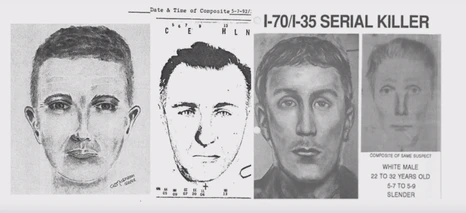
Midwest Serial Strangler Case
CLASSIFICATION: Serial Homicide
LOCATION
Indianapolis, Indiana
TIME PERIOD
1980-1991
VICTIMS
12 confirmed
The I-70 Strangler is an unidentified American serial killer responsible for the murders of at least twelve boys and men across the Midwest between June 1980 and October 1991, with victims found along Interstate 70. The killer targeted young males, often meeting them in gay bars, and all victims were discovered naked or partially clothed, having been strangled to death. The case remains officially unsolved, though deceased businessman Herb Baumeister has been suggested as a potential suspect.
Some investigators and sheriffs have speculated that deceased Indianapolis businessman Herbert (Herb) Baumeister — whose property yielded multiple sets of bones in 1996 and who led a secret life frequenting gay bars — was likely the I-70 Strangler and may have preyed on men he met in Indianapolis before dumping their partially clothed, strangled bodies near I‑70. Others have argued the Baumeister link is circumstantial and contested the closure of those cases, suggesting the possibility of multiple perpetrators (FBI profilers posited at least two different killers) and pointing to earlier suspects like Larry Eyler or isolated offenders for certain victims (for example Delvoyd Baker was considered unrelated by some investigators).
In the middle of 1996, a worker digging around a shallow stream on a central Indiana hobby farm north of Indianapolis turned up human bones. [1]
The land belonged to Herb Baumeister, an Indianapolis thrift‑store owner with a sprawling property in the Westfield area. [1] Within days of the discovery, Baumeister killed himself. [1] His death, coming just as investigators realized what lay beneath his soil, triggered a sprawling, interstate probe into a possible serial killer operating along the back roads and culverts of Indiana and Ohio. [1]
By the time sheriffs were ready to talk publicly, they believed Baumeister was responsible for at least nine dead men, and possibly more. [1]
The farm itself quickly became a crime scene. As investigators combed the grounds, they unearthed the bones of seven unidentified men. [1] Authorities said Baumeister may have killed those seven additional victims, suggesting that the property had been used as a private burial ground. [1]
Beyond the farm, sheriffs in multiple Indiana and Ohio counties began comparing notes. [1] They told United Press International that they had linked the deaths of nine men to Baumeister, who had already been dead for nearly two years. [1] The identified victims, they said, were young—between 15 and 29 years old. [1]
The way the bodies were found suggested a ritual of disposal. Sheriffs reported that the victims’ partially nude bodies were dumped in shallow streams or culverts, discarded in out‑of‑the‑way places that bordered fields, gravel roads, and drainage ditches. [1] They believed Baumeister preyed on men he met at a gay theater, luring them away and then killing them. [1] According to these sheriffs, he apparently strangled at least nine victims between 1980 and 1990. [1]
The bodies turned up across a surprisingly tight geography. The identified victims were found in three Indiana counties and two Ohio counties, all within about 70 miles of Baumeister’s farm north of Indianapolis. [1] Sheriffs in Hancock, Hamilton, and Shelby counties in Indiana, and Darke and Preble counties in Ohio, compared cases spanning roughly 16 years. [1] Preble County alone had four such cases; Hamilton County, two; and each of the other counties one. [1]
Taken together, the pattern—young men, strangulation, partial nudity, remote water‑adjacent dump sites within driving distance of Baumeister’s farm—was enough for investigators to see a single hand behind the deaths. [1]
In Hancock County, Sheriff’s Deputy Fred Bixler became one of the public faces of the investigation. From his vantage point in Greenfield, he could see how the puzzle pieces fit. [1]
Bixler said that common elements in nine cases led investigators to conclude that Baumeister was the killer. [1] “There are enough similarities for investigators to think they’re linked,” he told UPI. [1]
Those similarities included the victims’ ages, the manner of death by apparent strangulation, and the rural, out‑of‑the‑way locations where bodies surfaced. [1]
But the road to that conclusion started with a single bone in a streambed. The worker’s discovery in mid‑1996 forced authorities to take a hard look at who owned the property and what might have happened there. [1] When Baumeister killed himself only days later, the timing deepened suspicions and set off what one sheriff would later describe as a regional probe. [1]
The cases did not truly “break” until investigators circled back to a young man whose murder had been sitting unsolved for a decade.
Michael Riley was 22, from Indianapolis, when his body was found on June 5, 1988. [2] He had been strangled to death and left in a drainage ditch. [2] Investigators determined that his body had been dumped over a nearby bridge—a quiet disposal echoing the culverts and streams that would later figure in the Baumeister investigation. [1][2]
Riley’s case never found a suspect. Years slipped by; the file remained open. [2]
When the Westfield farm bones came to light, however, detectives began asking whether Riley’s death belonged in the same orbit. Police speculated that his killing could be connected to “Westfield serial killer Herb Baumeister,” as the suspected offender was already being described. [2]
Two months before UPI published its April 28, 1998 story “Sheriffs link 9 deaths to Indiana man,” Hancock County investigators said they finally caught a break. [1] They showed photographs of Baumeister to a friend of Michael Riley. [1] The friend recognized Baumeister as the last man seen with Riley back in 1983, outside the Vogue Theater—a gay movie house in Indianapolis. [1]
Michael Riley's 'Cloud' at the 2003 Sydney Festival.jpg
That recognition did not solve Riley’s murder in court; the case is still officially unsolved. [2] But the identification provided a human bridge between the local, long‑cold homicide and the wider pattern law enforcement was building around Baumeister—a thrift‑store owner who, sheriffs said, hunted for victims in exactly that kind of venue. [1]
Hancock County does not lack for unsolved violence. State and local law enforcement have been searching for years for answers in lingering homicides and disappearances in and around the county. [2] Regional reporting has outlined a somber roll call of victims, some of whose cases have been discussed in the same investigative context as Baumeister’s but have never been definitively linked.
Michael Riley at the CFC Actors Conservatory 2011 Showcase 8 (6926672939) (cropped).jpg
On October 3, 1970, ten‑year‑old Jerry Michael Bayles Jr. set out to deliver newspapers between Indianapolis and Henry County. [2] He never finished the route. His body was later discovered in a roadside ditch in rural western Henry County, with multiple stab wounds. [2] No suspects have ever been named in his killing. [2]
Fourteen years later, on November 12, 1984, eleven‑year‑old Peggy Sue Altes was abducted from a park near her Indianapolis home. [2] Five days later, searchers found her body in a Sugar Creek Township field. [2] She had been raped and stabbed to death. [2] One man was charged in her murder, but later exonerated; others have been named as suspects over the years, yet no one has ever been convicted. [2]
© Mapbox © OpenStreetMap
On October 7, 1991, the body of Otto Gary Becker was discovered in a ditch alongside a gravel road in rural southwestern Henry County. [2] Earlier that day, witnesses had seen him in a vehicle with two other men driving northbound on Interstate 465 near Shadeland Avenue in Indianapolis. [2] One witness reported that a suspect was restraining Becker while the other man drove. [2] Neither of those suspects has ever been identified. [2]
In Hancock County itself, a passer‑by made another grim discovery on October 18, 1994: the body of an unknown woman off the side of a bridge in the county’s southern area. [2] Investigators, lacking a name, called her “Wilma.” [2] She was wearing a Mickey Mouse T‑shirt, and detectives hoped the distinctive clothing might jog someone’s memory. [2] No one ever came forward to report a missing woman matching her description. [2]
The list of unanswered cases stretches into the 2000s. Nancy Lyons, 46, of Carthage, disappeared on June 17, 2002. [2] Her car turned up abandoned, with her belongings still inside and a flat tire. [2] Four months later, a farmer found her body in his Bartholomew County field. [2] She had suffered a fatal blow to the head, and investigators have never identified a suspect. [2]
And in 2007, 73‑year‑old Dora Tolx wandered away from her daughter’s home in Greenfield late at night on June 1. [2] Tolx had dementia, and investigators believe she may have become confused when she left the house. [2] Police dogs tracked her scent to a spot along State Road 9, where officers think she might have accepted a ride from a passing motorist. [2] After that point, the trail went cold; no leads ever surfaced. [2]
These cases form the backdrop against which the Baumeister investigation unfolded: a landscape where bodies turn up in ditches and fields, where families wait decades for a name, and where a single offender might explain some tragedies—but not all of them. [2]
Even with sheriffs lining up behind the conclusion that Herb Baumeister was a serial killer, the most basic question remains unsettled: how many people did he actually kill?
Sheriffs in Indiana and Ohio publicly linked nine men’s deaths to Baumeister and said he apparently strangled at least nine victims between 1980 and 1990. [1] At the same time, Baumeister’s farm yielded bones from seven unidentified men, and investigators said he may have killed those seven additional victims as well. [1]
Whether those seven sets of remains overlapped with the nine already linked deaths, or represented further, unknown victims, was never fully resolved. [1] The timeline of the body finds—stretching over about 16 years across five counties—only added to the uncertainty. [1]
Baumeister’s suicide a few days after the first bones were found meant there would be no trial, no cross‑examination of evidence, and no formal verdict tying him to any specific homicide in a court of law. [1] No charges or convictions against him appear in the available reporting. [1] For families of the dead, the closest thing to an answer came not from a jury, but from sheriffs’ press conferences and quiet, off‑the‑record conversations.
Michael Riley’s file is still marked unsolved. [2] The seven men buried, anonymously, on Baumeister’s farm remained unnamed in the reporting, their identities and stories unknown. [1] And across Hancock, Henry, Bartholomew, and neighboring counties, detectives still carry old case folders for Jerry Bayles, Peggy Sue Altes, Otto Becker, “Wilma,” Nancy Lyons, and Dora Tolx—each representing a life cut short, with no confirmed killer. [2]
Michael Riley.jpg
The bones in Baumeister’s shallow stream answered one question—something terrible had happened on that farm—while leaving a larger mystery unresolved: along the rural routes and culverts of central Indiana and western Ohio, how many victims are still waiting for their names, and how many of those deaths belong to the man who would never face a courtroom? [1]
Adapted from Wikipedia: I-70 Strangler.
This case file is an original Bloody Likely narrative synthesis based on the cited sources. Article © Bloody Likely. All rights reserved. Source materials remain the property of their respective owners. Facts, public records, quotations, and cited references are used for reporting, research, commentary, and documentation. Bloody Likely content license
Audio narration © Bloody Likely. All rights reserved. The audio player is provided for personal streaming/listening only.
No recent news articles found for this case. Check back later for updates.
No evidence found for this case. Be the first to submit evidence in the comments below.
Join the discussion
Loading comments...
Michael Petree's body is discovered, marking the start of the I-70 Strangler's known murders.
Indianapolis Police form a task force to investigate the string of murders linked to the I-70 Strangler.
Maurice Taylor's topless corpse is found in Weasel Creek, suspected to be strangled.
Michael Andrew Riley's body is discovered, leading to the inclusion of more victims in the investigation.
Jean Paul Talbot's body is found, marking one of the last known victims of the I-70 Strangler.
Otto Gary Becker's body is found, concluding the known series of murders attributed to the I-70 Strangler.
Herb Baumeister commits suicide, leaving the I-70 Strangler case officially unsolved.
Herb Baumeister is identified as a prime suspect in the I-70 Strangler case after a tip to police.