ANALYZING EVIDENCE
Processing case files...
Processing case files...
Unsolved Serial Murders Case
CLASSIFICATION: Unsolved Homicide
LOCATION
Jennings, Louisiana
TIME PERIOD
2005-2009
VICTIMS
8 confirmed
Between 2005 and 2009, a series of eight women, known as the Jeff Davis 8, were found murdered in swamps and canals surrounding Jennings, Louisiana, with many bodies discovered in advanced stages of decomposition. The investigation into these unsolved murders has faced significant criticism for alleged mishandling by authorities, and while some victims had identifiable causes of death, the overall circumstances remain unresolved. As of October 2023, the case remains unsolved, with ongoing concerns regarding potential connections between the victims, suspects, and law enforcement.
Some believe the killings were the work of a serial killer who picked off vulnerable local women, while others — including author Ethan Brown and many family members — dispute the single-unsub theory and argue the deaths reflect a messier pattern of local corruption and targeted killings. Investigators and witnesses have speculated that local law-enforcement figures and their associates were involved or complicit — including allegations that deputies helped dispose of evidence, that Sheriff’s Office personnel (and connected suspects such as Frankie Richard) had close ties to victims and obstructed the probe, and that reprisals related to the 2005 Leonard Crochet shooting may have motivated murders; conversely, state officials have also suggested the perpetrator(s) might have left the area or be incarcerated, leaving responsibility and motive unresolved.
In the flat, quiet country of rice and crawfish farms in southwestern Louisiana, bodies started turning up in the canals. [1]
Beginning in May 2005, eight young women—all from the small orbit of Jennings and nearby Lake Arthur—were found dead in Jefferson Davis Parish. [1] The first discovery came that May; the most recent of the eight would surface in August. [1]
The women were black and white, between 17 and 30 years old. [1] Most had grown up in extended families close by. [1] Many knew each other or were even related, and had drifted into the same risky street economy of drugs and prostitution. [1]
Their bodies, often badly decomposed, suggested homicide but gave investigators very little else. [1] As of 2014, all eight murders remained unsolved. [2]
The case would become known by the name of the town at its center: the Jennings 8. [2]
The string of deaths began on May 20, 2005. That day, 28‑year‑old Loretta Chaisson Lewis was found floating in a canal, decomposing and partially clothed. [2]
Less than a month later, another discovery. In a different canal, 30‑year‑old Ernestine Patterson was pulled from the water. Her throat had been slit. Froggers—out hunting at night—found her body. [2]
The brutality of Patterson’s killing left little doubt she had been murdered. [2] For Loretta and most of the women who would follow, decomposition would blur what had happened in their final hours, even as investigators said the victims appeared to have been slain. [1]
Detectives quickly made an arrest in Patterson’s case. Two local men were booked in her murder. But whatever evidence there was did not hold. Prosecutors dropped the charges for lack of proof. [2]
Behind the scenes, the deaths were no longer being treated as isolated crimes. A pattern was emerging, and it was centered on the same place: Jennings, a town of about 11,000 and the seat of Jefferson Davis Parish. [1][2]
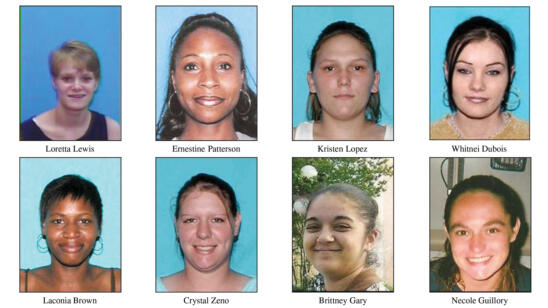
As months and years passed, six more women from the same small world would join Loretta and Ernestine on the list now known as the Jennings 8:
They were young, from the same parish, and part of overlapping circles. [1] Reporting would later describe many of them as having “lost their footing and succumbed to the undercurrent of drugs and prostitution” in Jefferson Davis Parish. [1]
Most of the bodies were discovered in or near canals and waterways, often in such an advanced state of decomposition that medical examiners could not determine a precise cause of death. [1][2]
Necole Guillory’s death in particular would haunt one man who had been drawn into the case. In June 2009, private investigator Kirk Menard shot video of Guillory walking alone down a street in Jennings. She would become the final known victim about two months later. [2]
© Mapbox © OpenStreetMap
Jefferson Davis Parish is rural and spread out, a place of fields and two‑lane highways. [1] Jennings sits in the middle of it all, both geographically and, now, at the center of a cluster of unsolved homicides. [2]
The killings landed in a jurisdiction that already struggled to solve serious crime. The parish’s homicide clearance rate was less than seven percent, according to FBI figures cited in local reporting. [2]
By 2014, even after years of coverage and a multi‑agency task force, every one of the Jennings 8 cases remained open. [2]
One name appeared again and again in interviews, police files, and local rumor: Frankie Richard.
By the time the bodies began turning up, Richard was a familiar figure on the south side of Jennings, described as a 58‑year‑old man with a long history of cocaine addiction and frequent jail stays. [2] His record included convictions for drug possession, theft, and battery, along with arrests for aggravated rape, aggravated assault, arson, and contributing to the delinquency of a minor. [2]
Richard admitted in an interview that he had owned strip clubs, used cocaine and crack cocaine, and traded drugs for sex with some of the women who would later be found dead. [2]
Witnesses interviewed by a multi‑agency task force linked Richard to several of the killings. [2] According to local reporting, he was named as a suspect in two of the Jennings murders and was held in custody for 89 days in connection with one of them. [2] Detectives on the task force said he has never been eliminated as a suspect. At the same time, they emphasized there is no physical evidence tying him to any of the murders. [2]
Nowhere was the focus on Richard more intense than in the case of 21‑year‑old Kristen Lopez.
Kristen Lopez was one of the youngest of the Jennings 8. [2]
Detectives zeroed in on a truck they believed was used in connection with her death. Two witnesses told deputies that Lopez had recently been a passenger in the vehicle. They said the truck was used to carry her body to a canal, where she was later found. [2]
A local man and his niece were taken into custody in Lopez’s killing. [2] That man was Frankie Richard; his niece was Hannah Connor. [2] Connor was booked as an accessory, and Richard was arrested in connection with Lopez’s death. [2]
The case against them rested heavily on a lone witness. When that witness recanted, the prosecution collapsed. [2] Detectives later described the case as shaky without corroborating evidence. [2]
Richard himself has said he was one of the last people to see Kristen Lopez alive. He told reporters he threw her out of a motel where they had been getting high together. [2] He has also said he took at least three polygraph tests about the Jennings killings, with inconclusive results. [2]
Even as he remained under suspicion, Richard became a source. He said he provided task force detectives with information about other possible suspects, including law enforcement officers. [2]
The idea that police themselves might somehow be involved in the killings was already in the air. [2] Over the next few years, that suspicion would grow louder, fueled in part by what was happening inside the very offices tasked with solving the murders.
As months turned into years with no arrests that stuck, several victims’ families turned to someone outside law enforcement: private investigator Kirk Menard. [2]
Menard worked undercover in Jennings, embedding himself in parts of town where the victims had spent their final years. He said he discovered drug hangouts, coaxed information from reluctant witnesses, and found evidence that police had overlooked. [2]
Looking at a map of where the bodies were found, Menard saw a pattern. The dump sites clustered along back roads and canals that, in his view, pointed to someone who knew the parish intimately. [2] This did not look, to him, like the work of a roaming stranger.
Menard also pushed back against the idea of a single serial killer. Based on his investigation, he said he believed multiple people were responsible for the Jennings 8 deaths. [2]
Even as he worked the case, the official task force was taking shape.
In 2008, a multi‑agency task force came together to address the growing list of victims. It was run primarily by the Jefferson Davis Parish Sheriff’s Office and the Jennings Police Department, with support from the Louisiana State Police and the FBI. [2]
The task force compiled a 109‑page report, thick with interviews, tips, and rumors. [2] Within those pages, multiple witnesses went further than private speculation, suggesting that law enforcement officers themselves might be involved in the killings. [2]
Those allegations were not formally substantiated in court. But they landed in a parish where trust in the justice system was already fragile—and where misconduct inside the evidence rooms would soon become public.
The same institutions investigating the Jennings 8 were contending with their own scandals.
Former Jennings Police Chief Johnny Lassiter pled guilty to stealing money and drugs from the police evidence room. At the time of the 2014 reporting, he was awaiting sentencing. [2]
Jefferson Davis deputy and detective Paula Guillory—a key member of the 2008 task force—was fired after being accused of stealing from the sheriff’s evidence room. [2] The missing evidence she mishandled came from a drug case against a man who would later become a lead suspect in the Jennings killings. [2]
Then there was Warren Gary, the sheriff’s chief criminal investigator. [3]
On or about March 20, 2007, a woman was brought into the Jefferson Davis Parish Sheriff’s Office for questioning in an ongoing criminal investigation. [3] During that interview, she mentioned she needed to sell her vehicle to avoid repossession. [3] As the questioning continued, Gary and the suspect negotiated a price for the vehicle. [3]
Later that same day, the suspect was arrested by the sheriff’s office for issuing bad checks. [3] Under internal policy, the department typically held a vehicle for ten days if its owner was incarcerated and no one could retrieve it. [3]
On March 29, Gary contacted the prison warden and asked him to inform the woman that her vehicle would be transferred to a wrecker service after the ten‑day hold expired. [3] Through the warden, she replied that she still wanted to sell. [3]
On March 30, 2007, the suspect was released from jail. [3] That same day, Gary purchased her vehicle for $8,748.90. [3] He paid off the remaining loan directly to the bank, and the suspect used about $3,207 of the sale proceeds to pay the district attorney’s office for her bad‑check offenses. [3]
Three weeks later, on April 20, 2007, Gary sold the vehicle for $15,500—a substantial profit. [3]
The Louisiana Board of Ethics opened a private investigation into Gary’s conduct. [3] In Opinion No. 2007‑489, dated June 26, 2008, the Board found that Gary, while serving as chief criminal investigator, had violated two sections of the state Code of Governmental Ethics. [3]
The Board noted that Gary later sold the vehicle for a substantial profit and concluded that a $10,000 penalty was appropriate, payable to the Louisiana state treasurer. [3]
Local reporting added another layer: the truck Gary bought belonged to a parish inmate and had been drawn into the Kristin Lopez investigation. [2] Two witnesses told deputies that Lopez had recently been a passenger in that specific truck, and that it had been used to transport her body to a canal. [2]
20180523—Kristen Anderson-Lopez and Robert Lopez, Tony Awards screenshot (00m03s) (cropped).jpg
The sheriff’s office described Gary’s quick purchase and resale of the truck as unfortunate but insisted it had not been done to derail the Lopez investigation. [2] Even so, the optics were devastating.
After his ethics fine, Gary was promoted to commander of the evidence room. [2] He left the department in 2012, when Sheriff Ivy Woods took office. [2]
Journalist Ethan Brown later argued that this cluster of misconduct—Gary’s truck deal, the evidence thefts—benefited the prime suspect in at least two of the Jennings 8 homicides, whom he identified as Frankie Richard. [2] The precise impact of those actions on specific murder cases has never been definitively mapped out in court, but for many in Jennings, the damage to trust was clear.
In 2012, voters in Jefferson Davis Parish chose a new sheriff: Ivy Woods. [2] He campaigned in part on reviving the stalled murder investigations and, once elected, took charge of the Jennings 8 task force. [2]
Woods brought in new detectives, including investigator Chris Ivey, and tried to jump‑start the cold cases by posting reminders and re‑upping an $85,000 reward for information. [2] The task force also publicized a tip line—1‑337‑824‑6662—and promised callers they could remain anonymous. [2]
Woods did not ignore the baggage his department carried. He publicly acknowledged that the sale of the truck by his former chief investigator had damaged public trust in the sheriff’s office. [2]
Even with fresh personnel and federal partners, though, the core mysteries of the Jennings 8 remained untouched: Who was killing these women? And how many killers were there?
The idea of a serial killer stalking Jennings is easy shorthand, and it has clung to the case for years. The victims share a profile: young women, black and white, from the same small communities, many of whom knew each other. [1] Their bodies appeared in similar rural waterways, often dumped in a way that suggested familiarity with the back roads and canals of Jefferson Davis Parish. [1][2]
But not everyone accepts the single‑killer narrative. Private investigator Kirk Menard, after immersing himself in the case, said he believed there were multiple killers, not one lone predator. [2]
Witnesses interviewed by the task force named different potential perpetrators and, in some cases, pointed fingers at law enforcement officers themselves. [2] Detectives have said that Frankie Richard remains a suspect, yet they also stress the absence of physical evidence tying him to the crimes. [2]
Forensic answers are scarce. Most of the women were found in such poor condition that medical examiners could not definitively say how they died. [1] Only in cases like that of Ernestine Patterson—her throat slit, discovered soon after death—does the violence stand out in sharp relief. [2]
What remains, then, is a tangle of overlapping worlds: sex work and addiction, small‑town politics, compromised evidence rooms, and a series of young women who kept turning up in the parish’s dark water.
By the time local television station WWL‑TV published its deep dive, “Jennings 8: Unsolved murders haunt town, police,” in January 2014, the case had been part of Jennings’ identity for almost a decade. [2] The town’s name had become shorthand for eight women whose deaths still lacked answers:
Loretta Chaisson Lewis.
Ernestine Patterson.
Kristen Lopez.
Whitnei Dubois.
Laconia “Muggy” Brown.
Crystal Benoit Zeno.
Brittney Gary.
Necole Guillory. [2]
They were daughters and granddaughters from extended families in Lake Arthur and Jennings, pulled into the same dangerous current and, according to investigators, likely murdered. [1]
Theories about what happened to them divide the parish: a serial killer vs. multiple killers, street criminals vs. corrupt officers, or some combination of all three. [2] The failure to secure convictions, the theft and mishandling of evidence, and the ethics violations by key investigators have all deepened the sense that whatever truth exists has been compromised. [2]
Adapted from Jeff Davis 8 - Wikipedia.
This case file is an original Bloody Likely narrative synthesis based on the cited sources. Article © Bloody Likely. All rights reserved. Source materials remain the property of their respective owners. Facts, public records, quotations, and cited references are used for reporting, research, commentary, and documentation. Bloody Likely content license
Audio narration © Bloody Likely. All rights reserved. The audio player is provided for personal streaming/listening only.
No recent news articles found for this case. Check back later for updates.
No evidence found for this case. Be the first to submit evidence in the comments below.
Join the discussion
Loading comments...
The murders of women in Jefferson Davis Parish begin, leading to a total of eight victims.
Loretta Lewis, the first victim, is discovered floating in a river.
A task force of 14 law enforcement agencies is established to investigate the murders.
Sheriff orders DNA swabs for all investigators involved in the Jeff Davis 8 case amid misconduct allegations.
Warrants are issued for four suspects connected to the case, including Frankie Richard.
Necole Guillory, the last of the Jeff Davis 8, is found off Interstate 10.
Ethan Brown publishes 'Murder in the Bayou,' detailing the Jeff Davis 8 and alleged police misconduct.
The two-part documentary series 'Death in the Bayou' airs, exploring the Jeff Davis 8 case.