ANALYZING EVIDENCE
Processing case files...
Processing case files...
Serial Killer and Sex Offender
CLASSIFICATION: Serial Homicide
LOCATION
Norwood Park Township, Illinois
TIME PERIOD
1972-1978
VICTIMS
33 confirmed
John Wayne Gacy, an American serial killer and sex offender, was apprehended on December 21, 1978, in Norwood Park Township, Illinois, after the investigation into the disappearance of 15-year-old Robert Piest led authorities to his home. Between 1972 and 1978, Gacy lured at least thirty-three young men and boys to his residence, where he raped, tortured, and murdered them, often using handcuffs under the guise of a magic trick. The majority of his victims were buried in the crawl space of his home, while others were discarded in the Des Plaines River. Gacy was convicted of thirty-three murders, marking the highest number of homicides by a single individual in U.S. history at the time, and was executed by lethal injection on May 10, 1994, at Stateville Correctional Center.
Investigators and the public speculate that Gacy may have had more victims than the confirmed thirty-three, as some believe he could have been involved in a larger network of crimes or had connections to other unsolved cases. There are also theories regarding his psychological state, with some suggesting he may have been a psychopath who carefully planned his murders, while others believe he acted impulsively. Additionally, some theories propose that Gacy's public persona as a community leader and clown allowed him to evade suspicion for longer than he might have otherwise.
John Wayne Gacy spent his last years in a six–by–nine–foot cell in southern Illinois, surrounded by his own paintings of clowns and skulls, while the state prepared to kill him and lawyers, auctioneers, and officials argued over his money, his art, and even his guilt.[1]
Behind that tiny room lay one of the worst murder cases in modern American history: 33 boys and young men killed in a suburban Chicago house, 29 skeletons pulled from the crawl space beneath it, and some victims still unnamed decades later.[1][2][3]
© Mapbox © OpenStreetMap
The case broke open with a single missing teenager.
In December 1978, a 15-year-old boy vanished after going to suburban Norwood Park, outside Chicago, to seek a part-time laborer’s job with a local contractor named John Wayne Gacy.[1] Gacy ran a building repair firm and offered boys work doing odd jobs; that routine contact is what drew police to him when the teen did not come home.[1]
John Gacy Home Diagram Kokomo Tribune December 28 1978 PL.png
Wikimedia Commons· Public domain
Before long, investigators’ attention shifted from a missing-person search to the quiet house Gacy occupied in the neighborhood. What they found under it would define the case forever.
In the weeks after Gacy’s December 1978 arrest, police and medical examiners went to work beneath his suburban Chicago home.[1] Inside the cramped crawl space, they began exhuming human remains. By the time they were done, they had removed the skeletons of 29 youths.[1]
8213 West Sumerdale exhumations Frank Hanes Chicago Tribune December 23 1978A.jpg
Wikimedia Commons· Public domain
The scale shattered any notion of an isolated crime. Prosecutors would later say those remains represented only part of Gacy’s toll. In March 1980, a jury convicted him of the murders of 33 boys and young men tied to his suburban house, a case described in court coverage as the worst recorded serial killing in the United States that century.[1]
Gacy pleaded insanity and admitted the killings, but the jury rejected his plea.[1] He was sentenced to death for 12 of the murders and given life sentences for the other 21.[1] Another account likewise summarized the outcome: Gacy was convicted in 1980 for 33 slayings.[2]
Even at that early stage, the numbers did not quite line up. There were 29 skeletons brought out from the crawl space, but 33 murders on the indictment and conviction.[1][2] In the years that followed, as some victims were identified and others remained unknown, that gap would loom over the investigation.
Long before police converged on his house, clowns had been a private obsession for Gacy.[2] He performed at children’s parties and charity events in clown makeup under the name “Pogo,” a persona he used in public long before it appeared in his prison art.[1][2]
After his 1980 conviction, Gacy was sent to Death Row at Menard Correctional Institute in southern Illinois, where he would spend the next 14 years.[1] There, he lived in a narrow 6‑by‑9‑foot cell decorated with his own paintings of clown characters and a Chicago Cubs banner.[1]
Locked up, he turned to art as his main occupation. Accounts from the early 1990s described Gacy as having created as many as 2,500 paintings while on death row and spending as much as six hours a day at the easel.[1][2] His attorney Gregory Adamski said the artwork ranged from pastoral scenes to skulls and “grinning clowns,” a continuation of the imagery that had fascinated him for years.[1][2]
Gacy’s paintings rarely sold for more than “a few hundred dollars,” Adamski said, but over time the volume added up.[1] By March 1994, Adamski estimated that Gacy had made more than $30,000 from art sales.[1] UPI reporting around the time of his scheduled execution likewise noted that Gacy had spent much of his 14 years on death row dabbling in art, and that the pieces had been sold through many sources.[2]
The subject matter fed the public’s morbid curiosity. Many of the paintings depicted clowns; others featured the seven dwarfs, Elvis Presley, Jesus Christ, and a three‑piece set of cardinals Gacy painted specifically for his mother.[2] Outside the prison, these images of a convicted serial killer’s inner life soon became commodities.
Gacy cultivated an audience in other ways as well. He received more than 100 letters a week, Adamski said, collecting his favorite correspondence in a slim volume he titled “Letters to Mr. Gacy.”[1] He weighed interview offers from tabloid news shows and was described as planning a publicity blitz to insist he had killed no one, even as he sat under a death sentence for 33 murders.[1]
Supporters launched a taped toll telephone line advertised as “John Wayne Gacy Speaks” to broadcast his protestations of innocence.[1] And according to Adamski, Gacy was likely to grant at least one paid television interview, with any fee earmarked to defray mounting legal bills.[1]
Fourteen years after his conviction, the legal clock finally began to run out.
In October, the U.S. Supreme Court refused to hear Gacy’s appeal of his death sentence, closing off one of his last major avenues for review.[1] That December, the Illinois Supreme Court ordered that he be put to death by lethal injection on May 10.[1] Separately, reports stated that he was scheduled to be executed in May 1994 at the Stateville Correctional Center near Chicago.[2]
Even with an execution date set, Gacy’s new legal team mounted a flurry of last-ditch efforts. Adamski and other lawyers filed motions to overturn the conviction altogether.[1] One motion claimed that Gacy had been “incompetent” to stand trial and therefore could not legally be put to death under Illinois law.[1]
Another strategy focused on his alibi. Adamski said he planned to submit proof from old business records showing that Gacy was out of town—in Little Rock, Arkansas; Kansas City; and upstate New York—when several of the killings took place.[1] “If we can show that he did not kill even one of these boys,” Adamski argued, “that throws doubt on the state’s case.”[1]
John Gacy Home Diagram Kokomo Tribune December 28 1978.jpg
Wikimedia Commons· Public domain
Not everyone in Chicago’s legal community was persuaded. Renee Goldfarb, a criminal appeals lawyer in Cook County, predicted that state appellate judges would make short work of Gacy’s final appeals.[1] She noted that the incompetence claim had already failed in prior challenges and dismissed the business‑records tactic as flimsy, saying Gacy’s earlier lawyers had repeatedly told him it was a waste of time.[1]
Gacy, meanwhile, used his days at Menard to talk strategy with his attorneys and keep up with a small circle of friends on the outside, while interest in his case only intensified as the May execution date drew closer.[1]
As Gacy’s appeals dwindled, Illinois officials turned their attention to his finances.
The Illinois attorney general filed suit against Gacy, seeking to recover profits from the sale of his artwork.[1] Under a little‑used state law, officials could pursue the costs of an inmate’s incarceration from the inmate’s assets.[1] As of December before the Los Angeles Times profile, the state had spent $141,074 to house Gacy at Menard.[1] Another account likewise noted that the attorney general’s office had considered suing Gacy to recoup roughly $141,000 in incarceration costs from any money he made through artwork sales.[2]
Attorney General Roland Burris made little secret of his view of the condemned man. At a press conference, he said Gacy “is still manipulating the system,” echoing public frustration that the killer’s notoriety was generating money and attention even as the victims’ cases remained open wounds.[1]
State lawyers sought a court order to seize Gacy’s prison bank account under the reimbursement statute.[1] Adamski responded that his client had already earned more than $30,000 from selling paintings [1] and said Gacy had stopped painting altogether because of the state’s efforts to seize his profits.[1] Fears that he was transferring his art income to outside accounts led one legislator to propose a bill allowing the state to freeze an inmate’s assets as soon as such a suit was filed.[1]
Despite the attention and revenue surrounding his art, Illinois law barred Gacy or his estate from profiting from his crimes, and reports noted that his estate would not benefit from art sales.[2] Attorney general spokesman Ernie Slottag later said that state officials were never able to determine how much of the money in Gacy’s prison account, if any, had come from selling artwork.[2]
The same spring the state pursued Gacy’s art money in court, an Illinois auctioneer moved to put his paintings under the hammer.
Timothy McCoyJohnGacy1972.jpg
Wikimedia Commons· Public domain
James Quick, owner of James Quick Auctioneers Ltd. in Naperville, announced plans to auction off 15 pieces of Gacy artwork on May 14, 1994—five days after the date set for Gacy’s execution at Stateville.[2] Quick told reporters he expected the paintings to fetch as much as $25,000 at auction.[2] He also planned to sell autographed copies of an upcoming book, Question of Doubt, in which Gacy offered his account of the 33 slayings for which he had been convicted in 1980; Quick believed those signed books could bring in another $25,000.[2]
There was, Quick said, plenty of inventory. Gacy’s artwork “exists in abundance,” he remarked, adding that the scheduled execution would likely increase the value of the remaining pieces by permanently ending the supply.[2] He acknowledged that some buyers were drawn by what he called a “ghoulish factor” surrounding the paintings of a notorious killer.[2]
Quick highlighted the three‑piece cardinal series Gacy had painted for his mother as especially valuable because of its personal provenance.[2] He also entered negotiations with Chicago prosecutors over how much of his proceeds would go to a Gacy victim relief fund.[2]
As the auction drew near, though, the paintings themselves came under suspicion. Speculation mounted that many works attributed to Gacy had not been painted by him at all, but by other inmates who then had Gacy sign them.[2] Quick publicly rejected that theory and insisted he was convinced the items he was selling were legitimate Gacy pieces.[2]
For some of those closest to the investigation, the very existence of a market for Gacy’s art was offensive. Joseph Kozenczak, the former Des Plaines police lieutenant who had been instrumental in Gacy’s arrest and prosecution, called it ludicrous that anyone would want the serial killer’s artwork simply because of who had signed it.[2] He went further, deriding the quality of the paintings and saying he had seen grade‑school children produce better work.[2]
While lawyers dissected trial transcripts and collectors argued over who had really painted what, some of Gacy’s victims still did not have their own names back.
Authorities in Cook County released highly detailed forensic facial reconstructions of two unidentified victims linked to Gacy, hoping someone might recognize them.[3] The images were created by a forensic artist and distributed by the National Center for Missing & Exploited Children and the Cook County Sheriff’s office.[3]
These reconstructions—carefully modeled faces built from anonymous skulls—were a stark reminder of how incomplete the story remained. After Gacy’s December 1978 arrest, investigators had brought 29 sets of remains out of the crawl space under his home.[1] Yet he was ultimately convicted of killing 33 boys and young men.[1][2] The gap between those numbers represented real people whose final identities were still not fully known.
In that sense, the forensic artist’s work was a counterpoint to Gacy’s own paintings. Where his canvases turned infamy into a commodity, these images tried to give back what had been taken: a face that might jog a memory, a likeness that might unlock a name.[3]
Years after the trial, the auctions, and the scheduled execution dates, the public record of the case continued to shift. At one point, a page on the Cook County Sheriff’s Office website related to Gacy’s crimes returned only a stark error: “404 Not Found | Cook County Sheriff’s Office,” topped with the message “OOPS…! The page was not found.”[4][5][6] The page offered little more than a “Back To Home” link and a row of “Follow” buttons directing visitors elsewhere.[4][5][6][7]
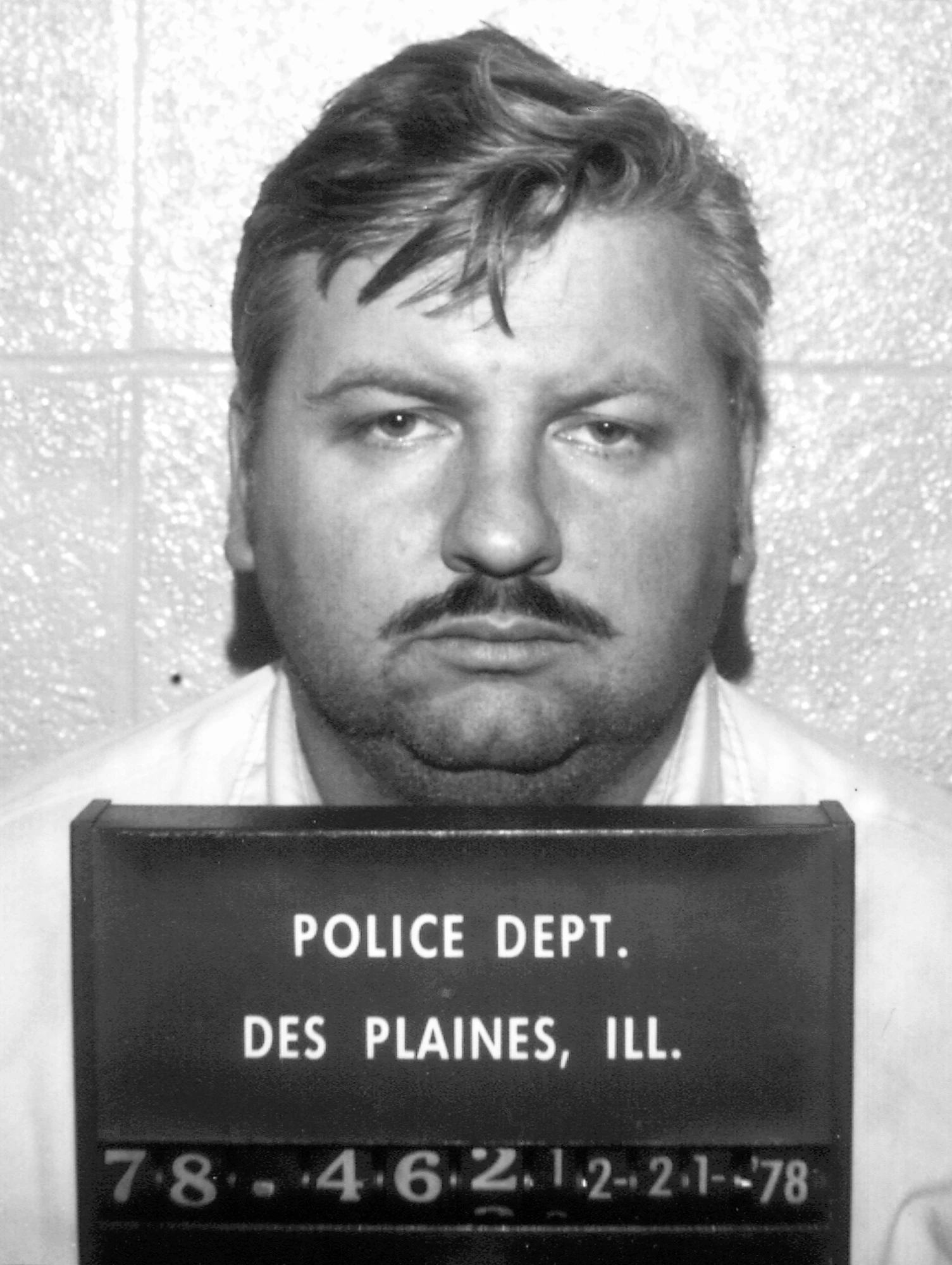
Booking photo of Gacy taken by the Des Plaines Police Department, December 1978
Wikimedia Commons· Public domain
That broken link is its own kind of coda. Officially, the case ended with convictions for 33 murders and a death sentence.[1][2] In reality, pieces of it remain unresolved: victims whose names must be reconstructed from bone, artwork whose authorship is still doubted, and a legacy that continues to flicker in and out of public view.
Under a Chicago house, 29 boys and young men lost their futures in a darkness that no excavation can fully illuminate.[1] The rest of the story—how to remember them, and how much space to give the man who killed them—remains a work in progress.
Adapted from Wikipedia: John Wayne Gacy.
This case file is an original Bloody Likely narrative synthesis based on the cited sources. Article © Bloody Likely. All rights reserved. Source materials remain the property of their respective owners. Facts, public records, quotations, and cited references are used for reporting, research, commentary, and documentation. Bloody Likely content license
Audio narration © Bloody Likely. All rights reserved. The audio player is provided for personal streaming/listening only.
No recent news articles found for this case. Check back later for updates.
No evidence found for this case. Be the first to submit evidence in the comments below.
Join the discussion
Loading comments...
John Wayne Gacy murders 16-year-old Timothy McCoy, marking the beginning of his killing spree.
15-year-old Robert Piest goes missing after leaving work, leading to the investigation of Gacy.
John Wayne Gacy is arrested after police investigate his connection to Robert Piest's disappearance.
Gacy confesses to murdering approximately 30 young males, revealing the extent of his crimes.
Police discover the first bodies in Gacy's crawl space during a search of his home.
Investigators continue to unearth bodies from Gacy's crawl space, confirming multiple murders.
John Wayne Gacy is sentenced to death for 33 counts of murder, the most for a single individual in U.S. history.
John Wayne Gacy is executed by lethal injection at Stateville Correctional Center.