ANALYZING EVIDENCE
Processing case files...
Processing case files...
California Golden State serial killer
CLASSIFICATION: Serial Homicide
LOCATION
California, United States
TIME PERIOD
1974–1986
VICTIMS
13 confirmed
Between 1974 and 1986, an assailant who came to be known as the Golden State Killer (also EAR/ONS/Visalia Ransacker) carried out hundreds of burglaries and rapes and murdered 13 people across multiple California counties. After decades of investigation and the 2001 DNA linkage of the East Area Rapist and Original Night Stalker crimes, investigators used forensic genetic genealogy and obtained surreptitious DNA samples in late 2017/early 2018 to identify Joseph James DeAngelo as the suspect. DeAngelo was arrested on April 24, 2018, later pleaded guilty to multiple counts of murder and kidnapping on June 29, 2020, and was sentenced on August 21, 2020, to consecutive life terms without parole. Key evidence included crime-scene DNA, STR matches to samples from multiple murders, and genealogical tree-building that led to DeAngelo.
Investigators and commentators have suggested motive elements including a desire for power and control and possible animus toward his ex‑fiancée (reports cite victim statements like "I hate you, Bonnie"). There was also public debate and ethical concern over the use of open‑source genealogy databases (GEDmatch) and the secondary use of relatives' DNA to identify the suspect.
For ten years, from 1976 to 1986, an unknown man moved through California’s suburbs and coastal towns, slipping into darkened homes and leaving behind a trail of burglaries, about 45 rapes, and 12 homicides. [1][2]
He was first called the East Area Rapist. Later, when investigators connected his attacks to a series of murders hundreds of miles away, they added another label: the Original Night Stalker. Collectively, the public came to know him as the Golden State Killer. [2]
For four decades he was a phantom—until April 25, 2018, when law enforcement announced they had arrested a 72‑year‑old California man they believed was responsible. [1] The FBI quietly updated its “Cold Case Killer” webpage to reflect the news. [1]
The documents behind that page—built long before the arrest—show how a sprawling, disjointed series of crimes were painstakingly stitched together into one of the most notorious unsolved cases in American history.
It started as a pattern of break‑ins in the eastern district of Sacramento County in the summer of 1976. [1][2]
Burglars were nothing new, but this one was different. He didn’t just steal; he ransacked homes, going methodically through drawers and closets, leaving chaos behind. [1][2] He favored small items: coins, jewelry, identification—things easy to pocket, hard to trace, and intimate enough to feel like a violation on their own. [1][2]
Soon, the break‑ins escalated into sexual assaults. [2] Over the next two years in the greater Sacramento area, the East Area Rapist would target women home alone, women at home with their children, and couples. [2] His victims ranged in age from 13 to 41. [1][2]
East Area Rapist Attacks Map.jpg
Wikimedia Commons· Public domain
The number of attacks mounted quickly. The Sacramento County Sheriff’s Department eventually attributed 24 sexual assaults and two homicides in its jurisdiction to the same subject. [2] Neighboring departments in Sacramento and surrounding cities began logging their own cases that appeared to fit the pattern. [2]
According to Special Agent Marcus Knutson, the terror reshaped daily life: people in Sacramento were “sleeping with shotguns” and “purchasing dogs” because the East Area Rapist “was terrorizing the community.” [1]
By the time the attacks were recognized as the work of a serial predator, the East Area Rapist already had a routine. He struck at night. He entered occupied homes. He tied up his victims. In cases that escalated into homicide, he bound both partners, raped the female victim, and then murdered the couple. [2]
During the Sacramento‑area phase from June 1976 to February 1978, he remained rooted in the suburbs, repeating his pattern: break in, terrorize, steal small trophies—coins, jewelry, IDs. [1][2]
Some survivors later shared their accounts publicly through the FBI’s webpage, which linked to pieces titled “First Survivor of East Area Rapist Shares Her Story” and “Survivor of East Area Rapist Shares Her Story.” [1] The site also hosted a 1977 recording of a suspected call from the attacker himself. [1]
The picture building in those early years was of a meticulous, physically capable offender who knew how to control a scene and vanish before police could close in.
On February 2, 1978, the violence took on a new dimension.
EAR-ONS-Back of "Punishment" map.png
Wikimedia Commons· Public domain
Sergeant Brian Maggiore and his wife, Katie, were out for an evening walk with their dog in their Rancho Cordova neighborhood when they crossed paths with the attacker. [2] The man chased them down, overcame the couple, and shot them at close range. [2]
They died not inside a ransacked home, but on a residential street. [1]
© Mapbox © OpenStreetMap
Retired Sacramento County Sheriff’s detective Ray Biondi, who investigated the Maggiore double homicide, later said the case was quickly linked to the East Area Rapist. [1] The FBI’s materials now list Brian and Katie Maggiore among the murders attributed to the same unknown subject. [1][2]
With the Maggiore killings, the line between serial rapist and serial killer had formally been crossed.
After February 1978, the attacker’s activity shifted. The FBI notes that from June 1976 to February 1978 he had been active in the greater Sacramento area, but after that, his crimes continued “primarily in the East Bay Area of Northern California.” [1][2]
As investigators began to see the bigger picture, the scale was staggering. Between 1976 and 1986, a single subject had committed 12 homicides, approximately 45 rapes, and more than 120 residential burglaries in California. [1][2] These offenses spanned numerous jurisdictions—exactly the kind of fragmentation that, in the pre‑DNA era, helped serial offenders evade detection.
As he left the Sacramento region and moved into the East Bay and then south along the coast, his crimes escalated into rapes and homicides or attempted homicides in coastal communities. [1][2] Goleta, Ventura, Laguna Niguel, and Irvine all eventually appeared on the FBI’s list of affected jurisdictions. [2]
Local agencies began totalling their own damage. Contra Costa County reported five sexual assaults believed to be his work; Concord, Davis, Fremont, Modesto, San Jose, Stockton, and Walnut Creek each logged between one and three assaults with similar hallmarks. [2]
On the homicide side, Santa Barbara County reported four murders (two of them attempted) in Goleta tied to the subject. [2] Ventura logged two. [2] Orange County and Irvine shared responsibility for multiple homicides linked to the same unknown man. [2]
What united them were details of the crimes and, later, DNA. The FBI’s press materials state that all of these offenses were linked either by matching DNA profiles or by specific details of the attacks. [2]
By October 1979, the pattern of coastal homicides had become clear enough for investigators to chart. [2]
A press release later summarized the killings this way:
During these murders, the attacker followed a grimly consistent script: he tied up both victims, raped the female victim, then murdered the couple. [2]
By then, the moniker “Original Night Stalker” had been attached to the coastal killer. Only later, as DNA evidence improved, would law enforcement conclude that the East Area Rapist and this roaming murderer were the same man. [2]
After July 1981, the trail went cold. The FBI notes that no associated incidents are known to have been reported for the next five years. [1][2]
EAR-ONS Maggiore Suspects 1978.jpg
Wikimedia Commons· Public domain
There is no explanation in the Bureau’s public materials for this silence—no discussion of whether the offender moved, was incarcerated for unrelated crimes, changed his behavior, or simply managed to evade detection. [1][2]
Then, in 1986, he appears once more in the record. That year, an 18‑year‑old woman in Irvine, California, was raped and murdered. [1][2] The FBI’s Cold Case Killer page identifies this as the last known crime associated with the same subject. [1][2]
After that, no additional crimes have been connected to him. [2]
The gap between 1981 and 1986—and the abrupt end after the 1986 Irvine murder—remain open questions in the FBI’s own narrative of the case. [1][2]
From hundreds of reports, survivor interviews, and forensic findings, investigators constructed only the most skeletal public profile.
The suspect was described as a white male, approximately 5'10" to close to six feet tall, with blond or light brown hair and an athletic build. [1][2] If alive today, the FBI estimated, he would be roughly 60 to 75 years old. [1][2]
He appeared to have a familiarity with military or law‑enforcement techniques, and he was clearly proficient with firearms. [1][2] That expertise fed speculation that he might have formal training, though the Bureau stopped short of declaring a known background. [1][2]
Perhaps most unsettling, the FBI warned that people who knew him “may not believe him capable of such crimes,” and that he might never have exhibited obvious violent tendencies or had a known criminal record. [2]
In other words, the Golden State Killer might have blended seamlessly into everyday life—someone’s neighbor, coworker, or relative—while committing some of the state’s most notorious crimes.
When the East Area Rapist/Original Night Stalker was active, the investigative tools that now seem basic were not yet available. DNA testing simply did not exist as a forensic option, and there were no cell phones or widespread surveillance cameras to help anchor a suspect in time and place. [1]
EAR Sketches.jpg
Wikimedia Commons· Public domain
Despite that, investigators had done something crucial: they preserved evidence. Decades later, that evidence could be revisited. The FBI notes that detectives compiled DNA samples from multiple crime scenes and used them to positively link or eliminate suspects. [1][2]
The DNA evidence became a high‑stakes filter. It allowed investigators to quickly exclude innocent parties and focus on those who could not be ruled out. [2] The FBI emphasized that part of its role was to help local agencies follow leads around the country and use these tests, along with other evidence, to narrow the field. [1]
Still, by 2016—forty years after the first Sacramento‑area burglaries—no suspect had been publicly identified.
On June 15, 2016, the FBI took an unusually public step. It published a dedicated “Cold Case Killer” webpage and, alongside local partners, launched a nationwide multimedia campaign to bring the case back into the spotlight. [1][2]
The core of the effort was a $50,000 reward for information leading to the arrest and conviction of the killer. [1][2] Digital billboards went up across the country. [2] The Bureau pushed the case on Twitter, Facebook, and YouTube. [2] Audio segments ran as podcasts and radio public‑service announcements. [2]
The webpage itself—www.fbi.gov/EastAreaRapist—hosted case summaries, age‑progressed images, crime‑scene maps, survivor stories, and that eerie 1977 recording. [1][2] Visitors were urged to share official links and content to widen the net. [2]
Sgt. Paul Belli of the Sacramento County Sheriff’s Department put the strategy bluntly: “the sheriff's department never gave up on the investigation.” [1] “Our lifelines are people who give us information. It all boils down to people helping.” [1] He added that the $50,000 reward “may push somebody over the edge who knows something” and “could provide us with that one tip we need.” [1]
To jog memories, the FBI asked the public to think about specific, concrete details:
The Bureau didn’t just want tips about suspicious behavior. It wanted people to re‑examine the familiar men in their lives through the lens of an old, terrifying mystery. [1][2]
For nearly two years after the 2016 rollout, the FBI’s Cold Case Killer page painted a picture of a killer still at large, possibly now an older man living an unremarkable life somewhere in America. [1][2]
Then, on April 25, 2018, that changed. Law enforcement announced the arrest of a 72‑year‑old California man they believed to be the East Area Rapist/Golden State Killer. [1] The FBI updated the webpage to note the arrest. [1]
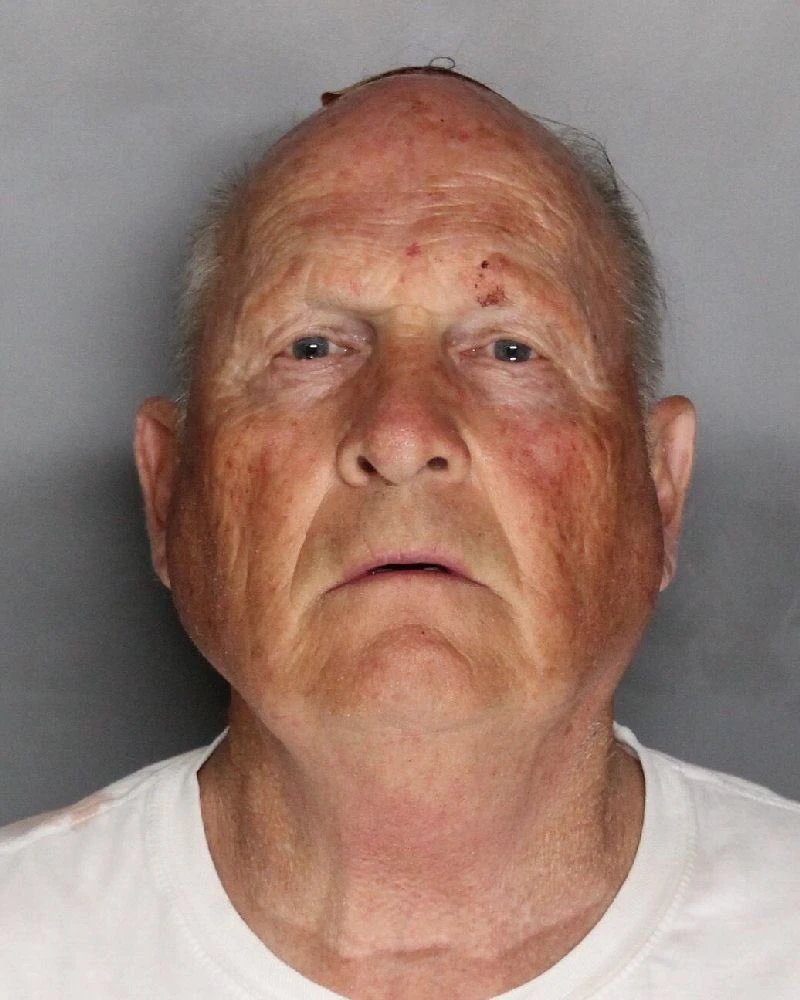
Mugshot of Joseph DeAngelo, the Golden State Killer
Wikimedia Commons· Public domain
The materials provided here stop there. They do not include the suspect’s name, the charges filed, details of any trial, or a final legal disposition. [1] In keeping with those limits—and with the presumption of innocence that applies until a conviction—this account cannot go further into what happened after the arrest.
What is clear is that the arrest marked a turning point. A case that had defined the limits of pre‑DNA policing had finally met the possibilities of modern forensic science and long‑term investigative persistence.
Even with an arrest, several threads in the FBI’s own narrative remain unresolved.
There is the unexplained five‑year gap in known activity between July 1981 and the 1986 Irvine murder. [1][2] Were there other attacks that have yet to be connected by DNA or signature? Did the subject stop, or did his crimes simply escape notice or linkage? The public materials do not say. [1][2]
There is also the question of how someone could live a life that, according to the FBI, might have shown no obvious violent tendencies or criminal history, while allegedly committing dozens of rapes and multiple homicides. [2]
For the survivors and for the families of those killed—from the Maggiores in Rancho Cordova to the unnamed 18‑year‑old in Irvine—those questions are not just academic. [1][2] They frame what justice can and cannot answer after so many years.
What the record does show is that investigators refused to let the case fade. They preserved evidence before anyone knew what DNA could do. [1] They linked crimes across city and county lines. [2] And, forty years later, they were still asking the public for help, convinced that someone, somewhere, knew a piece of the story they needed. [1]
The Golden State Killer case, as captured in the FBI’s own files, is ultimately about that long, grinding effort—across decades, technologies, and generations—to put a name and a face to the man who once seemed destined to remain a ghost.
Adapted from Joseph James DeAngelo - Wikipedia.
This case file is an original Bloody Likely narrative synthesis based on the cited sources. Article © Bloody Likely. All rights reserved. Source materials remain the property of their respective owners. Facts, public records, quotations, and cited references are used for reporting, research, commentary, and documentation. Bloody Likely content license
No recent news articles found for this case. Check back later for updates.
No evidence found for this case. Be the first to submit evidence in the comments below.
Join the discussion
Loading comments...
The earliest recorded incident attributed to the Visalia Ransacker occurred when $50 in coins was stolen from a piggy bank; this period later became linked to
Claude Snelling was shot and killed during a home invasion in Visalia while the assailant attempted to kidnap Snelling's daughter; investigators later linked
A 15-year-old girl, Kris Pedretti, was attacked and raped in Rancho Cordova; the attacker used the phrase "Do what I say or I'll kill you and be gone in the
Brian and Katie Maggiore were chased down and shot to death while walking their dog in Rancho Cordova; investigators later concluded these murders were
Shortly after moving to Southern California, the assailant began the Original Night Stalker murder series, attacking a Goleta couple on October 1, 1979; this
Eighteen-year-old Janelle Cruz was raped and bludgeoned to death in her Irvine home; this 1986 murder was the last attack publicly attributed to the Original
DNA testing indicated that the East Area Rapist and the Original Night Stalker were the same offender, prompting investigators to combine the cases (EARONS).
The FBI and local agencies announced a renewed nationwide effort and offered a $50,000 reward to capture the Golden State Killer, releasing updated sketches
Investigators began using forensic genetic genealogy on GEDmatch to identify distant relatives and construct family trees that ultimately led them to Joseph
Sacramento County Sheriff's deputies arrested 72-year-old Joseph James DeAngelo at his home; subsequent DNA samples from his car and trash matched crime-scene
DeAngelo was sentenced to multiple consecutive life terms without the possibility of parole after pleading guilty to 13 counts of first-degree murder and