ANALYZING EVIDENCE
Processing case files...
Processing case files...
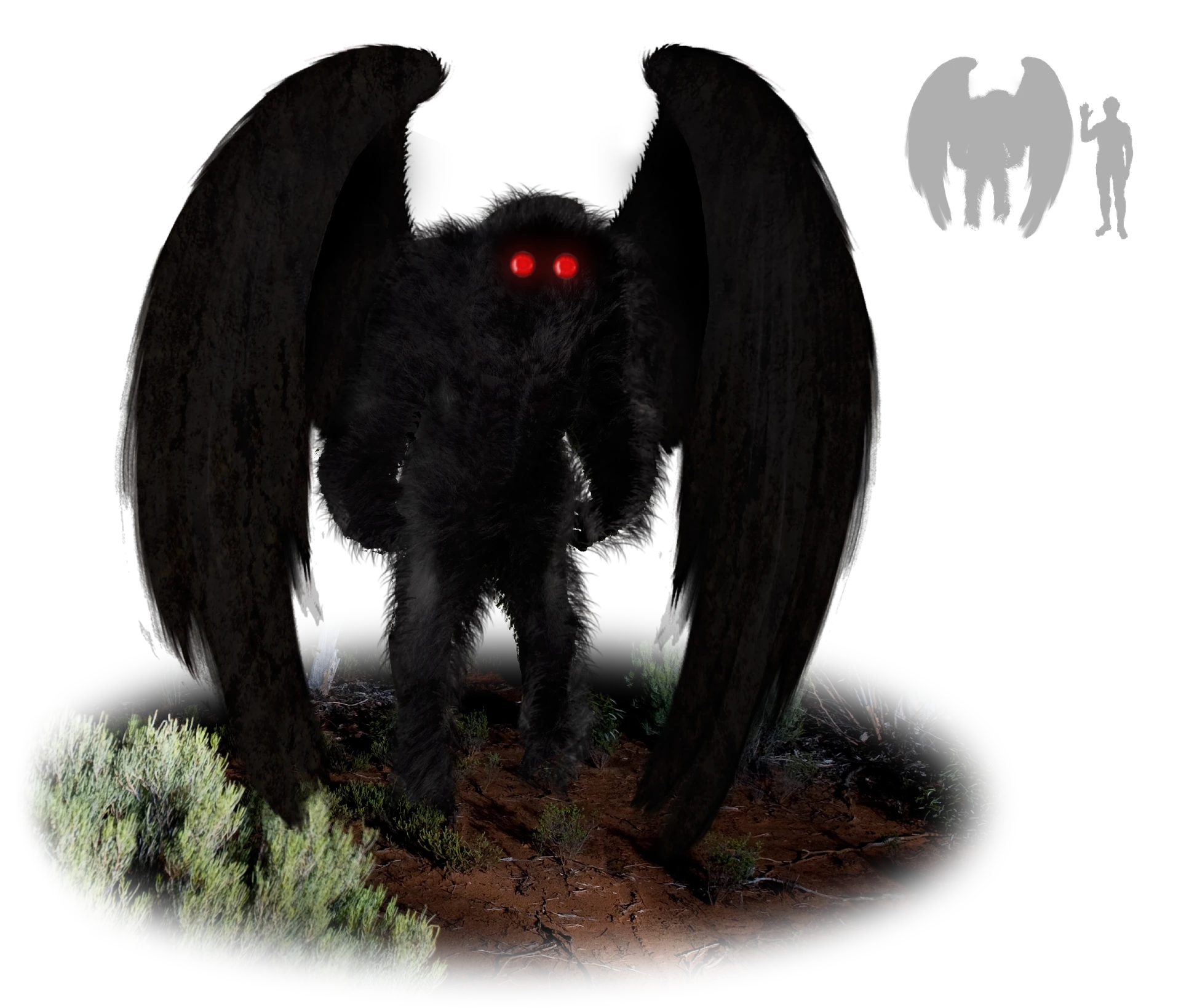
Urban Legend Creature Sightings
CLASSIFICATION: Unsolved Homicide
LOCATION
Point Pleasant, West Virginia
TIME PERIOD
November 15, 1966 - December 15, 1967
VICTIMS
46 confirmed
On November 15, 1966, in Point Pleasant, West Virginia, two young couples, Roger and Linda Scarberry, along with Steve and Mary Mallette, reported encountering a large, humanoid creature with glowing red eyes near a former munitions plant known as the TNT area. The creature, described as seven feet tall with white wings, allegedly pursued their vehicle, prompting them to alert local authorities. Following this initial sighting, numerous reports emerged from residents, leading to widespread media coverage and speculation regarding the creature's identity, with some attributing it to a large heron or sandhill crane. The phenomenon gained further traction through the writings of Gray Barker and John Keel, culminating in the 1975 book "The Mothman Prophecies," which linked the sightings to paranormal events and the later collapse of the Silver Bridge. As of now, the Mothman remains a subject of local folklore, with an annual festival celebrating the legend, although no definitive evidence has been found to confirm the creature's existence.
Mothman is believed by some to be a harbinger of disaster, with theories linking its sightings to the collapse of the Silver Bridge in 1967. Others speculate that the creature may be a supernatural entity or an extraterrestrial being, given the unusual nature of the sightings and the associated paranormal events reported by witnesses. Additionally, some people think the legend originated from misidentified local wildlife, such as sandhill cranes or herons, rather than a mythical creature.
On November 18, 1966, readers of the Athens Messenger opened their paper to a headline that sounded like a taunt:
“Monster no joke for those who saw it.”[1]
In the weeks around that headline, people in and around Point Pleasant, a small city on West Virginia’s western border, started reporting something they struggled to name — a huge, man‑shaped bird with glowing red eyes, gliding over an old munitions dump and along the river.[1][2][3]
© Mapbox © OpenStreetMap
Within a year, a bridge over the Ohio River would collapse, killing dozens, and a new American omen would be born.[1][2]
Half a century later, that same figure — now branded “Mothman” — would be blamed, or credited, for grainy photographs in Point Pleasant and a rash of flying‑humanoid sightings over Chicago’s neighborhoods.[2][4]
"The Mothman Prophecies", by John A. Keel.jpg
Wikimedia Commons· Public domain
This is less a monster story than a case file on how a local scare mutates into a modern myth — and what happens when belief collides with investigation.
Contemporary reporting from 1966–1967 described a “large, man‑like bird with glowing red eyes” around Point Pleasant.[2] Later accounts would place the earliest sightings near an abandoned World War II munitions site locals simply called “TNT,” a maze of industrial ruins and wildlife habitat outside town.[3]
Over roughly a month — November 15 to December 15, 1966, according to a later local summary — witnesses said they saw a winged creature in the area.[4] At least eight people reported similar beings over just three days following the initial accounts, according to a contemporaneous Associated Press item later quoted by Snopes.[1]
On November 18, 1966, two volunteer firemen, Capt. Paul Yoder and Benjamin Enochs, told reporters they had seen “a very large bird with large red eyes.”[1] Their sighting helped push the story from rumor to print, feeding the Athens Messenger’s “Monster no joke” headline the same day.[1]
The details varied, but a rough sketch emerged:
Already, the town was split: some residents were frightened, others amused, and a few went looking for whatever was out there in the TNT area and along the back roads at night.[2][5]
Within weeks, officials and scientists weighed in — and the monster began to look more like a bird on paper.
From the beginning, local authorities leaned hard toward a mundane explanation. Then‑Mason County Sheriff George Johnson told reporters he believed the creature was likely a “shitepoke,” a colloquial name for a type of heron — in other words, a big, odd‑looking bird spooking people in the dark.[1]
Books from the Library of Congress (IA supplementtoaddr02clay).pdf
Wikimedia Commons· Public domain
By December 1, 1966, a consensus of sorts had been floated to the Associated Press: authorities and a local biologist thought the “Mothman” was probably a sandhill crane that had wandered far off its usual route.[1]
Dr. Robert L. Smith, an associate professor of wildlife biology at West Virginia University, became the key voice for this view. He argued that eyewitness descriptions “fitted the sandhill crane,” a species that:
Those red patches, Smith suggested, could easily be remembered — or retold — as “red eyes” glowing in a flashlight beam or headlights.[1] Snopes, looking back decades later, noted that early news coverage generally echoed this line: whatever people were seeing, authorities thought it was “an unusual-looking bird.”[1]
The sandhill crane theory didn’t close the case. It simply created a fork in the story: on one side, officials and skeptics; on the other, witnesses and believers who insisted what they’d seen was nothing like any known bird.
That second camp would get a powerful ally a few years later.
In December 1967, the Silver Bridge, which carried U.S. 35 over the Ohio River between Point Pleasant and Ohio, collapsed during rush hour, killing dozens of people.[1] In local memory, this tragedy very quickly braided itself to the strange sightings of the year before.
Point Pleasant folklore linked the winged creature to the disaster, recasting it as a harbinger of doom — a thing that appeared when catastrophe loomed.[2][4] Some claim the creature was seen right before the bridge fell.[4] Others folded the entire 1966–1967 flap into a pattern: the being showed up, terrified people, then vanished after the collapse, as if its work was done.[3]
Snopes has pointed out an inconvenient fact for that narrative: the bridge collapse occurred more than a year after the first Mothman sightings, making any direct prophetic link “tenuous.”[1] The tragedy and the monster were chronological neighbors, not necessarily cause and effect.
But folklore thrives on meaning, not timelines. And in 1975, a New York writer named John Keel gave the story its definitive shape.
Keel’s investigative book The Mothman Prophecies stitched together the Point Pleasant reports into a single, uncanny narrative and helped cement the creature as an omen linked to the Silver Bridge collapse.[2][4][5] When the book was adapted into a 2002 feature film of the same name, starring Richard Gere (and, in one account, also Laura Linney), the legend’s audience exploded beyond Appalachian locals and paranormal buffs.[1][2][4][5]
From then on, Mothman wasn’t just a weird local bird story. He was a national myth.
By the early 2000s, Point Pleasant had a choice. It could treat the Mothman years as an embarrassing mass scare — or lean into the story.
Iconshock Myths.jpg
It chose the latter, enthusiastically.
Since 2002, the town has commemorated the sightings with an annual Mothman Festival every September.[2][5] The event eventually grew big enough that roadside chroniclers would note it drew “upwards of 15,000 people” to downtown Point Pleasant each year.[5]
The centerpiece is a stainless‑steel Mothman statue in the middle of town, its mirrored red eyes and 13‑foot wingspan making it impossible to miss.[1][5] Created by retired welder‑turned‑artist Bob Roach, who spent about a year building it in his garage, the sculpture was unveiled on September 13, 2003.[5] It quickly became a magnet for tourists.[5]
Across the street, a dedicated Mothman Museum opened in 2006.[5] Among its exhibits: the white suit John Keel wore to the statue’s dedication.[5] Snopes, cataloging the town’s transformation, noted that the small city now boasts not only the statue, but also a festival and museum, and multiple local businesses that use the Mothman as a draw for customers.[1]
Few people embody this pivot more than Carolin Harris. Owner of The Mothman Diner for decades, Harris helped start the festival and became one of the legend’s most visible local champions.[4] “I definitely know the Mothman is real,” she told WCHS in 2016, adding that first responders and sheriff’s deputies she spoke with “definitely made a believer” out of her.[4]
For Harris, the creature is both conviction and commerce. “It’s a good thing,” she said. “It brings lots of people to the area. He’s here to stay.”[4]
By 2009, the Toronto Star could run a travel piece under the headline “’Mothman’ still a frighteningly big draw for tourists,” reflecting just how firmly the monster had been folded into Point Pleasant’s identity and economy.[6]
Crucially, despite the ominous reputation, one roadside account wryly noted another point in Mothman’s favor: for all the fear, the creature “ate no human victims.”[5]
The legend, however, was not content to stay in the past — or in West Virginia.
On November 21, 2016, local station WCHS/WVAH ran a story with an irresistible hook: “Man photographs creature that resembles legendary ‘Mothman’ of Point Pleasant.”[4] The timing was conspicuous — roughly the 50th anniversary of the original 1966 flap.
According to the station, an unnamed man was driving along State Route 2 outside Point Pleasant on November 20 when he saw something jumping from tree to tree.[4] He pulled off the road and snapped several photos.[4] The pictures, published by WCHS, appeared to show a two‑legged, winged figure in flight, with pointed wings and long legs bent at an awkward angle.[4] Later, Snopes would describe the same images as “grainy” silhouettes of a winged creature flying around treetops.[1]
The man declined an on‑camera interview but told WCHS the pictures were not doctored. He also said he had only recently moved to Point Pleasant for work and hadn’t known about the Mothman legend when he took the photos.[4]
Locals didn’t need convincing that something like Mothman could be out there. Harris, of The Mothman Diner, told the station she believed the photos could be real because “there have been many other sightings over the years.”[4] Passing tourists Karen and Ralph Smith, who had stopped in town to visit the Mothman Museum, said the pictures looked real to them and that Karen hoped she could add herself to the “believer” category.[4]
Jeff Wamsley, owner of the Mothman Museum and often described as a local Mothman expert, was more cautious. With modern technology, he said, “it is almost impossible to know for sure if the pictures are real.”[4]
Snopes weighed in four days later, publishing a fact‑check titled “‘Mothman’ Returns to Point Pleasant, West Virginia?”[1] The outlet summarized the claim — that a man had caught the legendary creature on camera — and noted that the photos had been supplied to WCHS by an unidentified photographer and aired on November 21.[1]
After examining the images and the context, Snopes suggested that “it seems likely” the 2016 photographs were produced to stir up the myth on its 50th anniversary, rather than constituting hard evidence of anything paranormal.[1]
Still, the story underscored what had become obvious: in Point Pleasant, the Mothman legend is now so ingrained that any ambiguous shape in the sky is instantly viewed through that lens.[1]
And the lens was no longer confined to West Virginia.
In 2017, hundreds of miles from the TNT fields and the Ohio River, something started turning up in Chicago’s skies.
VICE chronicled what it called 55 reported Chicago‑area sightings of a flying humanoid that year, most of them in flight over parks, buildings, and roadways.[2] Eyewitness descriptions ranged from “a large, black, bat‑like being with glowing red eyes” to “a big owl,” a “Gothic gargoyle,” or explicitly “a Mothman.”[2]
One of the earliest and most detailed accounts came from John Amitrano, who was working a Friday night security shift at The Owl, a bar in the Logan Square neighborhood.[2] Stepping outside, he first noticed a plane overhead — then “something moving really awkwardly under it.”[2] What he saw, he told VICE, didn’t look like a bat:
"Jadoo", by John A. Keel (cropped).jpg
Wikimedia Commons· Public domain
After the thing flew off, Amitrano went back inside, grabbed his phone from the charger, and began texting his girlfriend and close friends about what he’d just witnessed.[2] Later, seeing Facebook posts about similar sightings, he contacted Lon Strickler, a self‑described Fortean researcher who compiles reports of Chicago’s flying humanoids on his website Phantoms and Monsters.[2]
Strickler, who says he has been investigating paranormal cases since the late 1970s and even claims to have seen both a “Mothman” and Bigfoot himself, dove into the Chicago wave.[2] By his own account, he painstakingly interviewed witnesses and documented their stories, eventually arguing that the clustered, urban nature of the reports made them “historical in cryptozoology terms.”[2]
Analyzing the geography and the subtle differences in testimony, Strickler concluded there were at least three distinct flying humanoids active around Chicago.[2] He contrasted this with Point Pleasant, where he believes only a single being was present during the 1960s flap.[2]
Unlike the ominous West Virginia version, Strickler told VICE he did not see the Chicago beings as harbingers of disaster and thought they were “less aggressive” than the earlier Mothman.[2] Ultimately, he has said, “I think they’re flesh and blood beings that aren’t of this world,” and he insists that “we have had very few cranks” among those contacting him.[2]
Chicago, for its part, reacted the way modern cities do: with fascination, pop culture, and memes. VICE reported that the alleged Mothman captured local attention, spawning news pieces, rap songs, Halloween costumes, and speculative Facebook groups.[2]
Belief had gone viral.
Not everyone watching the Chicago case file grow is convinced there’s anything unusual in the skies.
VICE spoke with psychologist Dr. David A. Gallo of the University of Chicago, whose research focuses on memory and how people reconstruct the past.[2] Gallo raised a series of methodological red flags about treating Strickler’s database as evidence of a genuine phenomenon.
First, the sample is self‑selecting: Strickler is counting only voluntarily reported sightings, not surveying a random cross‑section of the population.[2] People who visit paranormal‑centric websites, Gallo noted, are likely already inclined to believe in — and therefore to “witness” — entities like Mothman.[2]
Second, Gallo pointed to what he called “The Will Smith Effect”: a pattern where media coverage and entertainment lead to spikes in reported sightings of UFOs or other anomalies.[2] Once a story is in the air, people primed by it may begin to reinterpret ambiguous experiences in its light.
Finally, there’s the question of memory. If witnesses have gaps in what they originally perceived, Gallo said, they may unconsciously fill those gaps later when someone suggests an interpretation — say, that the shape they saw was “Mothman.”[2]
None of this shook Amitrano’s conviction that he saw something truly strange. He told VICE he still believes his own account and that many people keep quiet about sightings for fear of being labeled a “crackpot or a crazy person.”[2]
The tension between those positions — personal certainty versus cognitive science — is where the Mothman case now lives.
By 2020, the stainless‑steel Mothman statue in downtown Point Pleasant had become such a pop‑culture icon that thousands of people signed an online petition proposing that Confederate monuments around the U.S. be replaced with figures like it — “primarily the Mothman,” as one roadside account put it.[5] A creature once blamed for an omen of mass death had, in some circles, become a kind of tongue‑in‑cheek civic hero.
Artist's impression of the mothman
Wikimedia Commons· CC BY-SA 4.0
That same year, the documentary The Mothman Legacy — a follow‑up to earlier cryptid films — was acquired for worldwide digital and broadcast rights.[3] The film, which was initially set to premiere at the Mothman Festival before the event was canceled due to COVID‑19, promises a “terrifying real‑life horror story, and a case study on the roots of a modern myth,” featuring witness interviews alongside experts, authors, and locals.[3]
In other words, even the documentaries about Mothman now openly frame him as both fear and folklore.
Strip away the red eyes and bat wings, and what’s left is something very human:
Whether you think that shape was a lost crane, a cryptid, or a trick of memory, the Mothman case shows how quickly a fleeting shadow can harden into a shared narrative — and how stubbornly that narrative can endure once it has a name, a statue, a festival, and a place in pop culture.
The monster may or may not be real. The consequences of believing in him absolutely are.
Adapted from Mothman - Wikipedia.
This case file is an original Bloody Likely narrative synthesis based on the cited sources. Article © Bloody Likely. All rights reserved. Source materials remain the property of their respective owners. Facts, public records, quotations, and cited references are used for reporting, research, commentary, and documentation. Bloody Likely content license
Audio narration © Bloody Likely. All rights reserved. The audio player is provided for personal streaming/listening only.
No recent news articles found for this case. Check back later for updates.
No evidence found for this case. Be the first to submit evidence in the comments below.
Join the discussion
Loading comments...
Two couples report seeing a large black creature with glowing red eyes near the TNT area.
The Point Pleasant Register publishes the first report on Mothman sightings, sparking public interest.
Local authorities suggest the creature may be a large heron, termed a 'shitepoke' by Sheriff George Johnson.
The Silver Bridge collapses, killing 46 people, leading to a connection between the disaster and Mothman sightings.
Gray Barker publishes a book that introduces Mothman to a wider audience, linking it to paranormal events.
John Keel publishes 'The Mothman Prophecies', claiming connections between sightings and supernatural phenomena.
The book 'The Mothman Prophecies' is adapted into a film starring Richard Gere, further popularizing the legend.
Point Pleasant holds its first Annual Mothman Festival to celebrate the local legend and attract tourism.
The Mothman Museum and Research Center opens in Point Pleasant, dedicated to the legend and its history.