ANALYZING EVIDENCE
Processing case files...
Processing case files...
Cross-Border Serial Killer
CLASSIFICATION: Serial Homicide
LOCATION
Texas, United States
TIME PERIOD
1990s
VICTIMS
15 confirmed
Were both brutally murdered in their homes in Texas, showcasing Reséndiz's pattern of targeting vulnerable individuals. His ability to evade law enforcement while committing these heinous acts highlights significant gaps in cross-border criminal tracking and coordination. Reséndiz was ultimately captured in 1999 and sentenced to death, but his case remains a chilling reminder of the dangers posed by transient criminals exploiting the rail system. Investigators are urged to review cold cases from the 1990s for potential links to Reséndiz's methodology and victim profile.
Ángel Maturino Reséndiz is believed to have targeted victims near railroads, as many of his murders occurred in proximity to train tracks. Some speculate that his transient lifestyle, facilitated by hopping freight trains, allowed him to evade capture and commit crimes across multiple states and countries. There are theories that his violent behavior may have been influenced by a troubled childhood and a history of criminal activity.
By the time federal agents were hunting a man named Rafael Resendez‑Ramirez in connection with the murder of a doctor known in records only as Dr. Benton, he had already slipped through the United States border system again and again — often with the government’s help.[1]
© Mapbox © OpenStreetMap
Border Patrol agents had caught him, fingerprinted him, and sent him back to Mexico at least seven times in 1998, then once more on June 1, 1999 — the very year police were scrambling to get his name into lookout systems and federal task forces were organizing to find him.[1]
The failure wasn’t just one bad judgment call at a checkpoint. It was a cascade: a young biometric database not fully understood, unclear policies, thin training, and investigative seams between agencies that a determined suspect could slip through.
The fallout would force the U.S. Department of Justice’s Office of the Inspector General to dissect the case in a special report, turning one man’s file into an X‑ray of how a modern border worked — and how, in crucial moments, it didn’t.[1]
On paper, Resendez looks unremarkable. In Texas prison records, he is listed as a male, 5 feet 6 inches tall, 190 pounds, with brown eyes.[2]
Those same records list his native county as Durango and his native state as Mexico, and describe his prior occupation simply: laborer.[2]
PolunskyUnitWestLivingstonTX.jpg
Wikimedia Commons· Public domain
In the Justice Department’s later special report, his full name appears as Rafael Resendez‑Ramirez, though throughout the document he’s referred to simply as “Resendez.”[1]
The details that would make him infamous lie outside administrative paperwork. What the official documents do capture — in precise dates and chapter headings — is the pattern of his movements, the gravity of the crimes being investigated, and the institutional failures that let him move on.
The federal report devotes an entire chapter to what it calls “Resendez’s Criminal History and Apprehensions by the Border Patrol Before 1999.”[1]
Within that chapter, a section titled “Resendez’s Seven Apprehensions and Voluntary Returns to Mexico in 1998” lays out a stark sequence in the dry language of casework: January 5, January 7, January 8, April 17, April 21, April 22, and November 3, 1998.[1]
Each of those dates marks a specific apprehension by the Border Patrol, followed by a voluntary return to Mexico.[1] The report also notes, elsewhere, that his criminal history predates those encounters, though it reserves the details for a separate section and appendix devoted to “Resendez’s Criminal History.”[1]
By design, voluntary return was a routine tool — a way to move noncitizens back across the border quickly. In 1998, that’s how the system processed him each time. No prosecution. No long‑term detention. Just paperwork, prints, and a push back over the line.
The tone of the files shifts in the next chapter, titled, simply and chillingly, “The Investigation of Resendez for Murder.”[1]
One section heading gives the crime its name: “The Murder of Dr. Benton.”[1] The report doesn’t linger on the details of how Benton died; it doesn’t need to. The point is that a homicide investigation had now attached itself to the same man Border Patrol agents had been catching and releasing.
Local and state officers quickly realized they would need help tracking someone who moved across borders as easily as most people cross counties. One section is titled “The Police Attempt to Place Lookouts for Resendez,” signaling how investigators tried to flag him in immigration and border systems.[1]
Another describes how “The Police Contact Houston INS Investigators About Resendez,” reflecting an early attempt to pull federal immigration investigators into a murder case.[1] A Texas Ranger, working his own avenues, reached out separately, in a section labeled “A Texas Ranger Contacts Another Houston INS Investigator About Resendez.”[1]
Information about him began circulating in intelligence channels: the report cites “The Weekly Intelligence Report With Information on Resendez,” and notes his case becoming part of the “Gulf Coast Violent Offenders Task Force.”[1]
Soon, the FBI formally joined in. Another heading marks the expansion: “The FBI Enters the Resendez Investigation.”[1] What had started as a homicide in a local file was now a multi‑agency manhunt focused on a man whose fingerprints were already in federal databases.
Even as the murder investigation gathered steam, the border machinery kept turning.
The Justice Department’s report singles out one date: June 1, 1999. An entire chapter is titled “The Border Patrol Apprehends and Voluntarily Returns Resendez to Mexico on June 1, 1999.”[1]
The title alone lays out the problem. After multiple 1998 apprehensions and returns, and after police had begun investigating him for murder and trying to place lookouts, Border Patrol agents still processed him as a voluntary return and sent him back to Mexico.
It would later emerge that his prints had been taken and run through IDENT, the Immigration and Naturalization Service’s automated fingerprint identification system — the same system that stored records of his earlier apprehensions.[1]
In a later analysis, the Inspector General would devote a full chapter to the 1998 and 1999 encounters, titled “OIG Analysis of the Border Patrol’s Apprehensions and Voluntary Returns of Resendez in 1998 and 1999.”[1] One section reached a blunt conclusion: “The Voluntary Returns of Resendez Were in Accord with Standard Border Patrol Practices and Procedures.”[1]
In other words, the agents on the line were, in many ways, doing what they’d been trained and authorized to do.
But the same chapter also cataloged mistakes in how agents used IDENT. A section titled “The Border Patrol Agents who Processed Resendez in IDENT Made Mistakes, Although These Mistakes Did Not Affect Their Decision to Voluntarily Return Resendez” underscored that data handling and system interaction were flawed, even if policy itself pointed toward return.[1]
Other subsections probed deeper technical issues: “Allowing IDENT to Auto Verify Previous Apprehensions” and “Denying Valid Hits,” suggesting that the way the fingerprint system was configured — and the way operators understood or overrode it — could blunt its ability to flag high‑risk individuals.[1]
Compounding all of this was a structural problem: a “Lack of Established Prosecution Thresholds” that left frontline agents without clear guidance on when repeated illegal entries or criminal history should trigger a push for charges instead of quick return.[1]
After June 1, the urgency sharpened. The next chapter in the report is titled “The Search for and Surrender of Resendez,” marking a shift from analysis of past mistakes to an unfolding pursuit.[1]
Within that narrative, an “FBI Multi‑Agency Task Force” takes center stage, reflecting a more coordinated hunt that pulled in federal, state, and local officers.[1] The task force worked not just the streets, but the systems.
A “Lookout Notice is Sent to Border Patrol Sectors,” a small but crucial detail: agencies were now trying to make sure that if his fingerprints or biographical data hit at a border station, the response would be different than it had been on June 1 — or the seven times before that.[1]
HuntsvilleUnitHuntsvilleTX.jpg
This time, according to a section heading, “Resendez is Enrolled in IDENT’s Lookout Database.”[1] IDENT wasn’t just logging his apprehensions in its recidivist database anymore; it was being asked to treat him as someone officers actively wanted to stop.[1]
The hunt wasn’t purely digital. The report credits individual initiative, with sections titled “Initiative by Border Patrol Agent Estevis” and “Initiative by United States Marshals Service Inspector Sorukas,” highlighting specific agents who pushed the case forward beyond routine procedure.[1]
Another section, “The INS’s Investigation into the Resendez Matter,” shows that immigration investigators were now running their own parallel efforts, rather than being only a support system for other agencies.[1]
The chapter ends the way many manhunts do: with surrender. A final section is titled, simply, “Resendez Surrenders.”[1] The report does not hang on the drama of that moment; it cares more about what the chase revealed.
By March 20, 2000, the case had become something larger than a single fugitive or even a single murder investigation. On that date, the Department of Justice’s Office of the Inspector General released a special report titled “The Rafael Resendez‑Ramirez Case: A Review of the INS's Actions and the Operation of Its IDENT Automated Fingerprint Identification System.”[1]
The document opens with a chapter called “Introduction,” which lays out background, explains “The OIG Investigation,” and sets out the “Organization of the OIG Report.”[1]
From there, the report turns analytical — and critical.
Only after building that technical foundation does the report return to him. Chapter Three charts “Resendez’s Criminal History and Apprehensions by the Border Patrol Before 1999,” the 1998 apprehensions and voluntary returns, and the earlier criminal record outlined again in “Details of Resendez’s Criminal History” in an appendix.[1]
Chapter Four, “The Investigation of Resendez for Murder,” threads together the local and federal pieces: the murder of Dr. Benton, law enforcement’s efforts to place lookouts, their contacts with Houston INS investigators, the Texas Ranger’s outreach, the weekly intelligence reports, the Gulf Coast Violent Offenders Task Force, and the FBI’s entry into the case.[1]
Chapter Five spotlights the pivotal June 1, 1999 apprehension and voluntary return.[1] Chapter Six recounts the search, the multi‑agency task force, the lookout notices to Border Patrol sectors, his enrollment in IDENT’s lookout database, the initiatives by individual agents, the INS’s own investigation, and his eventual surrender.[1]
From there, the report turns analytical — and critical.
The Inspector General’s findings about frontline processing formed just one layer of the critique. Chapter Seven, the analysis of the 1998 and 1999 apprehensions and voluntary returns, not only affirmed that agents had followed standard procedures but also flagged how IDENT was being used — and misused — during those encounters.[1]
The sections on agents’ mistakes in processing Resendez in IDENT, the reliance on auto‑verification, and the problem of “Denying Valid Hits” underscored that even when agencies invested in biometric tools, poor configuration and training could nullify their value.[1]
A later chapter, “OIG Analysis of the Actions of INS Investigators and Intelligence Officers Who Were Involved in the Resendez Case,” scrutinized the human side of the federal response beyond the border line.[1] It examined Houston INS investigators by name — including Special Agent Kelly Dozier, Special Agent Marco Saltarelli and his supervisors, and Special Agent Albert Plasket — along with INS intelligence officers in the Houston District Office and Central Region, and other INS employees who touched the case.[1]
The report also dissected “The IDENT Lookout and Alert Policy” and its “Development and Distribution,” probing how rules about who should be placed in lookout status were drafted and communicated — or not — across a large bureaucracy.[1]
One section made an important admission about the technology itself: “Information From IDENT Would Have Been Useful to The Law Enforcement Agencies Seeking Resendez.”[1] That line captured the core tragedy. The data existed. The systems existed. But the right information did not reach the right people in time.
Chapter Eight also took on policy, including an “IDENT Lookout Policy” that, on paper, should have governed how dangerous individuals were flagged and tracked.[1]
Chapter Nine, “OIG Analysis of Broader Problems with the INS’s Implementation and Use of IDENT,” pulled these threads into a systemic critique.[1] It examined “The Design of IDENT,” “The INS’s Implementation of IDENT,” and “IDENT Training.”[1] It noted that earlier “Training Recommendations in the OIG’s 1998 Inspection Report” had already warned of problems, and that the INS’s response had not closed the gap.[1]
The report’s judgment was blunt: a section titled “The INS Failed to Train INS Employees Adequately on IDENT” concluded that training for the very people expected to run fingerprints and interpret hits had been insufficient.[1]
Other sections looked at training in specific places — the El Paso and Del Rio Border Patrol Sectors, the Houston Investigations Office, and training for intelligence employees — along with Detention and Deportation offices, reinforcing that the shortcomings were nationwide, not local quirks.[1]
Technical problems compounded human ones. A section titled “Problems with IDENTIX Livescan Machines” suggested that even when agents were willing and ready, they sometimes had to wrestle with equipment issues that could undermine print capture and database searches.[1]
The report also dissected “The IDENT Lookout and Alert Policy” and its “Development and Distribution,” probing how rules about who should be placed in lookout status were drafted and communicated — or not — across a large bureaucracy.[1]
The final chapters look beyond one man. Chapter Ten, “Integration of IDENT with FBI Automated Fingerprint Identification Systems,” traces the “History of Efforts to Integrate INS and FBI Automated Fingerprint Identification Systems.”[1]
It walks through “Early Discussions About Integration,” the “Deployment of IDENT,” and two key Justice Management Division (JMD) reports from 1995 and 1998, before assessing the “Current Status of Integration.”[1] The message is simple: the federal government had long known it needed seamless fingerprint sharing between immigration databases and FBI systems, but progress had been halting.
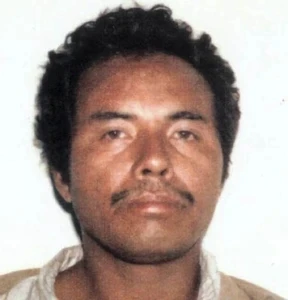
Mugshot of American serial killer Ángel Maturino Reséndiz
Wikimedia Commons· Public domain
Chapter Eleven, “OIG Recommendations,” lays out concrete steps: changes to the operation of IDENT, improvements in training and education, deeper integration with other criminal and INS databases, and other reforms designed to keep another high‑risk suspect from slipping through on a voluntary return.[1]
The report closes with a chapter of “OIG Conclusions” and a set of appendices — a glossary of terms and names, a history of IDENT, explanations of INS and criminal databases, detailed accounts of Resendez’s criminal history, and exhibits backing up the investigation.[1]
In its structure, the report mirrors the case itself: beginning with one name and one murder, then panning out to reveal a web of databases, policies, and people, some trying their best under unclear rules, others improvising where systems fell silent.
In the cold language of a special report, the murder of Dr. Benton appears as one chapter heading among many.[1] But that killing — and the fear that the suspect could cross borders with ease — is what forced a reckoning with how the United States handled fingerprints, lookouts, and intelligence.
Resendez’s life before the case, and the full scope of his crimes, are not the focus of the government’s document. What it does capture is something equally unsettling: how a man from Durango, Mexico, listed in Texas records as a 5‑foot‑6 laborer with brown eyes, could move through federal systems again and again with little friction.[2]
The Inspector General’s report doesn’t pretend that better databases or sharper training would erase the violence that had already occurred. But it makes one thing clear: information that could have helped protect potential victims existed in government hands — it was just never fully connected, or acted on, in time.[1]
In that sense, the story of Rafael Resendez‑Ramirez is not only about a suspect and a murder investigation. It’s about a border system that, for too long, treated fingerprint hits as paperwork rather than warnings — until one case forced it to reckon with the cost.
Adapted from Wikipedia: Ángel Maturino Reséndiz.
This case file is an original Bloody Likely narrative synthesis based on the cited sources. Article © Bloody Likely. All rights reserved. Source materials remain the property of their respective owners. Facts, public records, quotations, and cited references are used for reporting, research, commentary, and documentation. Bloody Likely content license
Audio narration © Bloody Likely. All rights reserved. The audio player is provided for personal streaming/listening only.
No recent news articles found for this case. Check back later for updates.
No evidence found for this case. Be the first to submit evidence in the comments below.
Join the discussion
Loading comments...
Reséndiz commits his first known murders in Texas, killing an unidentified woman and her boyfriend.
Reséndiz bludgeons 22-year-old Michael White to death in San Antonio.
Reséndiz murders Jesse Howell and Wendy Von Huben in Ocala, Florida.
Reséndiz kills Noemi Dominguez and Josephine Konvicka on the same day in Texas.
Reséndiz murders George Morber Sr. and his daughter Carolyn in Gorham, Illinois.
Reséndiz surrenders to Texas authorities on a bridge connecting El Paso and Ciudad Juárez.
Reséndiz is sentenced to death for the murder of Claudia Benton.
A judge rules that Reséndiz is mentally competent to be executed.
Reséndiz is executed by lethal injection in Texas.