ANALYZING EVIDENCE
Processing case files...
Processing case files...
Religious Group Murders
CLASSIFICATION: Serial Homicide
LOCATION
Opa-locka, Florida
TIME PERIOD
1986
VICTIMS
4 confirmed
Robert Earnest Rozier Jr., born July 28, 1955, is a former professional football player turned convicted murderer, who, in the 1980s, committed at least four murders in connection with the Nation of Yahweh religious group. The crimes occurred by Halloween 1986 in various locations in California. Rozier was charged and subsequently turned state's evidence against the group, leading to a 22-year prison sentence, of which he served ten years before being paroled and placed in witness protection. In 2001, he was re-incarcerated under California's three-strikes law after being convicted of check bouncing, and he is currently serving a 25-to-life sentence at Mule Creek State Prison. Significant evidence in the case included Rozier's confessions and corroborating testimonies from other members of the Nation of Yahweh.
Robert Rozier is believed to have committed murders on behalf of the Nation of Yahweh, a religious group he joined in the 1980s, leading to speculation about the group's influence and potential involvement in orchestrating violent acts. Some theories suggest that Rozier's actions were part of a larger agenda by the Nation of Yahweh, which was known for its controversial practices and beliefs. Additionally, there are discussions about Rozier's motivations, with some believing that he may have been manipulated or coerced into committing these crimes by the group's leadership.
Before dawn on a Thursday in late October 1986, city workers began moving families out of a low-slung, pastel-colored apartment complex in Opa-locka, Florida. [1] A few hours earlier, two tenants who had publicly criticized the new owners — a religious sect called the Yahwehs — had been gunned down in the street. [1]
Police quickly found a man hiding in the bushes near the scene. [1] They identified him as 33-year-old Yahweh member Robert Rosier, also known within the group as Neariah Israel. [1] Detectives said he wore a white turban when they pulled him from the undergrowth, matching the sect’s distinctive dress. [1] Within hours, he was charged with first-degree murder in one of the killings. [1]
The two dead men — Anthony Brown, 28, and Rudolph Broussard, 37 — had been among the most outspoken tenants resisting the Yahwehs’ sudden takeover of their homes. [1] Their deaths would explode a simmering property dispute into a full-blown emergency that emptied an entire block and focused attention on a secretive religious empire — and on the violent work of the man suspected of enforcing its will.
The Opa-locka complex sat on Northwest 131st Street at Northwest 32nd Avenue, five pastel buildings recently assessed at $710,000. [1] Days before the shootings, the Yahweh organization — operating under the corporate name Temple of Love Inc. — had assumed a $480,000 mortgage on the property. [1] Former owners said they could not keep up the place, and that the neighborhood’s drug activity made the apartments unprofitable. [1]
The new landlords arrived with a mission. Yahweh members said they intended to turn the complex into a “respectable place to live,” and that the way to do it was to force most of the existing tenants out. [1] The group had done this elsewhere: from its base at the Liberty City Temple of Love on Northwest 62nd Street, it claimed 12,000 followers around the world and held substantial property along Hallandale Boulevard near Carver Ranches in Broward County. [1]
The Yahwehs preached that Black people were the true Jews and that white people were “devils.” [1] Members faced east to pray, wore the Star of David, avoided pork, and adopted the shared surname “Israel.” [1] Outwardly, the leadership cast its real-estate moves as neighborhood uplift. Sect member Gideon Israel said they wanted to “clean up the area for those women and children so they will have a beautiful place to live.” [1]
2208 Brown - Best Dems (7771452176).jpg
Behind that rhetoric, investigators across multiple jurisdictions were already treating the group very differently. Authorities had probed a Delray Beach firebombing in May, allegedly connected to the sect. [1] Two years earlier, a member who reportedly tried to leave the group was found decapitated. [1] In Queens, New York, eleven Yahweh adherents had been charged in May with 171 counts tied to what prosecutors called systematic torture and terrorizing of three children in their care. [1] The article noted that Yahweh members in Israel had been accused of child abuse and had clashed with the Israeli government. [1]
Investigators said the organization demanded total commitment: members, they contended, were required to sign over all possessions and work without pay for Yahweh-owned businesses. [1] A Yahweh newspaper issue promised retribution against “white America,” vowing “an eye for eye, tooth for tooth, hand for hand, foot for foot, burning for burning, wound for wound.” [1]
That was the ideology and track record moving into a tight-knit, mostly low-income community in Opa-locka.
Once the Yahwehs took control of the complex, tension came fast. For two days, tenants described what one official would call a “standoff”: Yahweh members ordering families to move out, tenants refusing to go. [1]
Brown and Broussard emerged as voices of resistance. The men had criticized the sect on television or in newspapers, opposing the takeover of their homes. [1] In one TV segment, Brown declared he would not budge “until he received an eviction notice” and insisted the Yahwehs “ain’t going in.” [1]
Meanwhile, according to what Broussard told relatives and friends, Yahweh members had already gone in — straight into his apartment. He said they entered without his permission and removed his furnishings. [1] His sister, Celine Broussard, said the group took a freezer from his place. [1] Tenants later recalled that Brown and Broussard confronted sect members after seeing them carry out a refrigerator that belonged to Broussard. [1]
The public criticism, the accusations of trespassing, and the nightly presence of robed men patrolling the property pushed the complex to a breaking point.
In the early hours of that Thursday — about 1 a.m. — witnesses said two cars pulled up and roughly eight men climbed out near Brown and Broussard. [1] Shouting erupted. The argument escalated. Then came gunfire. [1]
Anthony Brown Stanford layup 2014.jpg
Broussard was hit in front of the complex. Witnesses later said he was shot four times in the head. [1] Brown was also shot, but managed to run; he made it about two blocks before he fell. [1] According to witnesses, when he tried to get up, he was shot again — once in the back and twice in the head. [1] They said Brown had pleaded with his assailant before the first shots were fired. [1]
Brown was rushed to Jackson Memorial Hospital in Miami, but died a few hours later. [1] Broussard died at the scene. [1]
By then, their earlier statements — the defiant television clip, the complaints about furniture being hauled away — were circulating in the same city that now had to process two execution-style killings tied to a controversial sect.
Police moved quickly at the complex. Shortly after the shootings, officers searching nearby found a man hiding in bushes close to the crime scene. [1] He wore the white turban associated with the Yahweh faithful. [1]
Officers identified him as Robert Rosier, 33, a Yahweh member who also used the name Neariah Israel. [1] He was taken into custody and charged with first-degree murder in one of the slayings, though authorities did not say which victim they believed he had killed. [1]
Rosier’s arrest fit the sect’s internal pattern: members adopted the surname Israel, and the flowing white robes and turbans had become a visual shorthand for the group around Miami. [1] Yet there was also confusion, then and later, about who exactly this man was. Newspapers gave his last name as “Rosier,” while later accounts of the same figure — linking him to the Yahweh leadership and to a brief NFL career — spelled it “Rozier” and referred to him by his Yahweh name, Neariah Israel. [1][2]
The legal record from that night, however, is stark but limited: Rosier was arrested near the scene, wearing Yahweh garb, and charged in connection with one of the two murders that had just unfolded outside the complex. [1]
The killings forced Opa-locka officials into crisis mode. As dawn broke, city workers began evacuating residents from the five buildings. [1] Mayor John Riley said flatly, “We had to cool the situation down.” [1]
Brown for Gov PGComColl 346 - 8728080852.jpg
Riley later detailed just how present the sect had been on the property. He said 22 Yahweh members had been patrolling the complex with six-foot-long wooden staffs and walkie-talkies. [1] After the slayings, those patrols were ordered to leave. [1]
The municipal response went beyond simply clearing out the robed guards. At a special meeting that Thursday, the Opa-locka City Commission condemned the buildings themselves. [1] Residents, commissioners decided, would not be allowed back until the structures were renovated and new certificates of occupancy issued. [1]
That move triggered an emergency safety net. The condemnation allowed the American Red Cross and county housing authorities to start finding new accommodations for about 80 tenants pushed into shelters. [1] Those families, the reporting noted, were primarily low-income, many of them single-parent households with numerous children. [1]
The courts weighed in as well. A Dade circuit judge issued an injunction barring the Yahwehs from returning to the entire block-long site at Northwest 131st Street and Northwest 32nd Avenue until a tenants’ lawsuit could be heard. [1]
Suddenly, what had been marketed as a religiously driven neighborhood cleanup had cleared out almost everyone but the police, the courts, and aid workers.
To the families at the Opa-locka complex, the Yahwehs appeared overnight as strict, robed landlords with apocalyptic rhetoric. But by 1986, the network behind them was far larger.
Retrospective accounts identify the movement’s leader as Hulon Mitchell Jr., head of the Yahweh ben Yahweh cult. [2] Under his direction, the group expanded from the Liberty City Temple of Love into a web of properties and businesses. [1]
Later court documents and summaries would paint a darker picture of the sect’s inner structure. According to those materials, Mitchell formed a clandestine cadre called “The Brotherhood,” an elite group within Yahweh ben Yahweh. [2] To gain entry into this circle, applicants were said to be required to kill a “white devil” and bring Mitchell a body part — an ear, a nose, or a finger — as proof. [2]
Between April and October 1986, court papers alleged that another faction, dubbed Mitchell’s “Death Angels,” repeatedly descended on Miami to kill random white people. [2] These alleged operations were presented as part of a campaign aligned with the movement’s teaching that whites were devils and that vengeance was coming. [1][2]
Within this structure, one man stood out in later accounts as the chief enforcer: Robert (or Bob) Rozier, the same figure arrested in Opa-locka under the Yahweh name Neariah Israel. [1][2]
Long before he appeared in a white turban in an Opa-locka bush, Rozier had moved in very different uniforms.
Kyle Anderson vs Anthony Brown.JPG
Professional football records list a Bob Rozier as a defensive player moving through the NFL at the end of the 1970s. The Pro Football Archives show that on May 4, 1979, Bob Rozier was drafted by the St. Louis Cardinals. [3] He was signed by the team that July, released in September, re-signed in October, placed on injured reserve on October 31, and released again in November. [3] In 1981, he had a brief stint with the Oakland Raiders, who signed and later released him that same year. [3]
Retrospective reporting ties that player to the Yahweh enforcer, describing Rozier as a former professional football player who had once worn the uniforms of the Cardinals and the Raiders. [2] He was about six-foot-four and muscular. [2]
By the time he encountered Yahweh ben Yahweh around 1982, those professional opportunities were gone. Later accounts say Rozier was one step from homelessness when he “found Yahweh,” wanted by police across the United States and in Canada for a string of petty crimes ranging from writing bad checks to forgery. [2] After serving a six-month prison stint, he moved into the Temple of Love. [2]
© Mapbox © OpenStreetMap
Inside, he embraced the group’s identity. Rozier is described as having changed his name to Neariah Israel — a name later said to mean “child of god” — and taken on work in the sect’s businesses, including what sources call the Yahweh “booze factory.” [2] His diligence there reportedly earned him “brownie points” with temple elders. [2]
From there, according to retrospective narratives and court-based summaries, he moved into a different kind of work for the organization.
Later court papers and retrospective accounts place Rozier squarely in the orbit of the Brotherhood and the so-called Death Angels during 1986. [2]
One account describes a pivotal night in April of that year. On a Saturday, Rozier allegedly set out intending to “try out” for the Brotherhood. [2] He was said to be carrying a 12-inch Japanese-style knife inside his jacket when he left. [2]
He went to Coconut Grove, a Miami neighborhood, and, according to this account, prowled the area looking for someone who appeared weak or small enough to overpower. [2] The narrative continues: Rozier followed a white man to his apartment, forced his way inside, and stabbed the man in the heart. [2]
These allegations, presented in later legal descriptions and summaries, were tied to the broader claim that, between April and October 1986, Mitchell’s Death Angels roamed Miami targeting white victims. [2] Within that structure, Rozier was repeatedly characterized as Mitchell’s chief enforcer. [2]
Those accusations reach beyond the specific Opa-locka case — and the legal record assembled here does not spell out how, or whether, they factored formally into the charges laid in the wake of Brown and Broussard’s murders. What the retrospective sources do make clear is that by late 1986, Rozier’s life was no longer that of a fringe ex-athlete eking out a living. He was allegedly doing violent work for a leader who preached retribution and absolute loyalty. [1][2]
At some point after the Opa-locka shootings and the period of alleged Death Angels activity, those loyalties shifted. One web-archived account states that Rozier later became the prosecution’s star witness in related legal actions against Yahweh leadership and members. [2] That evolution — from enforcer to key witness — would make him central to efforts to dismantle parts of the empire he had once helped protect.
In Opa-locka, the impact of that October night was immediate and visible: a block-long complex emptied, 80 low-income families forced into emergency shelters, and an entire religious organization barred from returning while the courts sorted out a tenants’ lawsuit. [1] Mayor Riley’s assessment — “We had to cool the situation down” — captured how explosive the mix of religion, real estate, and violence had become. [1]
Some parts of the story are clear in the record. Brown and Broussard confronted Yahweh members over property taken from an apartment, spoke out against the sect’s takeover in the press, and were later shot to death outside the very buildings the group had just bought. [1] A Yahweh member, Robert Rosier — Neariah Israel — was caught nearby in a white turban and charged with first-degree murder in one of the killings. [1] Officials never publicly specified which man he was accused of killing, and the available record here does not detail the ultimate outcome of that charge. [1]
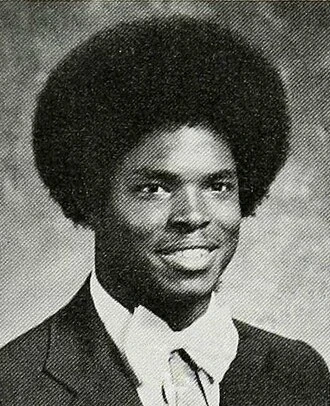
Page 101 from the Cordova High School 1974 yearbook, Lancer Legends, doctored to remove writing from photo
Wikimedia Commons· Public domain
Other threads are more tangled. The man in the Opa-locka bushes appears in different sources under different spellings, as Rosier and Rozier, linked both to a fleeting NFL career and to the inner circle of a violent cult. [1][2][3] Later accounts cast him as Mitchell’s chief enforcer, possibly tied to a string of racially motivated killings, before he resurfaced as a star witness for the prosecution. [2]
What is not in doubt is that on that night in Opa-locka, the conflict between a secretive religious movement and two tenants who dared to challenge it ended in gunfire. The bullets that killed Anthony Brown and Rudolph Broussard did more than silence two critics. They exposed, in one small corner of Miami, the human cost when charismatic authority, apocalyptic belief, and power over housing converge — and when the man hiding in the bushes is not just a believer, but an enforcer.
Adapted from Wikipedia: Robert Rozier.
This case file is an original Bloody Likely narrative synthesis based on the cited sources. Article © Bloody Likely. All rights reserved. Source materials remain the property of their respective owners. Facts, public records, quotations, and cited references are used for reporting, research, commentary, and documentation. Bloody Likely content license
Audio narration © Bloody Likely. All rights reserved. The audio player is provided for personal streaming/listening only.
No recent news articles found for this case. Check back later for updates.
No evidence found for this case. Be the first to submit evidence in the comments below.
Join the discussion
Loading comments...
Robert Rozier kills a drunk man and his roommate in Miami as part of his initiation into the Nation of Yahweh.
Rozier and another member kill 61-year-old Raymond Kelly, cutting off his ear as a trophy.
Rozier is charged with the first-degree murder of Anthony Brown and Rudolph Broussard during a shooting.
Rozier cooperates with police, confessing to four murders and implicating the Nation of Yahweh in a larger conspiracy.
A 14-murder conspiracy indictment against 16 members of the Nation of Yahweh is built, relying heavily on Rozier's testimony.
After serving ten years, Rozier is paroled under a new identity as part of the witness protection program.
Rozier is arrested for bouncing checks, leading to felony charges under California's three-strikes law.
Rozier is sentenced to 25 years-to-life for bouncing checks, marking his third strike.
Rozier is denied parole after serving time for his third strike, with eligibility for another hearing set for 2028.