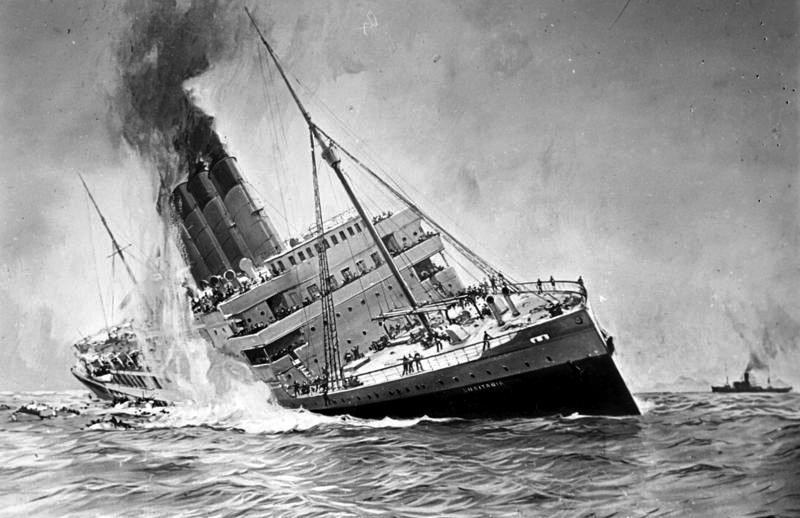
Sinking Of The RMS Lusitania
Maritime Disaster During WWI
CLASSIFICATION: Mass Murder
LOCATION
Celtic Sea, near Old Head of Kinsale, Ireland
TIME PERIOD
May 7, 1915
VICTIMS
1197 confirmed
On 7 May 1915, the RMS Lusitania, a British ocean liner, was torpedoed by the German U-boat U-20 approximately 11 nautical miles off the Old Head of Kinsale, Ireland, during World War I. The attack occurred in a declared maritime war-zone, resulting in the deaths of 1,197 of the 1,960 individuals aboard, including 128 American citizens. The sinking, which took place between 14:10 and 14:28, significantly swayed international opinion against Germany and temporarily halted unrestricted submarine warfare. The incident ultimately contributed to the United States' entry into the war in April 1917. Investigations were conducted by both British and American authorities, focusing on the circumstances surrounding the attack and the ship's cargo, which included munitions.
Some believe that the sinking of the Lusitania was a deliberate act by the British government to provoke the United States into joining World War I, as the ship was carrying munitions. Others speculate that the ship was not properly equipped for the dangers of wartime travel, contributing to the high casualty rate. Additionally, there are theories suggesting that the Lusitania was sailing into a known war zone despite warnings, raising questions about the decisions made by its captain and crew.
The Sinking of the RMS Lusitania: A Tragic Tale of War
A Catastrophe at Sea
On the afternoon of May 7, 1915, the tranquil waters of the Celtic Sea near Old Head of Kinsale, Ireland, were shattered by a devastating maritime disaster that would echo through the annals of history. The British ocean liner, RMS Lusitania, was making her way through these waters when she was suddenly and violently torpedoed by a German U-boat, U-20, commanded by Kapitänleutnant Walther Schwieger. This attack, executed without warning from a submerged position a mere 700 meters away, occurred within the declared maritime war zone around the United Kingdom—a zone Germany had warned ships to avoid since announcing unrestricted submarine warfare as a retaliation against the Allied naval blockade.
A Swift and Deadly Descent
The Lusitania, a proud vessel of British engineering, was reduced to a sinking wreck in just 18 short minutes after the torpedo's impact. The initial explosion was followed by a second, internal explosion, hastening her demise. Of the 1,960 passengers, crew, and stowaways on board, a staggering 1,197 souls were lost, including 128 Americans. The tragedy claimed 61% of those aboard, leaving a meager 763 survivors. This act of aggression turned international opinion against Germany and temporarily halted their unrestricted submarine warfare. The image of the immense ship sinking into the depths stirred powerful emotions and shifted public opinion, contributing significantly to the United States' decision to enter World War I nearly two years later, on April 6, 1917.
Investigations and Obfuscations
In the aftermath, investigations were launched in both the United Kingdom and the United States to uncover the precise causes of the Lusitania's loss. However, these inquiries were hampered by the exigencies of wartime secrecy and a concerted propaganda effort to cast all blame on Germany. At the time of her sinking, the Lusitania was carrying not just passengers, but also a substantial cargo of war materials: approximately 173 tons, including 4.2 million rounds of rifle ammunition, nearly 5,000 artillery shell casings filled with shrapnel, and 3,240 brass percussion fuses.
The legitimacy of the Lusitania's sinking sparked intense debate throughout the war and beyond. Some controversial theories even suggested that the British government, with Winston Churchill's involvement, deliberately placed the Lusitania in harm's way to provoke a German attack and thereby draw the United States into the conflict. Mainstream historians, however, largely dismiss these theories as speculative and lacking credible evidence, instead attributing the disaster to a combination of British errors and unfortunate circumstances.
The Lusitania's Origins and Wartime Service
Built with the assistance of British government subsidies, the Lusitania was designed to be convertible into an armed merchant cruiser if necessary. Her plans included provisions for mounting 12 six-inch guns, and she was classified as a "Royal Naval Reserve Merchant Vessel." However, when war broke out, the Admiralty decided against requisitioning her as an armed cruiser, given the immense coal consumption such liners required—910 tons per day. Instead, smaller and less conspicuous vessels were preferred for such roles.
Despite the initial wartime fears for her safety, the Lusitania continued her transatlantic voyages. During her first wartime eastbound crossing, she was repainted in a drab gray to evade detection. When it became clear that the Royal Navy effectively neutralized the German naval threat, the Atlantic seemed safe for large passenger liners once more, prompting the Lusitania to revert to her civilian colors.
The Prelude to Disaster
By early 1915, German U-boats had begun targeting British shipping more aggressively. Initially adhering to the traditional cruiser rules, they gradually shifted toward a more ruthless approach. A declaration on February 4, 1915, effectively made the waters around the British Isles a war zone, with Allied ships liable to be sunk without warning from February 18 onward. Although efforts were made to spare neutral ships, the German Imperial Admiralty secretly instructed U-boat captains to prioritize passenger vessels, hoping to deter other shipping.
Amidst these escalating tensions, Captain Daniel Dow of the Lusitania faced pressure from American passengers, who urged him to fly the U.S. flag to avoid attack. The controversy that ensued highlighted the international implications of the submarine campaign. Despite precautions and warnings issued by the British Admiralty to safeguard the Lusitania, such as escort orders and the use of Q-ships as decoys, the liner sailed into perilous waters unescorted.
A Gathering Storm
In the weeks leading up to the Lusitania's final voyage, the tension mounted. On March 28, the sinking of the British passenger ship Falaba by a German submarine resulted in the first American casualty of the war. Subsequent attacks on American vessels, including the Gulflight and Cushing, further strained diplomatic relations. The U.S. government warned Germany of "strict accountability" for any American deaths resulting from the campaign.
During this time, Captain Dow, reportedly stressed by the pressures of operating in a war zone, was replaced by Captain William Thomas Turner. A seasoned commander, Turner took the helm as the Lusitania embarked on her 201st transatlantic journey, leaving Liverpool on April 17 and arriving in New York on April 24.
A Fateful Voyage
As the Lusitania prepared to depart New York on April 30, a warning from the Imperial German Embassy appeared in American newspapers, cautioning travelers about the dangers of sailing on British ships in the war zone. The timing of this notice, appearing alongside advertisements for the Lusitania's voyage, caused unease among passengers and crew. Yet, the Lusitania set sail on May 1, 1915, unfazed by the ominous warnings.
What followed was a tragic sequence of events that left an indelible mark on history. As the Lusitania neared the British Isles, her fate was sealed by the torpedo that struck her hull, sending her to the ocean floor and changing the course of World War I.
Sources
For a comprehensive exploration of the RMS Lusitania's sinking, visit the original Wikipedia article: Sinking of the RMS Lusitania.
No Recent News
No recent news articles found for this case. Check back later for updates.
No Evidence Submitted
No evidence found for this case. Be the first to submit evidence in the comments below.
Join the discussion
Loading comments...
Sinking of RMS Lusitania
The RMS Lusitania is torpedoed by German U-boat U-20, sinking in 18 minutes and resulting in 1,197 deaths.
Inquest Opens
The local coroner opens an inquest into the deaths of victims from the Lusitania sinking, attributing blame to the attack on a non-combatant vessel.
Wreck Commissioner's Inquiry
The formal inquiry into the sinking begins, focusing on the actions of Captain Turner and the circumstances surrounding the attack.
US Court Ruling
The US District Court rules that the sinking was caused by the illegal act of the German government, absolving Captain Turner of negligence.
US Public Outrage
The sinking leads to massive outrage in the United States, with calls for accountability from Germany for the loss of American lives.
German Justification
The German government issues a statement justifying the sinking, claiming the Lusitania was carrying contraband and was armed.
British Government Response
The British government responds to German claims, asserting that Lusitania was a civilian ship and not armed, emphasizing the illegality of the attack.
US Enters WWI
The United States declares war on Germany, influenced by the Lusitania sinking and ongoing submarine warfare.
Survivor Accounts
Survivor testimonies begin to emerge, detailing the chaos during the sinking and the actions of the crew.
On 7 May 1915, the RMS Lusitania, a British ocean liner, was torpedoed by the German U-boat U-20 approximately 11 nautical miles off the Old Head of Kinsale, Ireland, during World War I. The attack occurred in a declared maritime war-zone, resulting in the deaths of 1,197 of the 1,960 individuals aboard, including 128 American citizens. The sinking, which took place between 14:10 and 14:28, significantly swayed international opinion against Germany and temporarily halted unrestricted submarine warfare. The incident ultimately contributed to the United States' entry into the war in April 1917. Investigations were conducted by both British and American authorities, focusing on the circumstances surrounding the attack and the ship's cargo, which included munitions.
Some believe that the sinking of the Lusitania was a deliberate act by the British government to provoke the United States into joining World War I, as the ship was carrying munitions. Others speculate that the ship was not properly equipped for the dangers of wartime travel, contributing to the high casualty rate. Additionally, there are theories suggesting that the Lusitania was sailing into a known war zone despite warnings, raising questions about the decisions made by its captain and crew.
The Sinking of the RMS Lusitania: A Tragic Tale of War
A Catastrophe at Sea
On the afternoon of May 7, 1915, the tranquil waters of the Celtic Sea near Old Head of Kinsale, Ireland, were shattered by a devastating maritime disaster that would echo through the annals of history. The British ocean liner, RMS Lusitania, was making her way through these waters when she was suddenly and violently torpedoed by a German U-boat, U-20, commanded by Kapitänleutnant Walther Schwieger. This attack, executed without warning from a submerged position a mere 700 meters away, occurred within the declared maritime war zone around the United Kingdom—a zone Germany had warned ships to avoid since announcing unrestricted submarine warfare as a retaliation against the Allied naval blockade.
A Swift and Deadly Descent
The Lusitania, a proud vessel of British engineering, was reduced to a sinking wreck in just 18 short minutes after the torpedo's impact. The initial explosion was followed by a second, internal explosion, hastening her demise. Of the 1,960 passengers, crew, and stowaways on board, a staggering 1,197 souls were lost, including 128 Americans. The tragedy claimed 61% of those aboard, leaving a meager 763 survivors. This act of aggression turned international opinion against Germany and temporarily halted their unrestricted submarine warfare. The image of the immense ship sinking into the depths stirred powerful emotions and shifted public opinion, contributing significantly to the United States' decision to enter World War I nearly two years later, on April 6, 1917.
Investigations and Obfuscations
In the aftermath, investigations were launched in both the United Kingdom and the United States to uncover the precise causes of the Lusitania's loss. However, these inquiries were hampered by the exigencies of wartime secrecy and a concerted propaganda effort to cast all blame on Germany. At the time of her sinking, the Lusitania was carrying not just passengers, but also a substantial cargo of war materials: approximately 173 tons, including 4.2 million rounds of rifle ammunition, nearly 5,000 artillery shell casings filled with shrapnel, and 3,240 brass percussion fuses.
The legitimacy of the Lusitania's sinking sparked intense debate throughout the war and beyond. Some controversial theories even suggested that the British government, with Winston Churchill's involvement, deliberately placed the Lusitania in harm's way to provoke a German attack and thereby draw the United States into the conflict. Mainstream historians, however, largely dismiss these theories as speculative and lacking credible evidence, instead attributing the disaster to a combination of British errors and unfortunate circumstances.
The Lusitania's Origins and Wartime Service
Built with the assistance of British government subsidies, the Lusitania was designed to be convertible into an armed merchant cruiser if necessary. Her plans included provisions for mounting 12 six-inch guns, and she was classified as a "Royal Naval Reserve Merchant Vessel." However, when war broke out, the Admiralty decided against requisitioning her as an armed cruiser, given the immense coal consumption such liners required—910 tons per day. Instead, smaller and less conspicuous vessels were preferred for such roles.
Despite the initial wartime fears for her safety, the Lusitania continued her transatlantic voyages. During her first wartime eastbound crossing, she was repainted in a drab gray to evade detection. When it became clear that the Royal Navy effectively neutralized the German naval threat, the Atlantic seemed safe for large passenger liners once more, prompting the Lusitania to revert to her civilian colors.
The Prelude to Disaster
By early 1915, German U-boats had begun targeting British shipping more aggressively. Initially adhering to the traditional cruiser rules, they gradually shifted toward a more ruthless approach. A declaration on February 4, 1915, effectively made the waters around the British Isles a war zone, with Allied ships liable to be sunk without warning from February 18 onward. Although efforts were made to spare neutral ships, the German Imperial Admiralty secretly instructed U-boat captains to prioritize passenger vessels, hoping to deter other shipping.
Amidst these escalating tensions, Captain Daniel Dow of the Lusitania faced pressure from American passengers, who urged him to fly the U.S. flag to avoid attack. The controversy that ensued highlighted the international implications of the submarine campaign. Despite precautions and warnings issued by the British Admiralty to safeguard the Lusitania, such as escort orders and the use of Q-ships as decoys, the liner sailed into perilous waters unescorted.
A Gathering Storm
In the weeks leading up to the Lusitania's final voyage, the tension mounted. On March 28, the sinking of the British passenger ship Falaba by a German submarine resulted in the first American casualty of the war. Subsequent attacks on American vessels, including the Gulflight and Cushing, further strained diplomatic relations. The U.S. government warned Germany of "strict accountability" for any American deaths resulting from the campaign.
During this time, Captain Dow, reportedly stressed by the pressures of operating in a war zone, was replaced by Captain William Thomas Turner. A seasoned commander, Turner took the helm as the Lusitania embarked on her 201st transatlantic journey, leaving Liverpool on April 17 and arriving in New York on April 24.
A Fateful Voyage
As the Lusitania prepared to depart New York on April 30, a warning from the Imperial German Embassy appeared in American newspapers, cautioning travelers about the dangers of sailing on British ships in the war zone. The timing of this notice, appearing alongside advertisements for the Lusitania's voyage, caused unease among passengers and crew. Yet, the Lusitania set sail on May 1, 1915, unfazed by the ominous warnings.
What followed was a tragic sequence of events that left an indelible mark on history. As the Lusitania neared the British Isles, her fate was sealed by the torpedo that struck her hull, sending her to the ocean floor and changing the course of World War I.
Sources
For a comprehensive exploration of the RMS Lusitania's sinking, visit the original Wikipedia article: Sinking of the RMS Lusitania.
No Recent News
No recent news articles found for this case. Check back later for updates.
No Evidence Submitted
No evidence found for this case. Be the first to submit evidence in the comments below.
Join the discussion
Loading comments...
Sinking of RMS Lusitania
The RMS Lusitania is torpedoed by German U-boat U-20, sinking in 18 minutes and resulting in 1,197 deaths.
Inquest Opens
The local coroner opens an inquest into the deaths of victims from the Lusitania sinking, attributing blame to the attack on a non-combatant vessel.
Wreck Commissioner's Inquiry
The formal inquiry into the sinking begins, focusing on the actions of Captain Turner and the circumstances surrounding the attack.
US Court Ruling
The US District Court rules that the sinking was caused by the illegal act of the German government, absolving Captain Turner of negligence.
US Public Outrage
The sinking leads to massive outrage in the United States, with calls for accountability from Germany for the loss of American lives.
German Justification
The German government issues a statement justifying the sinking, claiming the Lusitania was carrying contraband and was armed.
British Government Response
The British government responds to German claims, asserting that Lusitania was a civilian ship and not armed, emphasizing the illegality of the attack.
US Enters WWI
The United States declares war on Germany, influenced by the Lusitania sinking and ongoing submarine warfare.
Survivor Accounts
Survivor testimonies begin to emerge, detailing the chaos during the sinking and the actions of the crew.