ANALYZING EVIDENCE
Processing case files...
Processing case files...
Unsolved Missing Persons Case
CLASSIFICATION: Missing Person
LOCATION
Springfield, Missouri
TIME PERIOD
June 7, 1992
VICTIMS
3 confirmed
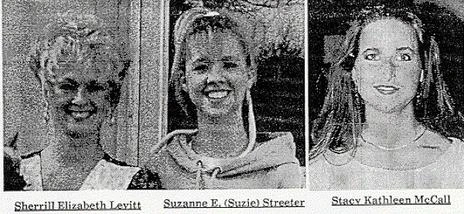
On June 7, 1992, Sherrill Levitt, her daughter Suzanne "Suzie" Streeter, and friend Stacy McCall disappeared from Levitt's home in Springfield, Missouri, leaving behind all personal belongings and showing no signs of struggle. Despite extensive investigations and a claim from a convicted felon suggesting knowledge of their fate, the case remains unsolved, with no trace of the women ever found. The Springfield Three case continues to be an active investigation by law enforcement.
Theories surrounding the Springfield Three disappearance include speculation about the involvement of Robert Craig Cox, a convicted kidnapper who claimed to know the fate of the women, suggesting they were murdered and their bodies would never be found. However, law enforcement does not consider Cox's statements credible. Additionally, the mysterious erased message on the answering machine has led to further speculation regarding possible clues related to their disappearance.
On a June morning in 1992, a single-story house at 1717 East Delmar in central Springfield, Missouri, stood quiet with three cars in the drive, a dog inside, and purses lined up as if their owners had just stepped out for a moment. Instead, Sherrill Levitt, her daughter Suzanne “Suzie” Streeter, and Suzie’s friend Stacy McCall had vanished. [1][2]
The weekend had started as a celebration.
On June 6, 1992—the day before they disappeared—Suzanne “Suzie” Streeter and her close friend Stacy McCall graduated from Kickapoo High School in Springfield. [1][2] Suzie was 19, a petite young woman, 5-foot-2 and about 102 pounds, with brown eyes and straight, bleached-blonde hair that fell to her shoulders. [1][2] She had a distinctive look: large teeth without any dental work, a 3½‑inch scar along the top of her right forearm, and a small tumor at the left corner of her mouth that made it seem as if she was holding something there. [1]
Stacy, 18, was a little taller at 5-foot-3 and about 120 pounds, with blue eyes and dark blonde hair that reached the middle of her back, its ends lightened by the sun. [1][2] She had freckles across her face and a dimple in the middle of her chin. [1] The two were friends, planning the kind of modest adventures that follow graduation—according to later accounts, they intended to go to an amusement park the next day. [2]
Both were working part-time jobs as they stepped into adulthood: Suzie at a movie theater, Stacy at a health club. [2] Their lives, and their plans, were rooted in a city where their families expected them home.
At the center of that home life was Suzie’s mother, 47‑year‑old Sherrill Levitt. [1] Sherrill was 5 feet tall, about 110 pounds, with brown eyes and short, naturally curly, bleached‑blonde hair that was longer on top and closely cut in the back. [1] She had a thin build and freckles scattered across her neck and upper chest. [1] Her house at 1717 East Delmar was the anchor point—for Suzie, for Suzie’s friends, and, that night, for Stacy. [1]
The final confirmed contact with Sherrill came late in the evening. Around 11:15 p.m. on June 6, 1992, she spoke with a friend on the phone about something as mundane as painting a chest of drawers. [1] Nothing in that conversation suggested trouble was brewing.
A few hours later, in the early minutes of June 7, Suzie and Stacy were at a graduation party in a nearby community. [1][2] At approximately 2:15 a.m., they were last seen leaving the party. [1][2] They were headed to the Levitt–Streeter home on East Delmar. [1][2]
From that point, there is no confirmed public record of anyone outside the home seeing any of the three women alive again. [2]
Police would later say it appeared the two teenagers made it back to the house. Their clothing, jewelry, purses, and vehicles were all still there. [1] Their possessions, like Sherrill’s, looked as though they had been abandoned in mid‑routine. [1][2]
By the morning of June 7, plans had started to go off‑script. When Stacy did not return home or check in, her parents grew worried. They contacted the Springfield Police Department and reported their daughter missing from the Levitt–Streeter house. [1]
© Mapbox © OpenStreetMap
Officers were notified of the disappearance of three women—Sherrill, Suzie, and Stacy—from the residence in central Springfield. [1] The home at 1717 East Delmar was quickly identified as the last known location for all three. [1]
What exactly the first people at the scene found inside the house depends on who is describing it.
The official description from the Springfield Police Department notes that when officers arrived, the house bore no signs of a struggle and “gave the appearance that the missing women had been abducted.” [1] The family dog was inside. Personal property—including purses, money, clothing, cars, keys, and cigarettes—was left behind. [1] Sherrill’s car sat outside, and her purse and keys were still in the residence. [1] Her bed appeared to have been slept in. [1] Nothing was obviously missing. [2]
Relatives later described a different first impression. According to subsequent reporting, family members who went to the house after the women vanished found it in disarray. [2] Not initially imagining an abduction, they did what many people might do in a loved one’s messy home: they straightened up, cleaning the house before the situation was understood as a possible crime. [2]
Those diverging accounts—no sign of a struggle in the official record, a disordered scene in relatives’ memories—have lingered over the case. [1][2] What they agree on is more haunting: three women were gone, and nearly everything they owned was not.
The disappearance of three women from a single home mobilized law enforcement.
The Springfield Police Department opened a major investigation and quickly drew assistance from the Federal Bureau of Investigation, the Missouri State Highway Patrol, and numerous other agencies. [1] Detectives dug into the women’s lives and connections, but the extensive work produced no positive leads pointing to a motive or their location. [1]
Over time, the scale of the case became its own grim statistic. Police spokeswoman Lisa Cox has said the file has generated roughly 5,000 tips. [2] Investigators compiled more than 27,000 documents as they chased down leads. [2] The department has emphasized that the case has never been suspended; at least one detective has always been assigned to follow up on incoming information. [2]
Even decades later, the flow of information has not stopped. In recent years, Cox said, the department continues to receive about 100 tips a year regarding the three missing women. [2]
First Assistant Greene County Prosecutor Darrell Moore was part of the office when the women disappeared. [2] He would go on to serve as Greene County prosecuting attorney for 12 years before retiring, and he has spoken publicly about some of the investigation’s more memorable leads. [2] Even decades on, he has said he still prays for justice for Levitt, Streeter, and McCall. [2]
Moore recalled two occasions where tips were strong enough to convince a judge to issue search warrants for possible burial sites. [2]
One warrant led investigators to Webster County, where they searched a cave or some type of natural depression for the women’s remains. [2] Another took them to an abandoned farmhouse in Barry County. [2] That Barry County tip came with a vivid story: a green van was allegedly involved, and both the van and the women’s bodies had supposedly been buried on the property. [2]
Investigators took it seriously enough to physically tear up flooring and dig both inside and outside the farmhouse. [2] They found nothing. [2]
The green van itself has remained a kind of ghost. Moore has been clear that its role is not an established fact. [2] Yet he has also said that there were people who insisted a green van was central to the case, and that investigators could not totally discard the possibility. [2] The alleged vehicle sits on the edge of the narrative: never confirmed, never entirely dismissed. [2]
Despite the manpower, the searches in Webster and Barry counties yielded no bodies, no vehicle, and no resolution. [2]
As the years stretched on, the investigation drew not only traditional witnesses and informants but also people with dreams, visions, and psychic claims.
The case has attracted so many such calls that Lisa Cox specifically noted them: some of the hundreds of annual tips come from people who say they are psychic. [2]
Moore remembered a particularly striking example. One tip claimed the women’s bodies were buried in the foundational concrete of a Cox Hospital parking garage at South National Avenue and Primrose Street. [2] That tip, he said, came from someone who described a dream, vision, or psychic impression. [2] Acting on it, he believed, would have pushed the system past the breaking point: if investigators had tried to seek a search warrant based solely on that psychic‑type tip, he said, they would have been “laughed out of court.” [2]
Another call, Moore said, came from a psychic who claimed the bodies were wrapped in a blanket and buried near water. [2] Across his recollections, he described people having dreams and visions about the case as a drain on limited police resources. [2]
Those accounts reveal something about the atmosphere around the Springfield Three. The disappearance was so unsettling—and so stubbornly unresolved—that it invited theories untethered from verifiable evidence. Investigators, constrained by law and practicality, had to draw the line at where those theories could take them.
Even as the active leads thinned, authorities tried to re‑interrogate the case with fresh eyes.
From 2010 to 2012, Springfield investigators undertook a formal review of the disappearance. [2] In 2012, they carried their findings to a panel of 25 criminal‑justice investigators assembled by the National Center for Missing and Exploited Children. [2] The outside experts examined the case and made recommendations.
Lisa Cox later said that several of those recommendations were adopted into the ongoing investigation. [2] The department has chosen not to make those suggestions public. [2]
The secrecy underscores how, even decades on, investigators continue to treat certain aspects of their strategy as sensitive. The public story of the Springfield Three is detailed in some ways—down to hair color and scars—yet the inner workings of the case file remain largely sealed.
For the families, the investigation has not been an abstract set of numbers or policy decisions.
Stacy’s mother, Janis McCall, has remained in Springfield. [2] In the years after her daughter and the other two women vanished, she transformed her loss into advocacy, founding a nonprofit website called One Missing Link to assist other families of missing persons. [2] The way Janis responded became part of the local memory of the case: not only three women missing, but a mother refusing to let their names slip from public view.
Darrell Moore, long after leaving the prosecutor’s office, spoke candidly about the hardest question of all—whether the women might still be alive. He said it is possible they are not, but investigators simply do not know. [2]
That uncertainty has defined the emotional landscape. There were no bodies to bury, no official cause of death, no trial to sit through. There was only the ache of absence and the murky hope that, against all odds, an answer might still appear.
From early on, authorities and community members offered money in the hope that someone, somewhere, might know enough—or be willing enough—to come forward.
An official notice from the Springfield Police Department lists a reward fund of $43,000 for information leading to the location and prosecution of those responsible for the abduction of the three women. [1] Later reporting has described a $42,000 reward still in place for information that leads to a prosecution. [2] Despite those slight discrepancies, the message has remained consistent: substantial money is available for a tip that breaks the case open.
Anyone with information about the disappearances of Sherrill Levitt, Suzie Streeter, and Stacy McCall is urged to contact the Springfield Police Department or Crime Stoppers. [1] The request has been repeated for years, across anniversaries and news cycles, never fully fading.
The known facts of the Springfield Three can be summed up starkly.
Sherrill Levitt, born November 1, 1944, was last known to be at her home on the night of June 6, 1992, speaking with a friend around 11:15 p.m. about painting furniture. [1] Suzie Streeter, born March 9, 1973, and Stacy McCall, born April 23, 1974, graduated from high school that same day, June 6, and spent the night moving between celebrations. [1][2] At about 2:15 a.m. on June 7, the two young women left a graduation party, reportedly headed to the home at 1717 East Delmar where Suzie lived with her mother. [1][2]
Their clothes, jewelry, purses, cigarettes, and vehicles were later found at that house, along with Sherrill’s car, purse, and keys. [1] Her bed appeared used, but there were no clear signs of a struggle in the official police account, even as relatives recalled the house in disarray. [1][2] Nothing obvious had been taken, and nothing that mattered most—the three women themselves—could be found. [1][2]
Police, assisted by state and federal agencies, have treated the case as an abduction and have conducted an extensive investigation into the women’s lives, whereabouts, and possible enemies. [1][2] They have dug in caves and farmhouses, sifted tips about green vans and concrete foundations, fielded thousands of calls and compiled tens of thousands of documents. [2] They have never been able to say why the three disappeared—or where they ended up. [1][2]
In that silence, the house at 1717 East Delmar has become a symbol: a place where three lives simply stopped, leaving behind only the ordinary debris of daily living and a mystery that has endured for more than three decades. [1]
The essentials remain chillingly simple. Three women walked into the night of June 7, 1992. None of them came back. [2]
Adapted from Springfield Three - Wikipedia.
This case file is an original Bloody Likely narrative synthesis based on the cited sources. Article © Bloody Likely. All rights reserved. Source materials remain the property of their respective owners. Facts, public records, quotations, and cited references are used for reporting, research, commentary, and documentation. Bloody Likely content license
Audio narration © Bloody Likely. All rights reserved. The audio player is provided for personal streaming/listening only.
No recent news articles found for this case. Check back later for updates.
No evidence found for this case. Be the first to submit evidence in the comments below.
Join the discussion
Loading comments...
Sherrill Levitt, Suzanne Streeter, and Stacy McCall go missing from Levitt's home in Springfield, Missouri.
Janis McCall reports her daughter and friends missing after they fail to arrive for planned activities.
A man calls the America's Most Wanted hotline with information about the disappearances, but the call is disconnected.
Convicted kidnapper Robert Craig Cox claims he knows the women were murdered and their bodies will never be found.
Sherrill Levitt and Suzanne Streeter are declared legally dead, although their case remains open.
Ground-penetrating radar scans a parking garage area based on a tip that the women's bodies may be buried there.
The Springfield Three case is featured in an episode of Investigation Discovery's Disappeared.
Journalist Anne Roderique-Jones launches a podcast focusing on the Springfield Three case.
The case of the Springfield Three remains unsolved, despite numerous tips and ongoing interest.