ANALYZING EVIDENCE
Processing case files...
Processing case files...
Unsolved Manuscript Mystery
CLASSIFICATION: Cold Case
LOCATION
Italy
TIME PERIOD
1404-1438
VICTIMS
0 confirmed
The Voynich manuscript is a 15th-century codex written in an unknown script, carbon-dated to between 1404 and 1438, and is believed to have originated in Italy during the Italian Renaissance. The manuscript, housed at the Beinecke Rare Book and Manuscript Library, contains approximately 240 pages of illustrations and text, with sections dedicated to herbal, astronomical, and pharmaceutical topics, yet its language and purpose remain a mystery, leading to various hypotheses about its authorship and function. Key figures associated with the manuscript include historical figures such as Rudolf II, Holy Roman Emperor, and modern scholars like Wilfrid Voynich, who acquired it in the early 20th century. Currently, the manuscript is preserved in Yale University, and despite extensive research, no definitive translation or understanding of its content has been achieved, leaving it one of the most enigmatic texts in history.
Theories about the Voynich manuscript include the possibility that it is written in a natural or constructed language, an unreadable code, or a form of cryptography. Some believe it could be a hoax or a reference work, such as a folkloric index or compendium. Additionally, there are speculations that it may represent a work of fiction, including genres like science fantasy or metafiction.
The mysterious Voynich manuscript, an enigmatic codex from the early 15th century, has baffled scholars, cryptographers, and historians alike for centuries. Handwritten in an unknown script, often referred to as "Voynichese," this manuscript is adorned with fantastical illustrations and diagrams. Its origins, authorship, and purpose remain shrouded in mystery, leaving experts to ponder whether it conceals a natural or constructed language, an undecipherable code, or even a sophisticated hoax.
The manuscript's earliest known owner was Georg Baresch, a 17th-century alchemist from Prague. However, it is named after Wilfrid Voynich, a Polish book dealer who purchased it in 1912. Since then, the manuscript has been housed in Yale University's Beinecke Rare Book and Manuscript Library, where it has been accessible to researchers since 1969. In 2020, Yale University made the manuscript available online in its entirety, allowing a global audience to marvel at its cryptic contents.
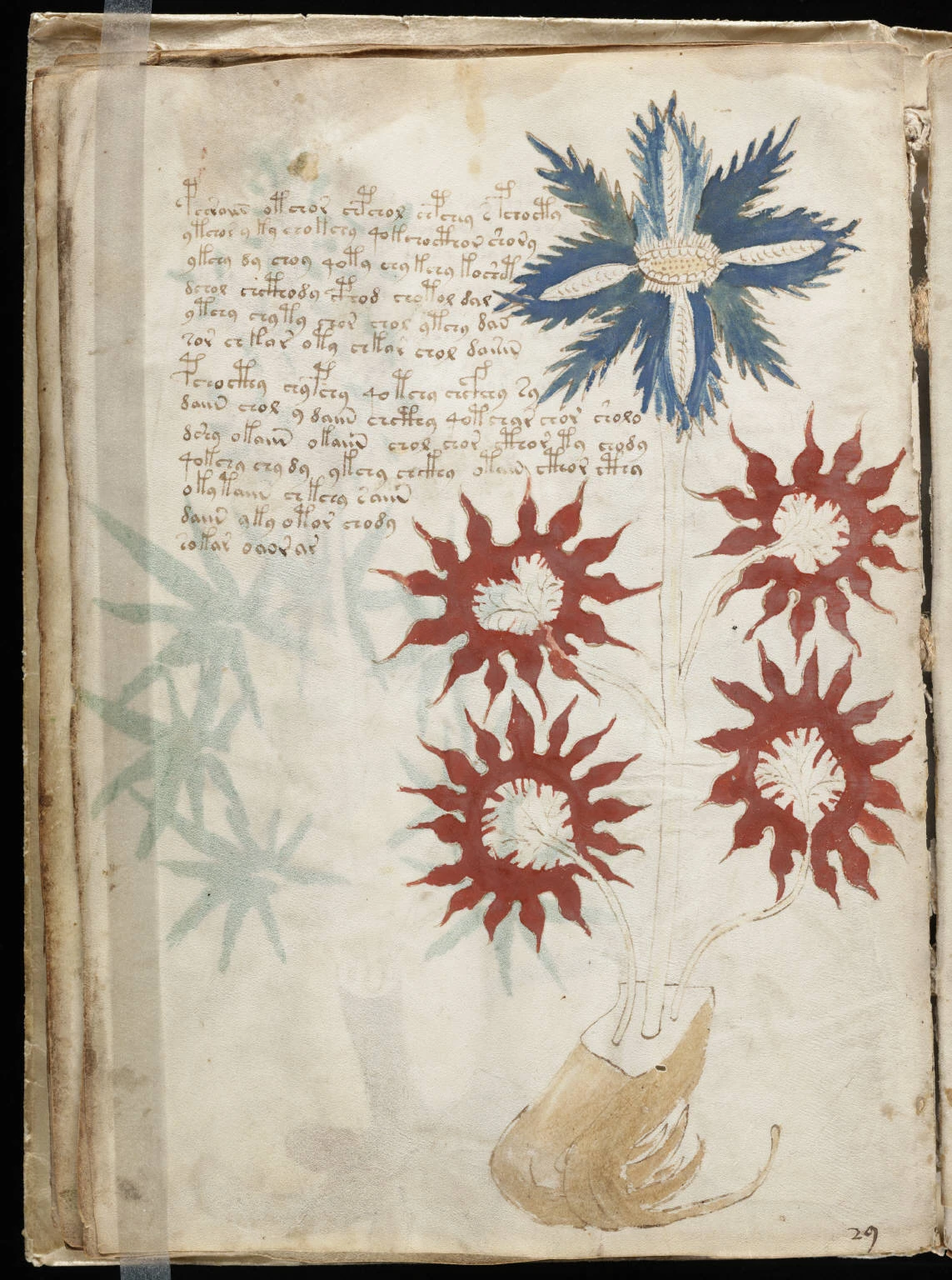
The Voynich manuscript is composed of approximately 240 vellum pages, though evidence suggests that some pages are missing. The vellum, carbon-dated to between 1404 and 1438, is of average quality, crafted from at least fourteen or fifteen entire calfskins. The manuscript's dimensions are 23.5 by 16.2 by 5 centimeters. Its pages are filled with text and intricate illustrations, including depictions of unidentified plants, astrological symbols, and enigmatic figures, some painted with colorful inks at a later date.
The text, written from left to right, consists predominantly of an unidentified script, with the occasional appearance of Latin script. The script flows smoothly, with no signs of encipherment, leading some to question whether it is a natural language or an elaborate code. The manuscript comprises approximately 170,000 characters, organized into around 35,000 "words" or word tokens. Despite years of study and the involvement of renowned cryptographers, including those from World War I and II, the manuscript's script has never been successfully deciphered.
The manuscript's pages are adorned with colorful illustrations, painted with pigments analyzed to be inexpensive. These include blue azurite, white egg-white and calcium carbonate, green copper compounds, and red ochre. Some of these paintings, applied somewhat crudely over the ink outlines, suggest the involvement of more than one artist or a later addition to the manuscript.
The authorship of the Voynich manuscript has been attributed to various historical figures, including Roger Bacon, Wilfrid Voynich, Jakub of Tepenec, Athanasius Kircher, Raphael Mnishovsky, Antonio Averlino Filarete, Cornelis Drebbel, and Anthony Ascham. However, no single hypothesis has gained universal acceptance. Theories about its purpose range from a compendium of folk knowledge to a work of speculative fiction, glossolalia, or even a sophisticated cryptographic puzzle.
Despite numerous attempts at decipherment by both professional and amateur cryptographers, the manuscript remains an unsolved enigma. Its text and illustrations continue to captivate and frustrate scholars, sparking endless speculation about its true meaning and purpose. The Voynich manuscript stands as a testament to the enduring allure of mystery, challenging our understanding of language, art, and history.
This case file adapts material from Wikipedia and is licensed under Creative Commons Attribution-ShareAlike 4.0 International. Additional Bloody Likely interface elements, metadata, images, comments, app features, and audio may be separately protected. Creative Commons Attribution-ShareAlike 4.0 International
Audio narration © Bloody Likely. All rights reserved. The audio player is provided for personal streaming/listening only.
No recent news articles found for this case. Check back later for updates.
No evidence found for this case. Be the first to submit evidence in the comments below.
Join the discussion
Loading comments...