ANALYZING EVIDENCE
Processing case files...
Processing case files...
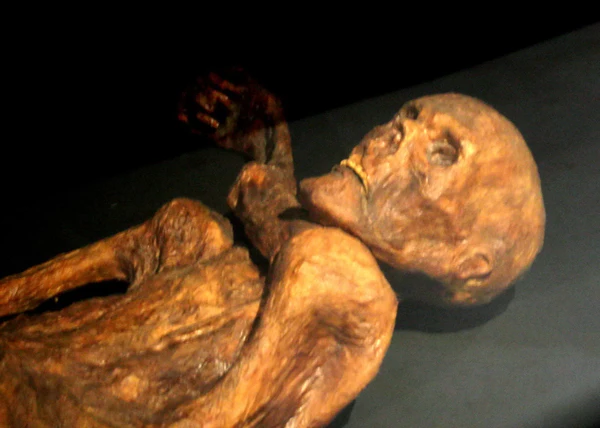
Copper Age Alpine Murder
CLASSIFICATION: Murder
LOCATION
Tisenjoch, Ötztal Alps, South Tyrol, Italy
TIME PERIOD
c. 3230 BC
VICTIMS
1 confirmed
A Chalcolithic man was found dead in glacier ice with an arrowhead lodged in his left shoulder and multiple other traumatic wounds, indicating he was killed by another person. The body was discovered in September 1991 on the Tisenjoch pass at the Austria–Italy border and later identified as a c. 3230 BC individual now known as Ötzi. Investigators and researchers have conducted radiocarbon dating, CT scans, DNA sequencing and stable isotope and pollen analyses, but the assailant(s) remain unidentified. Key physical evidence includes the embedded arrowhead, cuts and bruises, blood traces on gear from other individuals, and well-preserved clothing and tools that document his last movements and meals.
Some believe Ötzi was the victim of an ambush or violent dispute—a flint arrowhead in his shoulder, wounds consistent with a brawl, unfinished arrows and hurriedly carried tools have fueled theories of a blood‑feud or interpersonal killing rather than an accidental death. Investigators have alternately argued he was fleeing across the pass or engaged in social conflict, and debates continue over the exact sequence of events, the reinterpretation of how his body came to be preserved, and whether recovery mishandling and a cross‑border ownership dispute affected the integrity of the evidence; fringe claims even invoke a so‑called “curse” surrounding those involved in the find.
In the late summer of 1991, two German hikers crossing the high ice of the Ötztal Alps stopped short: a human body lay trapped in the melt, face‑down in a shallow gully near the crest of the range close to the Austrian–Italian border. [1][2][3]
The corpse looked recent enough that people first assumed it was a modern mountaineer killed in an accident or avalanche. [4][5] But the body’s leathery, caramel‑colored skin and the ancient tools scattered nearby told a different story. [4][6]
Radiocarbon dating would eventually show that the man in the ice had died between about 3370 and 3100 BC – more than 5,000 years earlier. [7] He is now known as Ötzi, the Iceman, Europe’s oldest known human mummy and, increasingly, the victim at the center of one of archaeology’s coldest homicide cases. [1][3][8]
Scientists would conclude that shortly after his death, Ötzi’s body was buried quickly by snow in a rocky basin high in the Alps, protecting it from scavengers and decay. [2][8] Over millennia, alternating meltwater and extreme cold naturally mummified him under the glacier. [2]
Otzi-Quinson.jpg
He died in the Copper Age, around 5,300 years ago. [6][7] Modern diagnostics and genomic sequencing estimate he was about 45 years old when he died, roughly 1.60 meters tall, and around 50 kilos in weight – an advanced age and respectable build for his time. [2][3][9]
When he was found, he was still dressed for the mountains. He wore a coat, hat, loincloth, leggings, belt, shoes and a quiver, a layered outfit of hides, plant fiber and fur. [8][10][11] Near the body lay goatskin leggings, a grass cape, a copper‑headed axe and arrows – the equipment of a mountain traveler who expected trouble and cold. [4][11]
Arthritis and worn ligaments marked his joints, and he carried the intestinal parasite whipworm and other parasites, along with bad teeth and fleas. [2][9][11] Yet one researcher who studied his remains described him as in “pretty good shape” overall. [9]
He had lived long enough, and hard enough, to accumulate a list of ailments modern medicine could recognize. But it was violence, not age, that killed him.
The hikers who found him were Helmut and Erika Simon, a German couple whose names would later surface in legal wrangles over finder’s fees and fame. [10] At first, even authorities treated the frozen man as a recent casualty of the mountains. [4][5]
Only after archaeologists began to recover his clothing, his axe and his other possessions did the scale of the discovery become clear. [3][4] The body and artifacts were lifted from the ice at more than 3,000 meters above sea level and taken for study. [9][4]
There was, almost immediately, a border problem. At first it was unclear whether the corpse lay in Austria or Italy. [10] Detailed surveys a month later showed the find spot was 93 meters inside Italian territory, and the Italian province of South Tyrol took formal possession of the remains. [3][10]
After a diplomatic dispute between Austrian and Italian authorities, the iceman’s custody was settled and he was transferred to Bolzano. [3][11] There, a specially built museum in the town – the South Tyrol Museum of Archaeology – became his permanent home, with a cold‑storage display chamber that keeps him under carefully controlled temperature and humidity. [3][10][11]
© Mapbox © OpenStreetMap
Over the next quarter‑century, scientists would return again and again to that glass case, thawing him just enough to scrape tissue from his knee, intestine and mouth, or to peer inside with ever more powerful scanners. [1][4] Each visit added another layer to his story. [4]
Ötzi the Iceman - Lithic assemblage.png
Austrian archaeologist Konrad Spindler pored over photographs from the discovery site to reconstruct how the body and objects had lain in the ice. [3] He noticed that Ötzi’s copper axe was found propped against a rock, and believed the man had set it there himself, implying the scene preserved the position of his belongings at the moment he died. [3]
Pollen in the surrounding ice was identified as coming from autumn‑flowering plants, leading early investigators to conclude he had died in the autumn. [3] At that stage, many researchers thought he had simply been caught out by Alpine weather.
Spindler developed what he called a “disaster theory”: that Ötzi was a shepherd who suffered rib fractures in some kind of argument or battle, then fled uphill and eventually died of hypothermia in the mountains. [3][4] CT scans and X‑rays were interpreted by some as showing broken ribs. [10]
Another expert, archaeobotanist Jim Dickson, spent five years examining plant remains from the site and also concluded that the iceman likely got caught in a storm, crawled into a hollow, and froze to death near what is now the border of Italy and Switzerland. [4]
He seemed, in other words, like a tragic victim of weather and high altitude – maybe injured, maybe fleeing a fight, but ultimately done in by the cold.
Ten years after the discovery, fresh X‑rays abruptly changed the story.
In June 2001, Italian scientists X‑rayed Ötzi again. A local hospital radiologist spotted a foreign object near the left shoulder that had the unmistakable shape of an arrow. [3] Its density on the image was higher than bone and matched that of flint. [3]
Further scans confirmed a stone arrowhead embedded in the iceman’s back just under his shoulder, a weapon that had been completely missed in earlier studies. [1][3][10]
CT and imaging work showed that the arrow had severed a major blood vessel between the rib cage and the left shoulder blade and ruptured the key artery carrying blood from his heart toward his left arm. [9][10] A separate analysis using high‑resolution computer tomography found that an arrow hole beneath his left collarbone had torn an artery, leaving a large haematoma in the tissue. [12]
Dr. Frank Rühli and colleagues concluded that massive blood loss and shock from that arterial wound led to cardiac arrest, and that the iceman probably died shortly after being hit. [12] Another team later analyzed his red blood cells and found traces of a clotting chemical that appears quickly after a wound and vanishes soon after, evidence that he did not survive long following the injury. [13]
Archaeologists and forensic specialists now widely think that an arrow wound to the shoulder caused Ötzi to bleed to death. [12][14][15] One article put it bluntly: he was killed by an arrow about 5,300 years ago. [9]
More detailed reconstructions suggest he was shot in the back with a stone‑tipped arrow, the shaft was pulled out – perhaps by himself or by others – leaving the head in his body, and he then made it into the mountains before collapsing and dying from exhaustion and bleeding in a remote gully. [2][3] Researchers noted that pulling an arrow out before death can worsen such an injury, and one pathologist floated the idea that a killer might have removed the shaft to conceal its origin. [10][12]
The man in the ice was no longer just an Alpine victim of the elements. He was a homicide victim.
To understand how he ended up in that gully, investigators turned to his gut.
Two years before one major study of his intestinal contents, the mummy was briefly defrosted so researchers could retrieve and analyze material from inside his body. [11] DNA specialist Franco Rollo and colleagues examined fragments from the intestines, finding degraded but still informative traces of food and other substances. [11]
Their work showed that shortly before he died, the iceman ate red deer meat and bread, and at an earlier meal consumed cereals, plants and ibex meat. [8][11] A separate analysis described his last meal as very fatty dried goat meat – “most likely bacon” from a wild goat of South Tyrol. [9] Other reports highlight unleavened bread, deer meat and sloes among the final foods moving through his system. [13]
From the pollen and plant remains, Rollo’s team reconstructed his final movements. They wrote that his last journey began in a coniferous woodland at intermediate altitude, where he may have eaten a first meal of cereals, plant foods and ibex. [11] Later, he climbed to over 3,200 meters above sea level and died in a rocky basin after a further meal based on red deer and possibly more cereals. [9][11]
Pollen became central to a debate over not just where he moved, but when he died.
Early on, scientists examining pollen in the ice around the body found grains from autumn‑flowering plants and concluded he had died in the autumn. [3] Later, researchers looking at pollen inside his digestive tract identified hop hornbeam grains with intact cell contents – pollen from a tree that flowers between March and June – implying he died in spring or early summer. [3][11] An analysis of pollen in his stomach suggested his last meal was eaten in the summer. [8]
Taken together, the plant evidence paints a picture of a man moving up from valley woods into high Alpine terrain in warm months – but it leaves room for disagreement on the exact season, and even the sequence in which different deposits formed.
What is clearer is that he died soon after sustaining violence. CT and physical examination showed a deep wound on his right hand, and multiple accounts describe cuts or lacerations there. [9][10][11] Some researchers have suggested that this hand injury points to close‑quarters fighting shortly before he was shot in the back. [11][14]
Combined with the lethal arrow, the pattern suggests a man who had already been in trouble before he reached 3,200 meters.
Ötzi did not enter the high mountains unarmed. He carried a bow, a quiver of arrows, and a copper axe – equipment that speaks to both hunting and self‑defense. [11][12][13]
Archaeologists recovered a small dagger, several arrowheads and other stone, wood and antler tools from the glacier gully near his body. [6] His kit included a sharp flake for cutting reeds, an oval end‑scraper, a borer for piercing leather and wood, and a wooden block with a deer‑antler insert called a retoucher, used to reshape stone tools. [6] Microscopic study showed many of these tools had been resharpened or repaired, leading one archaeologist to remark that “he cared about his tools.” [6]
Yet for a man walking into danger, his weaponry was oddly incomplete. The quiver held just two finished arrowheads and about a dozen unfinished arrow shafts, along with antler points and a bundle of sinew. [6] One researcher inferred that he must have been in some sort of rush, arguing that he could have finished the bow and arrows in a matter of hours if he had taken the time. [6]
Blood traces on his gear raised the stakes. An analysis of traces found on his clothes and weapons detected four different types of DNA, none matching his own. [12] Another report notes that blood from four different people was identified on his dagger. [10] Australian biologists interpreted the mixed blood as evidence that he had killed or at least been involved with several other people shortly before his own death, prompting suggestions that he might have been a hunter or warrior killed in a skirmish with a rival group. [10][12]
OtzishoesS1340065.jpg
Those interpretations remain contested. The blood spots could represent comrades, enemies or some combination of both; they might be the residue of group conflict or of attempts to help wounded companions. What the stains do establish is that the iceman’s final hours were not peaceful.
Beyond the fatal arrow and the hand wound, Ötzi’s body carries a catalog of chronic conditions that modern scans and genetic tools have painstakingly documented.
He suffered from advanced gum disease and had worn, damaged teeth. [2][9] Examinations found gallbladder stones and evidence of atherosclerosis – hardening of the arteries. [2] Imaging and tissue studies revealed parasites, including whipworms in his colon, and “worn ligaments.” [2][9]
Helminths were not his only microscopic burden. Researchers found an ulcer‑inducing bacterium in his stomach, and suggested he may have experienced stomach aches in life. [9] Later, genome sequencing identified the DNA of Borrelia burgdorferi, the infectious agent that causes Lyme disease, implying he may also have carried that ailment. [2][14][16]
Multiple studies describe him as arthritic, with bad knees and joint wear consistent with a life spent walking on steep terrain. [10][11][13] One analysis of his joints led anthropologists to propose that some Neolithic people, like Ötzi, spent much or all of their lives in the mountains. [10]
Genetic analysis suggested he was lactose intolerant, carried a predisposition to cardiovascular disease, and likely had brown eyes and blood group O. [8][16]
Ongoing debate surrounds some of his supposed fractures. Early interpretations reported three broken ribs, fitting Spindler’s “disaster theory” of a shepherd injured in a fight or accident before freezing to death. [3][10] Later examinations, however, indicated that the ribs were bent out of shape after death rather than fractured while he was alive. [3]
What emerges from this body is not a romantic rugged warrior, but a middle‑aged man carrying the accumulated damage of years of hard labor, infection and chronic pain – yet still mobile enough to climb into high Alpine country one last time. [7][9]
When the iceman’s clothes were removed, investigators noticed groups of dark, linear marks on his skin, especially on his legs and lower back. [7][13] Early counts reported between 47 and 60 tattoos, simple dots and lines, arranged in clusters. [2][10]
Over time, his epidermis had darkened from prolonged exposure to sub‑zero temperatures beneath the glacier, making some tattoos faint or invisible to the naked eye. [2] To see more, a team led by Marco Samadelli and colleagues at the South Tyrol Museum of Archaeology used non‑invasive multispectral imaging. [2]
They slightly thawed Ötzi’s body to remove surface ice, then photographed him from all sides with a modified 36‑megapixel digital SLR camera fitted with filters capturing ultraviolet, visible and infrared wavelengths. [2] Specialized software separated and analyzed seven wavelength bands per pixel, a method the authors termed “7‑Band Hypercolorimetric Multispectral Imaging.” [2]
Ricostruzione di Ötzi.jpg
The work revealed previously unknown tattoos, including four parallel lines on his lower right rib cage that cannot be seen in ordinary light. [2] Altogether, the team catalogued 19 groups of tattooed lines, 61 marks in total, mostly thin lines 7–40 millimeters long and 1–3 millimeters wide. [2][7] The greatest concentration was on his legs, which bear twelve of the groups. [2]
Analysis of pigment residues indicated the tattoos were made with ink from campfire soot pricked into the skin. [7][17] With these dates and methods, one comparative study concluded that, as far as current evidence goes, Ötzi is the oldest tattooed individual identified to date. [7]
The meaning of his tattoos remains a live argument. Previous research found that about 80% of his marks lie over points and meridians used in traditional Chinese acupuncture to treat rheumatism, back pain and abdominal disorders, leading to the suggestion they might represent a kind of therapeutic or proto‑acupuncture practice. [2][7]
In the new imaging study, Samadelli’s team noted that the rib‑cage tattoos do not sit above a joint and suggested they were unlikely to be related to degenerative joint disease in his lower back. [2] Anthropologist Lars Krutak, reading the work, countered that those lines might still be near acupuncture points tied to known problems such as gallstones, whipworms and atherosclerosis, and consulted an acupuncturist who pointed out that nearby points can be used to treat whipworms, gallstone symptoms and breathing issues. [2]
Whether they marked treatment, ritual, identity or some combination of the three, the soot lines on his skin are one of the earliest surviving records of people intentionally altering the human body in ink. [17]
If the tattoos testify to what was done to his body, his clothes reveal how he chose to equip it.
When he died, Ötzi was dressed in a coat, hat, loincloth, leggings, belt and shoes – a complex outfit for surviving the Alpine cold. [8] Early reconstruction identified goatskin leggings, a grass cape, a copper‑headed axe and arrows among his possessions, along with a cloak of grass and leather shoes stuffed with plant fibers. [4][10]
For a long time, however, it was hard to say exactly which animals those leathers came from. Copper Age tanning techniques had stripped away grain patterns and other obvious markers, and time had degraded the fibers. [8][14]
In 2017, researchers led by Niall O’Sullivan used a new genetic sequencing approach to reconstruct mitochondrial DNA from leather fragments in his wardrobe. [8][14] Working from nine samples from six garments, including his loincloth and fur cap, they successfully identified each tested fragment. [8][14]
The results showed that his wardrobe drew on at least five species. [8][14] His loincloth was sheepskin. [8][14] His leggings were made from goat hide. [8][14] Shoelaces were cut from cow leather. [8][14] His coat was a patchwork of at least four hides from sheep and goat stitched together. [8][14]
Some pieces came from wild animals: his hat was bearskin, with the fur on the outside, and his quiver was fashioned from roe deer hide. [8][14] DNA analysis confirmed that the sheep, goats and cattle used for much of his clothing were domesticated. [14]
The researchers argued that the preserved leathers offer a rare glimpse into how ancient populations used the secondary products of animal husbandry. [8] O’Sullivan suggested that the presence of domesticated hides points to an agricultural or herding community, and others have noted that goat hide, used for his leggings, may have been preferred for its flexibility. [8][14]
Albert Zink, head of the Institute for Mummies and the Iceman in Bolzano and a senior author on the clothing study, has said the work shows that functionality and comfort mattered in Copper Age clothing design – that this was a man who, within the limits of his world, dressed with care for the conditions he faced. [8][10]
By the late 1990s, Bolzano wanted to put a face to their frozen resident. The museum asked forensic pathologist Peter Vanezis to reconstruct the Iceman’s appearance for display. [3] Because the actual skull could not be removed from cold storage, an Austrian team created a detailed life‑size replica from 3‑D CT data using a rapid‑prototyping machine, which Vanezis then laser‑scanned into his facial reconstruction system. [3]
reconstruction of Ötzi mummy as shown in Prehistory Museum of Quinson, Alpes-de-Haute-Provence, France
Wikimedia Commons· CC BY-SA 3.0
Where forensic art tried to reconstruct the surface, molecular biology went for the code.
Earlier studies had decoded his mitochondrial DNA, but those sequences allowed only limited inferences and suggested that if he still had maternal‑line relatives in the Alps, they were scarce. [10] A later analysis concluded his mother’s line is likely extinct. [13]
In February 2012, researchers announced that they had sequenced his entire genome. [2][16] Among other findings, the genome work suggested probable brown eyes, blood group O, lactose intolerance, a predisposition to cardiovascular disease and the presence of Borrelia burgdorferi. [8][16]
His Y‑chromosome belongs to a subclade of haplogroup G defined by markers including L91. [16] When scientists in Innsbruck analyzed Y‑DNA from 3,700 male blood donors in Tyrol, about 4% of the haplogroup G men – roughly 19 individuals – carried the same rare G‑L91 signature. [16] The authors of that study described those men as paternal‑line relatives of the Iceman, sharing common male ancestors with him. [15][16]
Journalists sometimes called them his “descendants,” but genetic genealogists have cautioned that DNA alone cannot prove a direct line of descent, only relatedness. [16]
Analysis of his genome also showed that his genetic profile most closely resembles modern‑day Sardinians, and that many Neolithic farmers and pastoralists in central Europe likely carried DNA similar to his. [13] If his maternal line died out, his broader genetic legacy lives on in the populations that followed.
The fight over who killed the iceman has been matched only by the dispute over who owns him and what exactly happened in his last hours.
The initial border confusion and the eventual ruling that he lay just inside Italian territory fed into long‑running sensitivities in South Tyrol, a formerly Austrian region now part of Italy. [10] The city of Bolzano, where he rests, has built much of its tourist identity around him. [10]
Helmut and Erika Simon, the hikers who discovered the body, argued that the mummy had earned Bolzano tens of millions of euros in revenue and pushed for a substantial finder’s reward, eventually securing an agreed payment after years of dispute. [10] Others came forward claiming a role in the discovery – including a Swiss woman who said she had “spat on the Iceman” to stake a claim and a Slovenian actress who insisted she arrived five minutes earlier – but those stories could not be substantiated by DNA or witnesses. [10]
More speculative ideas about his death have surfaced over the decades. One professor even suggested that evidence of an ancient asteroid impact might be linked to the iceman’s demise and proposed he could have been ritually sacrificed. [10] Another theory floated locally claimed he had been cast out of his community because a low sperm count left him childless, a suggestion that even geneticists studying his DNA doubted could ever be confirmed. [10]
On the strictly forensic side, debate continues over parts of the narrative. Some archaeologists still weigh the arrow wound against alternative explanations such as a sudden fall or freezing after an accident, and one Guardian report noted that scientists had not reached absolute agreement on whether the arrow, a fall or hypothermia during a climb was the final cause. [12]
What most reconstructions now share is this basic arc:
He never made it back down the mountain. Snow fell, covering his body and gear in the small gully where hikers would eventually find him 5,000 years later as the glacier retreated. [2][8]
Today, he lies in a sterile, humid glass case in Bolzano, kept cold and monitored constantly. [11] Scientists have described him as the world’s most perfectly preserved mummy, and one of the most significant archaeological discoveries of the 20th century. [1]
From the soot under his skin to the torn artery under his collarbone, almost every part of him has now been read as evidence. [7][12] His clothes speak to the animals and technologies of his age; his genome to deep ancestry and disease; his tattoos to the beginnings of body art and medicine. [2][7][8]
What no scan or sequence can yet tell is who drew the bow that killed him, or why a middle‑aged herder‑hunter ended up bleeding to death on a high pass with unfinished arrows by his side. [4][6][12]
That mystery, frozen in place along with his body, is what keeps the Iceman’s case open.
Adapted from Wikipedia: Ötzi.
This case file is an original Bloody Likely narrative synthesis based on the cited sources. Article © Bloody Likely. All rights reserved. Source materials remain the property of their respective owners. Facts, public records, quotations, and cited references are used for reporting, research, commentary, and documentation. Bloody Likely content license
No recent news articles found for this case. Check back later for updates.
No evidence found for this case. Be the first to submit evidence in the comments below.
Join the discussion
Loading comments...
German tourists Helmut and Erika Simon discovered the upper part of a mummified body protruding from the ice near Tisenjoch in the Ötztal Alps.
Ötzi's body and associated artifacts were removed from the glacier and transported to Innsbruck for forensic examination.
Official survey placed the discovery site 92.56 metres inside Italian territory, establishing South Tyrol's ownership claim.
AMS radiocarbon analyses dated tissue, bone and associated grass samples, placing the remains in the 4th millennium BC.
X-rays and CT scans detected an arrowhead lodged in Ötzi's left shoulder and a matching tear in his coat, indicating violent injury.
DNA analyses identified traces of blood from at least four other people on Ötzi's knife, arrowhead and coat, suggesting interpersonal violence.
Legal dispute over the discovery ended when Erika Simon and the provincial government agreed on a payment of €150,000.
Ötzi's full genome was published, providing genetic insights into his ancestry, health risks and phenotypic traits.
A new high-coverage genome with reduced modern contamination was published, refining knowledge of Ötzi's ancestry.