ANALYZING EVIDENCE
Processing case files...
Processing case files...
Utah Campus Political Assassination
CLASSIFICATION: Murder
LOCATION
Orem, Utah
TIME PERIOD
Sep. 10th 2025
VICTIMS
1 confirmed
On 2025-09-10 Charlie Kirk, a 31-year-old conservative activist, was fatally shot while speaking at an outdoor Turning Point USA event at Utah Valley University in Orem, Utah. Surveillance and witness accounts indicate a single sniper shot from the roof of the Losee Center struck Kirk in the neck; he was transported to Timpanogos Regional Hospital and pronounced dead. Investigators recovered a Mauser-type bolt-action rifle and took palm/footprint and DNA samples; a suspect, 22-year-old Tyler James Robinson, surrendered the next day and has been charged with aggravated murder and related counts. The case remains pending prosecution and has not resulted in a conviction to date; prosecutors announced they will seek the death penalty and investigators cite DNA and forensic links to the recovered rifle and scene.
Some believe the assassination was a politically motivated attack tied to Kirk’s prominence in the MAGA movement, with investigators and media reporting that the accused allegedly told relatives he killed Kirk because he “spreads too much hate,” a motive various sources link to Robinson’s reported political shift and personal circumstances (including a roommate’s gender transition). Others have speculated that preventable security failures at the university — rooftop exposure, unenforced ticketing, limited metal screening and staffing gaps — enabled a sniper-style attack, and critics contend the Trump administration and allied groups politicized the killing by quickly blaming left-wing actors and using the event to justify broad enforcement actions, a sequence that has prompted allegations of opportunistic rhetoric and possible overreach.
At 12:23 p.m. on September 10, 2025, a single rifle round crossed roughly a football field and a half of open air at Utah Valley University and struck Charlie Kirk in the neck as he answered a question about mass shootings. [1][2]
President Trump Delivers Remarks on Charlie Kirk, September 10th 2025.webm
Wikimedia Commons· Public domain
Kirk, a 31‑year‑old conservative activist and the co‑founder and CEO of Turning Point USA, was speaking at an outdoor debate event on the Orem, Utah campus — the kickoff of a 14‑city tour. [1][2] Police later said roughly 3,000 people had shown up. [1][2] Six campus police officers were working the event. [2]
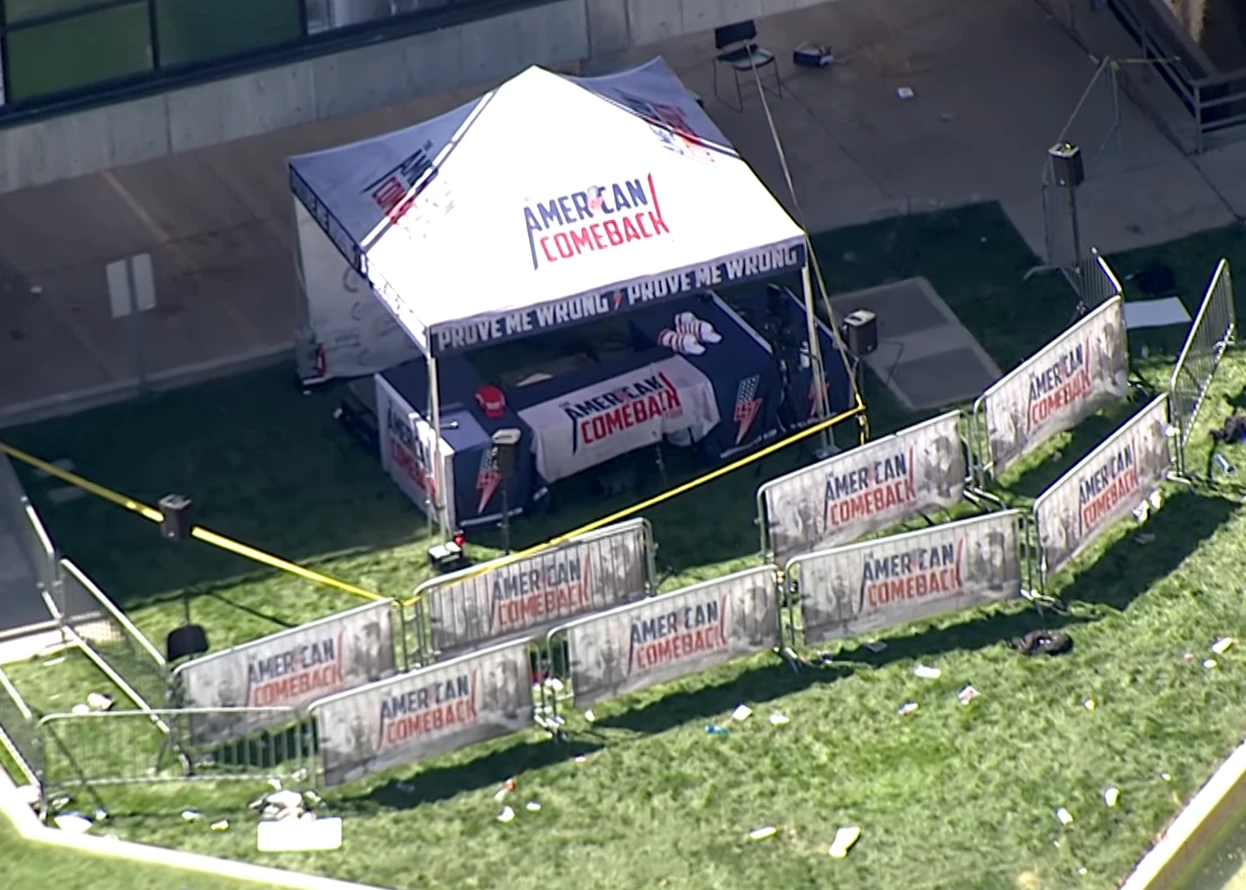
Video posted from Kirk’s own social media minutes earlier showed him under an open‑sided tent, separated from students by a barrier and a visible line of security. [2] When the shot came, it dropped him instantly. [1][2]
Surveillance timelines later pinned the impact to 12:23:30 p.m. [1] About 25 seconds later, six men lifted Kirk and rushed him to a waiting SUV, which sped to Timpanogos Regional Hospital. [1][2] Doctors could not save him. [1][2]
CNN and other outlets described him as a father of two young children. [2] President Donald Trump announced Kirk’s death on Truth Social at 2:40 p.m. that afternoon. [1]
Within hours, authorities were calling what happened in Orem by a word that carries its own political charge: assassination. [1]
From the start, investigators believed the bullet came from above and far away. [1] Video footage later released to the public showed a figure crawling into position on the roof of UVU’s Losee Center, an academic building that sits northwest of the outdoor event space. Around 12:15 p.m., the person moved into what investigators would describe as a suspected shooting position. [1]
By 12:22 p.m. — one minute before the fatal shot — surveillance images showed the suspect lying prone, facing the tent where Kirk stood at the microphone. [1] Investigators ultimately concluded the shot was fired from that rooftop, approximately 130 meters, or 142 yards, from Kirk. [1] A CNN report put the distance at “less than 200 yards.” [2]
In the chaos immediately after the gunshot, a video taken from inside a nearby building appeared to show someone running across the same roof. [2] Aerial footage broadcast later that day captured crime‑scene tape stretched along the edge of the Losee Center. [2] A UVU campus police officer was the first to climb the stairs and begin examining the suspected firing position. [1]
Regional law enforcement were monitoring radio traffic within minutes; one record places their awareness of the shooting at no later than 12:26 p.m. [1] At about 12:36 p.m., an officer on the radio described a possible suspect seen nearby: jeans, a black shirt, a black mask, and a long rifle. [2]
By 12:39 p.m., FBI agents and local police chiefs were on scene. [1]
As news alerts flashed and students sheltered in place, the information coming from the ground was messy and, at times, flat‑wrong.
Almost immediately after the shooting, one man began screaming that he was the killer. [1][3] According to documents filed by UVU campus police and later summarized in The Guardian, 71‑year‑old George Zinn shouted, “I shot him – now shoot me,” drawing officers who wrestled him to the ground. [3] Video of Zinn being held down circulated widely online, convincing many that the sniper had been caught. [3]
When an officer asked Zinn where the gun was, he allegedly replied, “I am not going to tell you.” [3] But police say that under further questioning, he admitted he was not the shooter and did not know who was. [3] In statements quoted in court documents, Zinn purportedly said he hoped to become “a martyr” for Kirk and was “glad he said he shot the individual so the real suspect could get away.” [3]
While Zinn was being detained, student journalists with UVU’s independent paper, the UVU Review, found themselves transformed into witnesses, documenting both the shooting’s aftermath and the surge of panic and recrimination that followed. [2] One student, Logan Topham, later described hearing yelling, panic, and blame shouted at a group of protesting students in the minutes after the shot. [2]
Two people were arrested soon after the shooting and later released, reflecting the confusion of those early hours. [1] One of them — the man who had loudly claimed to be the shooter — would not be quietly forgotten.
AmericaFest 2025 - Zeitgeist 04.jpg
State authorities identified him as George Zinn and later charged him with obstruction of justice for falsely confessing, as well as with multiple counts of sexual exploitation of minors based on material allegedly found on his phone. [1][3] Investigators reported locating more than 20 images of child sexual abuse and explicit messages sharing that imagery. [1][3] A judge ordered Zinn held without bail. [3]
In a separate case that unfolded months later, Zinn pleaded no contest to obstruction of justice and guilty to two counts of sexual exploitation of minors; he was sentenced to 15 years in prison. [1]
The spectacle of Zinn’s arrest, and the rapid walkback that followed, set the tone for how incomplete and contradictory the first wave of official statements could be.
While officers sorted out who had not pulled the trigger, other teams quietly worked the physical trail.
Sometime after the shooting, investigators searching a wooded area north of campus located a rifle wrapped in a towel and hidden among the trees. [1][4] The weapon was described as an older‑make Mauser‑type bolt‑action hunting rifle chambered in.30‑06 and fitted with a scope. [1][4] Authorities said it was the gun used in the assassination. [4]
Mauser‑pattern bolt‑action rifles, first developed in Germany in the late 19th century, have long since been adapted into civilian hunting guns and are often equipped with scopes for long‑range shooting. [4] The.30‑06 cartridge they fire, introduced by the U.S. Army in 1906, remains a common North American hunting round and retains lethal velocity at ranges of 200 to 500 yards — distances that comfortably cover the gap between the Losee Center roof and Kirk’s stage. [1][4]
Forensic specialists from the FBI and the Bureau of Alcohol, Tobacco, Firearms and Explosives began analyzing the rifle for fingerprints, DNA, and ballistic evidence that could tie it to the sniper and the fatal round. [4]
On and around the weapon, investigators found more than just trace evidence. They recovered palm prints, a footwear impression, and “forearm imprints” that appeared to show how someone had braced themselves to fire. [1] Cartridge cases and unfired rounds discovered with the rifle bore engraved messages. [1]
According to an FBI briefing described in later reporting, one spent cartridge case carried a cryptic inscription: “Notices Buldge OWO what’s this?” [1] Three unfired rounds were engraved with phrases ranging from the taunting (“If you read This, you are GAY Lmao”) to the overtly political or cultural (“hey fascist! CATCH! ↑→↓↓↓” and “O Bella ciao, Bella ciao, Bella ciao, Ciao, ciao!”). [1]
Early articles flagged these inscriptions as possibly pointing to ideological motives. [4] To this day, prosecutors have not publicly laid out a detailed motive theory in court filings, and the meaning of the markings remains a matter of interpretation rather than established fact.
Even as the rifle was being processed, the broader question of public safety loomed. Officials did not know whether the shooter had acted alone.
Tyler James Robinson Appears In Court - January 16, 2026.png
At 1:37 p.m., Utah Valley University ordered its campuses closed. [1] At 2:01 p.m., administrators instructed those still on campus to secure in place. [1] A CNN broadcast later noted that an all‑clear, declaring the immediate threat over, did not come until roughly six hours after the shooting. [2] Classes and activities system‑wide were suspended through September 15. [1]
The FBI director, Kash Patel, added to the confusion. On social media, Patel initially announced that a subject had been apprehended, only to retract the statement within two hours. [1] The retraction landed against the backdrop of Zinn’s public arrest and subsequent release from suspicion in the killing, blurring for many onlookers who, if anyone, was actually in custody for Kirk’s death.
Meanwhile, law enforcement agencies across the region activated what would become one of the most intensive manhunts in recent Utah history.
The FBI released images of a person of interest — a young man in a black T‑shirt emblazoned with a U.S. flag, a dark baseball cap, and large sunglasses — captured by campus CCTV around 11:50 a.m., about a half‑hour before the killing. [1] Another still showed a gray Dodge Challenger that officials said had been seen on campus at 8:29 a.m. [1] A reward of up to $100,000 was offered for information. [1]
Roughly 33 hours after the shooting, the man whose image had been broadcast nationwide picked up the phone.
On the evening of September 11, 22‑year‑old Tyler James Robinson surrendered to authorities at his parents’ home in Washington, Utah, about 260 miles south of the UVU campus. [1][3] Officials said he was taken into custody without incident. [1] Utah governor Spencer Cox publicly declared that Robinson was the only suspect and that the manhunt — from the moment of the shot to the surrender — had lasted 33 hours. [1]
© Mapbox © OpenStreetMap
By then, much of the country had already moved to assign political meaning to the killing. A CNN segment included a tribute from Rep. Warren Davidson, who called Kirk “an icon for people who shared his faith” and noted that the activist’s events reliably drew large, passionate crowds. [2] In the same broadcast, Davidson added that “one person pulled that trigger and fired one shot” but speculated there “may have been other people involved.” [2]
Some high‑profile Republicans, including Trump, publicly alleged that the suspect had links to left‑wing groups. [1] But reporting as of September 21 stated that no evidence had then been found to support those claims. [1]
In the days after Robinson’s arrest, investigators began to sketch out the evidence they said tied him not just to the manhunt posters, but to the rifle in the woods and the rooftop firing position.
On September 15, the FBI announced that Robinson’s DNA matched samples recovered from a towel wrapped around the suspected rifle and from a screwdriver found on the Losee Center roof. [1] The screwdriver’s role was not described in detail, but its presence atop the building suggested it might have been used to access or alter something at the shooting site.
Investigators also interviewed Robinson’s roommate and romantic partner. Both were questioned and explicitly not treated as suspects. [1] According to court documents summarized in later reporting, the roommate provided private messages in which Robinson allegedly discussed handling and hiding a rifle: retrieving it from a “drop point,” leaving it in a bush, watching the area where it had been stashed, and leaving it wrapped in a towel. [1]
Prosecutors further alleged that Robinson referenced Zinn’s detention in messages sent after the assassination. [3] In one exchange, according to their description, a roommate asked whether police had caught Kirk’s killer. [3] Robinson allegedly replied that he was the killer, even though officers had first “grabbed some crazy old dude” — a phrase prosecutors say referred to Zinn. [3]
Taken together — the DNA on the towel and tool, the surveillance footage on the roof, the car and CCTV images from earlier in the day, and the digital messages — authorities framed the case as a straightforward one: a young man, acting alone, had carried out a planned political assassination from long range and then tried to hide both his weapon and his role.
Oversight of the Federal Bureau of Investigation - September 16, 2025.webm
Wikimedia Commons· Public domain
Robinson, born April 16, 2003, has not yet been tried, and his defense team has not publicly laid out an alternative narrative of what happened on the roof that day. [1]
Formal charges followed quickly.
On September 16, 2025, prosecutors charged Robinson with aggravated murder in connection with Kirk’s killing. [1] Additional filings listed aggravated or capital murder alongside counts of felony discharge of a firearm, obstruction of justice, and witness tampering. [1] Utah state prosecutors announced that they would seek the death penalty if Robinson is convicted. [1][3]
In explaining that decision, they cited aggravating factors, including allegations that Robinson targeted Kirk for his political expression and acted knowing that children would witness the assassination. [1] (As noted, Kirk left behind two young children. [2])
Robinson was transferred to the Utah County Jail in Spanish Fork, and a judge ordered him held without bail. [1] His first court appearance, via video feed, took place on September 16 before Judge Tony Graf in Utah County Justice Court in Provo. [1] On September 24, Salt Lake City attorney Kathryn Nester was appointed to defend him. [1]
He made his first in‑person court appearance on December 11, 2025. [1] A preliminary hearing was set to begin May 18 (the year was not specified in the source) but was later pushed back to July because of the volume of evidence — including, presumably, the forensic analyses and digital records amassed during the manhunt. [1]
As of the latest public reporting in this docket, Robinson had entered no public plea and the case remained pre‑trial.
More than a week after the shooting, thousands of people gathered under a different stadium roof — State Farm Stadium in Glendale, Arizona — for a memorial service for Charlie Kirk. [1] The man remembered there was not just a controversial movement figure but a 31‑year‑old husband and father whose abrupt death left two young children without a parent. [1][2]
An aerial view of the tent where Charlie Kirk was shot
Wikimedia Commons· CC BY 4.0
The killing instantly became a political flashpoint. Kirk’s stature as the co‑founder and CEO of Turning Point USA — a group closely associated with the Republican Party and conservative youth activism — ensured that. [1][4] Within hours, commentators and politicians were framing the assassination as an attack not just on one man but on a movement and its right to speak on college campuses.
Yet, for all the rhetoric, some key questions are still unresolved in the public record.
Prosecutors have alleged that Robinson targeted Kirk for his political expression, but they have not, in filings cited here, detailed a specific ideological affiliation or group membership to support that claim. [1] Public speculation has run in several directions, including high‑profile accusations that the suspect had ties to left‑wing organizations, but as of September 21, one major report stated that no evidence had been found linking him to such groups. [1]
The engraved cartridge cases and rounds, with their mix of taunts, arrows, and a line from the Italian partisan song “Bella ciao,” only muddy the waters. [1] They may have been sincere ideological markers, trolling in‑jokes, or some combination; absent further detail from the defendant or investigators, their meaning remains opaque.
There is also the matter of institutional response. The early hours saw a false confession amplified by viral video, mixed messages about who was in custody, and a prematurely optimistic statement from the FBI director that had to be retracted. [1][3] For a public already primed to distrust institutions, the missteps will likely be revisited in future reviews of the case.
What is clear — from the CCTV on the Losee Center roof, the rifle in the trees, the DNA match, and the digital messages quoted in charging documents — is that investigators believe this was not a crime of opportunity. [1] It was, in their telling, a deliberate, long‑range killing of a nationally prominent political figure in front of thousands of witnesses, including children. [1][2]
Whether a jury will accept that narrative, and what further evidence will surface when the case finally reaches a courtroom, remain open questions — and until they are answered, the assassination of Charlie Kirk will stand as both a singular act of violence and a mirror for a polarized country trying to make sense of it.
This case file is an original Bloody Likely narrative synthesis based on the cited sources. Article © Bloody Likely. All rights reserved. Source materials remain the property of their respective owners. Facts, public records, quotations, and cited references are used for reporting, research, commentary, and documentation. Bloody Likely content license
Audio narration © Bloody Likely. All rights reserved. The audio player is provided for personal streaming/listening only.
No recent news articles found for this case. Check back later for updates.
No evidence found for this case. Be the first to submit evidence in the comments below.
Join the discussion
Loading comments...
Security footage indicates the suspected shooter arrived on campus in a gray Dodge Challenger at around 08:29 local time.
Surveillance shows the suspect ascending stairs and accessing the Losee Center roof shortly before the speaking event.
At 12:23 p.m. MDT Charlie Kirk was shot in the neck by a single sniper round while speaking under a tent at a Turning Point USA event; he was taken to
Authorities secured the scene, regional law enforcement responded, and the university closed campus and suspended activities; students were later escorted off
A Mauser-type bolt-action rifle was recovered in a wooded area north of campus; investigators collected palm prints, a footwear impression, DNA samples, and
FBI released photos of a person of interest, announced a reward up to $100,000, and began widespread public appeals for information.
Tyler James Robinson, 22, surrendered to the Washington County sheriff's office after his parents recognized him in released images and arranged for him to
FBI announced that DNA from the suspect matched DNA recovered on a towel wrapped around the suspected rifle and on a screwdriver found on the roof.
Prosecutors filed multiple charges against Tyler James Robinson, including aggravated murder and related counts, and announced they would seek the death
Robinson made his first in-person court appearance; pretrial litigation and motions have continued as prosecutors and defense prepare the case.