ANALYZING EVIDENCE
Processing case files...
Processing case files...
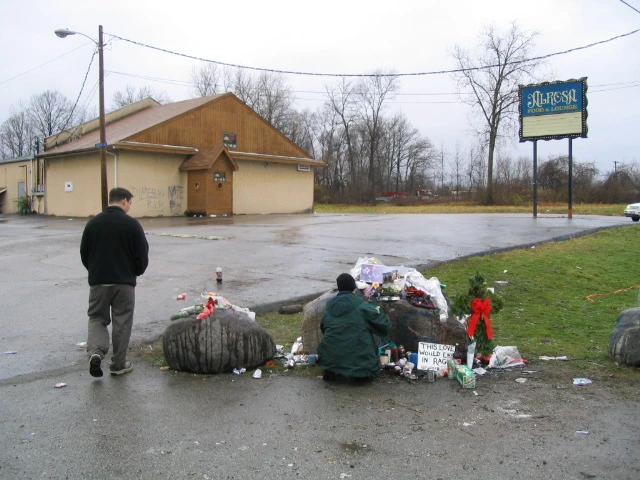
Ohio nightclub mass shooting
CLASSIFICATION: Mass Murder
LOCATION
Columbus, Ohio, United States
TIME PERIOD
December 8, 2004
VICTIMS
7 confirmed
Four people were killed and three others wounded in a mass shooting at the Alrosa Villa nightclub in Columbus, Ohio on December 8, 2004, during a Damageplan concert. The primary target was guitarist Dimebag Darrell, who was shot and killed onstage, along with three other victims; the gunman, Nathan Gale, fired about 15 rounds and took a hostage. Officer James Niggemeyer responded within minutes and shot Gale dead, establishing the shooters identity and ending the attack; motive remains unknown. Investigators recovered the shooters Beretta pistol, extra ammunition, and handwritten notes in his apartment as key evidence.
Some believe the rampage was driven by a mentally ill, obsessed fan who blamed the guitarist for Pantera’s breakup or even accused the band of stealing his lyrics and identity. Investigators and many reporters debated that motive—some sources linked the attack to the band split and Phil Anselmo’s perceived influence while detectives later downplayed any direct contact or conspiracy. Others point to missed warning signs and security failures—notably an earlier onstage disturbance months before—and unresolved questions about the shooter’s early military discharge and psychiatric history that leave motive and prevention unsettled.
On a Wednesday night in December 2004, a small Columbus rock club packed with a few hundred fans watched one of metal’s most revered guitarists kick into the first song of his set. Within minutes, four people were dead on and around that stage, three more were wounded, and the gunman lay killed by a single shotgun blast from a responding officer. [1][2][3]
At the center of it all was Darrell “Dimebag” Abbott—founder of Pantera, then touring with his new band Damageplan—and a 25‑year‑old fan named Nathan Gale, who walked into the Alrosa Villa nightclub with a 9mm handgun and a fixation that investigators would never fully untangle. [2][4][5]
Darrell Lance Abbott was born in the Dallas area on August 20, 1966, the son of country songwriter and producer Jerry Abbott and his wife Carolyn. [6] Encouraged early by their father to play music, Darrell and his brother Vincent—better known as Vinnie Paul—threw themselves into guitar and drums rather than the country records that surrounded them. [6]
As a teenager, Darrell was drawn to hard rock and metal players like Tony Iommi, Ace Frehley, Eddie Van Halen, and Randy Rhoads, and he quickly started winning local and statewide guitar competitions. [6] The brothers formed Pantera in the early 1980s, eventually signing with a subsidiary of Atlantic Records and releasing a run of albums—Cowboys From Hell, Vulgar Display of Power, Far Beyond Driven—that pushed the band into the center of 1990s heavy metal. [6]
Over time, the music hardened, the crowds grew, and Darrell’s nickname evolved from “Diamond” to “Dimebag,” a reflection of both his flash and his edge. [6] Pantera became one of metal’s defining acts, earning Grammy nominations and a fiercely loyal following that would not easily accept change. [6]
That history made what happened next especially volatile. After years of internal feuding, particularly between Abbott and vocalist Philip Anselmo, Pantera broke up in 2003. [6] Darrell and Vinnie Paul responded by forming a new band, Damageplan, recruiting vocalist Patrick Lachman and bassist Bob Kakaha and releasing their debut album New Found Power in February 2004. [6]
By December, Damageplan was touring the club circuit—smaller rooms, closer crowds, and a mix of fans who loved the new songs and those who still wanted Pantera. [4][6]
Eight months before the shooting in Columbus, Damageplan played Bogart’s nightclub in Cincinnati. Sometime in early April 2004—reports differ on whether it was the 4th, 5th, or 8th—a large man jumped onstage during the band’s set and refused to leave. [5][7][8]
Witnesses later described the intruder as a “big guy” who was intent on staying on the stage. [5] He grabbed a stack of amplifiers on one side and knocked down lighting as security tried to drag him away, ultimately causing about $1,800 in damage to lights and equipment. [5][7] Through it all, witnesses said, the band kept playing. [5][7]
Bogart’s security confiscated the intruder’s driver’s license and turned it over to Cincinnati police, who labeled the case criminal damaging/endangering. [5] But Damageplan declined to press charges, and no case was filed; authorities later said band members did not want to return to Cincinnati for hearings. [5][7]
In the days after the Columbus tragedy, fans began circulating stories online about that earlier incident and whether it involved the same man. [5] Cincinnati police eventually confirmed to Columbus investigators that the Bogart’s intruder was Nathan Gale, a 25‑year‑old from Marysville, Ohio, though some witnesses to both shows admitted they couldn’t positively identify him. [5]
For Sgt. Jeff Sacksteder of the Columbus homicide squad, the April disturbance was a potential “bridge” to the shootings—but not a complete explanation. He observed that whatever connection existed, the other part of the story was what Gale “was going through mentally.” [5]
On December 8, 2004, Damageplan rolled into Columbus to play the Alrosa Villa, a long‑running rock club at 5055 Sinclair Road. [6][8] The venue, with a capacity of around 600, had sold about 250 tickets for the night’s show, but by the time the headliner took the stage, roughly 400 people had crowded into the room. [2][5][8]
Among them was Nathan Gale. Witnesses and investigators later described him as a big, 6‑foot‑5, 268‑pound semipro football player from Marysville, 25 years old and a longtime Pantera fan. [2][5][7]
Around 9 to 9:30 p.m., an Alrosa security guard named Mitch Carpenter saw Gale park a red 1995 Pontiac Grand Am beside the club’s front door and pace outside the patio. [2] Carpenter and another guard asked if he had a ticket; Gale said he did and that he was waiting for the headliner. [2]
According to police reports, Gale later scaled a wooden fence surrounding the venue’s outdoor patio—a difficult climb for someone his size, witnesses noted—and made his way inside as several gig‑goers encouraged his intrusion and helped him sneak past a security guard trying to block anyone without a ticket. [1][2]
Damageplan had just begun its set, starting the first song of the night, when Gale moved through the crowd, scrambled up the stage‑right steps, and headed straight toward Dimebag at his microphone. [2][3] He was wearing a Columbus Blue Jackets jersey. [2][8]
Accounts differ on the split seconds that followed. Damageplan’s tour manager, Chris Paluska, told police he was shot as he tried to keep Gale from getting onto the stage. [1] Other eyewitnesses said they saw Gale produce the handgun and fire at Abbott first. [1]
What is clear is that, within the opening moments of the attack, Gale drew a 9mm handgun and shot Darrell Abbott at point‑blank range in the head, killing the 38‑year‑old guitarist instantly during the band’s first song. [2][3][4] An eerie feedback squeal from Abbott’s guitar filled the room as chaos took over. [2]
Dean Guitar.jpg
The gunfire turned the front of the club into a scramble of bodies moving toward and away from the shooter.
Damageplan’s head of security, Jeff “Mayhem” Thompson—40 years old, a towering bodyguard known as a “gentle giant”—charged across the stage after Gale. [3] He caught the gunman and pulled him to the ground in a violent struggle. [3][8] Thompson was shot multiple times in the chest, back, and upper thigh and died at the scene. [3][8]
Erin “Stoney” Halk, a 29‑year‑old Alrosa Villa roadie and security staffer and a former Marine, also moved to intervene. [3][8] Some reports later described him as trying to help Thompson take Gale down; others said he charged the shooter as Gale paused to reload. [3] In either version, Halk was mortally wounded—shot repeatedly while attempting to stop the attack. [8]
From the crowd, 23‑year‑old fan Nathan “Nate” Bray climbed onto the stage. [3] A married father with a two‑year‑old son, Bray had come to see his guitar hero. [3] Amid the confusion, he tried to give CPR to Abbott and to Thompson. [3] Gale shot him in the chest. Bray was rushed to Riverside Methodist Hospital, where he was pronounced dead at 11:10 p.m. [8]
As bullets tore through the stage area, others were hit while trying to intervene or escape. Paluska, Damageplan’s tour manager, suffered a gunshot wound to the abdomen or chest and was hospitalized at Riverside; he survived and was released eight days later. [1][2][8]
John “Kat” Brooks, the band’s drum technician, was also shot and wounded. [2] He and another crew member, Travis Burnett, would become central to the final, desperate moments of the attack. [1]
By the end of the gunfire, four people—Abbott, Thompson, Halk, and Bray—were dead, and three others wounded, before police killed Gale. [2][8] Early reports from the crime scene and national coverage varied on the exact victim count, reflecting the confusion in the immediate aftermath. [1][7]
Gale did not stop shooting once the first wave of victims fell. Investigators later concluded he fired a total of 15 rounds from his 9mm Beretta 92FS during the attack. [2][8]
As the stage area emptied out, Brooks told police that Gale pinned him to the floor and used him as a hostage, pressing the gun against his head and shouting, “Don’t move, don’t move.” [1] Brooks was shot three times during the struggle but survived. [1][8]
Travis Burnett, another road crew member, climbed onto the stage and tried to put Gale in a wristlock. [1] The gun discharged, grazing Burnett’s left forearm. [1][8] He fled and heard three more shots he believed were aimed at him. [1]
Outside the club, Columbus police officer James Niggemeyer, 31 years old and five years into his career on the force, had just finished roll call for the third shift when he got the live‑fire call. [2] He was the first officer to pull into the Alrosa’s parking lot, with two more units arriving right behind him. [2]
Niggemeyer drove around to the back of the building and went in through a rear entrance, passing people who were yelling that the shooter was still inside. [2][8] He had been assigned the shift’s Remington 12‑gauge pump‑action shotgun that night, a weapon he had previously fired on duty only to humanely destroy a deer. [2]
Inside, Sgt. Brent Mull later said, Gale had a hostage in a headlock—presumed to be John Brooks—when Niggemeyer entered. [2] Within roughly five minutes of the first shots, the officer stepped into the stage area, took aim, and fired a single shotgun blast to Gale’s head, killing him instantly and ending the attack. [1][2][8]
At the time of his death, Gale still had a half‑full magazine in his pistol and about thirty more rounds of ammunition on his person. [8]
Sgt. Mull would later say bluntly that, if not for Niggemeyer, what happened at Alrosa could have been “much worse.” [4] Gale’s own mother would eventually call the officer a hero and say, “I give that man credit. You’ll never know how many lives he saved.” [8]
In the months after the shooting, investigators and reporters tried to reconstruct how a young fan turned into the man on that stage.
Nathan Miles Gale had grown up in Ohio after his parents’ divorce, eventually graduating from a vocational program at Ohio Hi‑Point Joint Vocational School in 1998, where he studied construction and electrical work. [2][8] His mother, Mary Clark, would recall his childhood as “typical,” mentioning only a brief stint on the high school wrestling team before the vocational track. [2]
Clark said her son later “got into drugs” and joined the Marine Corps in an effort to straighten out his life, though that account has been presented as disputed. [2] Military records show that Gale enlisted in 2002 and was discharged in October 2003—less than two years into a four‑year stint. [5][7][8]
Here the record splits. Gale told his mother and a former employer that he had been diagnosed as a paranoid schizophrenic and discharged early on medical grounds. [2][5][7] Clark said the military sent him home with medication and a diagnosis of paranoid schizophrenia, but that he never sought further treatment. [2]
Military documents cited in later reporting, however, linked his discharge to a weight problem and did not mention mental illness. [5] A Marine Corps spokeswoman declined to explain the reason for the discharge. [8]
Despite the disputed diagnoses, people around Gale noticed that something was off. A tattoo artist in Marysville said he would often hang around the Bears Den Tattoo Studio, listening and “just sort of” staring. [4] Friends told reporters he lived with and financially leaned on his mother, picking up day jobs when he could. [4]
What is not disputed is his obsession with Pantera. Gale was a longtime fan of the band Darrell and Vinnie Paul Abbott had formed in the early 1980s. [5] A friend quoted in the press said, “He was hard‑core into Pantera.” [4] One article reported that he idolized vocalist Phil Anselmo and memorized Pantera’s lyrics. [4]
Former acquaintances told journalists that Gale had begun claiming Pantera had stolen songs from him. [5][7] Some said he accused the band of lifting his material, though no evidence of such theft has ever surfaced. [5][7]
Mary Clark said she bought her son a 9mm Beretta handgun as a Christmas present in 2002, after he completed Marine Corps basic training. [2] She later acknowledged that purchase and said she might have failed to recognize the extent of his mental illness. [2]
An autopsy by the Franklin County coroner’s office found no trace of drugs—prescription or otherwise—in Gale’s system at the time of his death. [8]
The crime scene that confronted Columbus police at the Alrosa Villa that night was sprawling, bloody, and crowded. Sgt. Jeffrey Sacksteder’s Critical Incident Response Team worked the club through the night, finally wrapping up at 6:55 a.m. the next morning. [2] Three Central Ohio Transit Authority buses were brought in to keep dozens of shaken witnesses secured and warm as statements were taken. [2]
Officers scoured the venue for shell casings, weapons, and personal effects, and they interviewed more than a hundred witnesses on site. [2] Later reporting based on the full investigative file put the number of eyewitness interviews at 287. [1] Sacksteder called it the most complicated case the response team had ever investigated, given the number of victims and people in the room. [5]
Police evidence logs documented that Gale had fired 15 shots and died with additional rounds still on him and in his pistol. [2][8] The weapon was identified as a 9mm Beretta 92FS, the same caliber as the handgun his mother had purchased him. [2][8]
Detectives quickly traced Gale’s red Pontiac Grand Am back to Marysville and obtained a warrant for his apartment. [1][2] Inside, according to later reports, they found no computers, magazines, or compact discs that connected him directly to Damageplan or Pantera. [1] In his car, however, the stereo held a Damageplan CD. [1]
Dimebag_001.jpg
In the apartment, police discovered two handwritten notes. [8] One read: “You’ll see come alive. I’ll take your life and make it mine. This is my life I’m gone. Git me.” [8] The other: “You’ll see the sky fall. I’ll makes Pig fly. Come on and give me some. Come on give me some. Do it and Die, Do it and Die.” [8]
Meanwhile, Columbus police—aware of the rumors swirling online about the earlier Bogart’s show—requested and received Cincinnati’s reports on the April onstage intrusion. [5] By April 12, 2005, they publicly linked that disturbance to Gale and confirmed that he had been the man dragged off Bogart’s stage that spring night. [5]
A separate review focused on Officer Niggemeyer. Members of the division’s Critical Incident Response Team compiled a detailed account of his actions at Alrosa Villa for the Franklin County prosecutor’s office. [5] In Columbus, all police uses of lethal force are presented to a grand jury. [5]
On May 23, 2005, a grand jury cleared Niggemeyer of any wrongdoing in the shooting of Gale. [8]
The officer would go on to receive several awards for his actions that night, including the Distinguished Law Enforcement Valor Award from Ohio’s attorney general and a national Law Enforcement Officer of the Year honor. [8] But the psychological toll was steep: he was later diagnosed with post‑traumatic stress disorder and a severe anxiety disorder, remained a first responder for three more years, and then moved into a robbery detective role before leaving the department in 2011 for another city job. [8]
The simplest story about the Alrosa Villa shooting emerged within hours: a deranged fan, furious that Pantera had broken up, blamed Dimebag for destroying his favorite band and took revenge. [4][6]
Some witnesses told reporters that as Gale bounded onto the stage, he screamed, “You broke up Pantera,” and that he shouted about the band as he pumped bullets into Abbott. [4] A user on Damageplan’s website claimed to have heard the shooter yelling, “You broke up Pantera, you ruined my life.” [4]
An early biographical summary went further, stating that Gale was upset about Pantera’s breakup and blamed Abbott for the band’s demise. [6]
But when investigators sifted through Gale’s apartment, car, and background, they reported finding no direct evidence that Pantera’s split—or the very public feud between Abbott and Phil Anselmo—had motivated the attack. [1][8] One detective wrote in the case file that there was no indication Gale had been communicating with Anselmo or any other individual about harming Abbott. [1]
By the time the full investigative file became public, authorities were explicit: they did not believe Gale’s actions were motivated by Pantera’s breakup or by the dispute between Abbott and Anselmo. [1][8] Some sources noted that the initial reports of Gale shouting about Pantera’s breakup before opening fire were never corroborated in formal witness statements. [8]
That left the case suspended between the stories people heard in the mayhem—about a fan screaming betrayal—and the cold absence of a clear motive in Gale’s own belongings. His long‑standing fixation on Pantera, his complaints that the band had stolen his songs, the disputed accounts of his mental health, and the cryptic notes police found in his apartment all pointed in the same dark direction, but they did not resolve why that December night became the moment he acted. [5][7][8]
As Sgt. Sacksteder suggested when reflecting on the earlier Bogart’s incident, whatever “bridge” connected that stage‑crashing to the massacre at Alrosa Villa ultimately ran through Gale’s mind—and that, investigators acknowledged, might never be fully known. [5]
In the days after the shooting, the Alrosa Villa went dark. [2] Fans and friends gathered at the club’s entrance to build a makeshift memorial—notes, CDs, flowers, beer bottles, and other offerings piled up where concertgoers had lined up just nights before. [2][3] Media crews set up across the street, broadcasting live shots of the club’s sign and the growing sea of tributes. [2]
Owner Rick Cautela, who had not been told about the earlier Cincinnati disturbance, spoke of his fury that the Bogart’s incident hadn’t been communicated before Damageplan’s show at his club. [2][5]
Some major events at the Alrosa were canceled, including a planned New Year’s Eve reunion by local band Rosie. [2] On January 8, 2005—exactly one month after the shootings—Rick’s father Al Cautela died. [2] Six days later, on January 14, Rick reopened the club with a benefit concert for the families of Nate Bray and Erin Halk. [2] Officer Niggemeyer attended at Cautela’s invitation but did not speak. [2]
Over time, the Alrosa Villa’s place in rock history became inseparable from the crime that unfolded inside it. Concert venues around the country tightened their security standards in the immediate aftermath, responding to the fear that what happened in Columbus could happen anywhere. [8] By 2014, some artists were already noting that many clubs had relaxed those protocols, citing the costs of maintaining such strict measures. [8]
The building itself lasted longer than the club’s reputation. The Alrosa Villa was listed for sale in late 2019 following the deaths of its founders, Al and Rosa Cautela, and was demolished in December 2021 to make way for a housing project. [8]
Darrell “Dimebag” Abbott’s legacy, however, only grew. He had been recorded at his home studio in Arlington, where several Pantera albums were tracked, and had played on records by bands from Anthrax to Nickelback. [6] In death, he was hailed as one of Guitar Player magazine’s “10 Most Important Guitarists Ever.” [6]
His funeral service was held at the Arlington Convention Center, and he was buried at Moore Memorial Gardens Cemetery in his hometown. [6] One of Eddie Van Halen’s guitars—his striped “Bumblebee”—was placed in the casket with him, a final tribute from one virtuoso to another. [6][9]
In the years that followed, heavy metal artists around the world released musical tributes to Abbott, and his brother Vinnie Paul worked to keep his memory alive through projects like the Dimevision video series and guest guitar appearances on other records. [8][9] Fans gathered annually at “Dimebash” concerts organized in his honor, turning their grief into loud, communal celebration. [9]
Inside the metal community, the night at Alrosa Villa is still referred to as a kind of 9/11 for rock—a point after which club shows would never feel entirely the same. [8]
The investigation into the shooting answered many questions: who pulled the trigger, how he got inside, how many shots were fired, and who died trying to stop him. [1][2] It also left others permanently open—chief among them why a devoted fan chose to walk through a club full of people, climb onto a stage, and aim his gun at the musician whose music had once meant everything to him.
This case file is an original Bloody Likely narrative synthesis based on the cited sources. Article © Bloody Likely. All rights reserved. Source materials remain the property of their respective owners. Facts, public records, quotations, and cited references are used for reporting, research, commentary, and documentation. Bloody Likely content license
Audio narration © Bloody Likely. All rights reserved. The audio player is provided for personal streaming/listening only.
No recent news articles found for this case. Check back later for updates.
No evidence found for this case. Be the first to submit evidence in the comments below.
Join the discussion
Loading comments...
Nathan Gale jumped onto Damageplan's stage at Bogart's nightclub, causing damage and a police response though the band declined to press charges.
During Damageplan's concert at Alrosa Villa in Columbus, Nathan Gale rushed the stage and fatally shot Dimebag Darrell and three others while wounding three
Officer James Niggemeyer entered the club and fatally shot Nathan Gale with a shotgun three minutes after the attack began, stopping further killings.
A grand jury declined to charge Officer James Niggemeyer after reviewing his use of deadly force during the Alrosa Villa shooting.