ANALYZING EVIDENCE
Processing case files...
Processing case files...
Olney Missing Women Investigation
CLASSIFICATION: Unsolved Homicide
LOCATION
Philadelphia, Pennsylvania
TIME PERIOD
June -August 2026
VICTIMS
2 confirmed
Police investigators recovered extensive digital files and physical evidence from a three-story home on West Chew Avenue in the Olney section of Philadelphia that appear to show two long-missing women deceased. The case centers on 44-year-old homeowner Eugene Horsch, who was arrested in June 2026 on weapons and fraudulent federal credential charges and remains in custody on unrelated federal counts. Detectives have not recovered bodies but say images and videos recovered from hard drives depict Maribel Fresses (missing 2018) and Gabrielle Amarando (missing 2012) alive and later appearing deceased; forensic review and additional searches, including yard excavations and chemical testing, are ongoing. The investigation is active and the medical examiner has not issued death certificates because human remains have not been located.
Some believe the trove of “graphic” images and videos recovered from the Olney house implicates Eugene Horsch — or people connected to him — in the deaths or concealment of at least two missing women, with investigators drawing comparisons to past Philadelphia cases of captivity and torture. Others point to the elder Horsch’s history producing violent erotic material and the discovery of urns, a basement “home lab,” weapons, fake credentials and references to disposal in writings as evidence of a broader operation that could involve snuff production, narcotics activity, and multiple collaborators rather than a lone actor. Because no bodies have been recovered and Horsch has not been charged in the disappearances, debate continues over whether evidence will prove homicide, whether additional missing women (including relatives or visitors to the home) are connected, and whether key suspects or accomplices remain unidentified or deliberately covered up.
In the middle of a June night in Center City, a U.S. park ranger heard a woman in a parked car say, “you’re going to hurt me.”[1] What started as a domestic disturbance call on the 600 block of Market Street would, within days, crack open one of Philadelphia’s most unsettling investigations in years: a two-story house on West Chew Avenue in Olney, a 44‑year‑old owner named Eugene Horsch, and at least four missing women whose stories now seem to run straight through that address.[2][3][4]
Police say that inside the Olney home they found drugs, guns, chemicals, hidden compartments, urns of cremated remains, and a vast digital archive of images and videos.[2][5][6] Among those files, investigators say, are recordings that appear to show two long‑missing women — Gabrielle Amarando and Maribel Fresses — alive in some moments and dead in others.[4][7]
No bodies have been found.[2][5] No cause of death has been determined.[4][7] And as of the latest reporting, Horsch has not been charged in connection with any homicide or any of the missing‑women cases.[3] He remains behind bars on weapons, drugs, and federal document charges, while detectives and the FBI keep going back to that house, searching for answers.[3][5][8]
On June 19, 2026, a park ranger near Independence Hall in Old City noticed an argument unfolding inside a parked vehicle.[6] The ranger was alarmed when the woman in the car told the man, later identified as Eugene Horsch, “you’re going to hurt me.”[1][6] Police were called.
Officers say they found Horsch and a woman in the vehicle with drugs, two loaded guns, and a fake DEA badge or credentials.[2][4][7] When they searched him further, they reported finding a switchblade in his pocket and two firearms with obliterated serial numbers.[1]
The woman in the car produced an identification card that was supposed to belong to someone else: 35‑year‑old Blair Tonzelli, who had gone missing from Kensington in 2023, according to police and reporters.[3][6][7]
That suspicious ID card and the guns and drugs in the car were enough to get Horsch arrested in Center City on weapons and narcotics charges.[2][6][7] They were also enough, investigators say, to point them toward the house he owned in Olney — and toward a much larger mystery.[2][3]
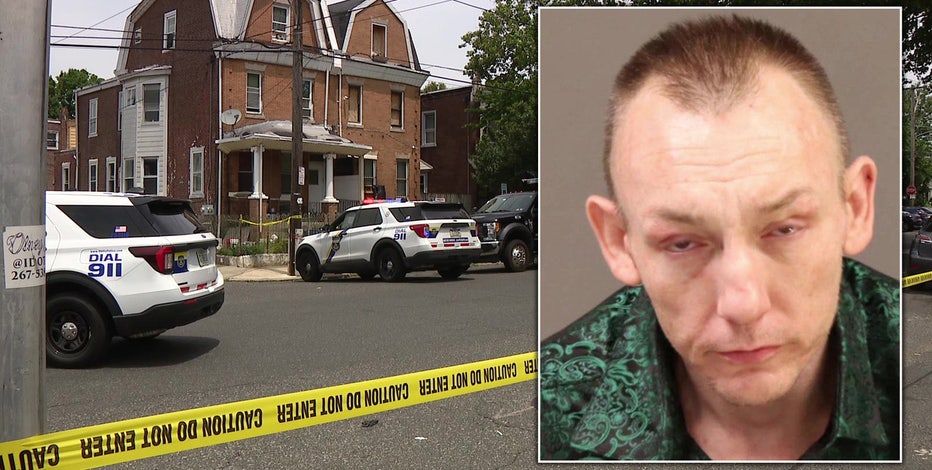
The home that suddenly drew law enforcement’s attention sits on the 400 block of West Chew Avenue in Olney, a two‑story property where 44‑year‑old Eugene Horsch lived and which he owns.[2][5][8] Police and federal agents executed search warrants at the house in June, not long after the Market Street arrest.[3][8]
Inside, according to investigators and court records, they found an arsenal and a lab‑like setup. Officers reported seizing guns, ammunition, and drugs, along with a complex system of water lines leading to a 55‑gallon drum in the basement.[2][8] Investigators say they collected more than 120 pieces of ballistic evidence, fake federal identification, and multiple computers.[2][6]
Law enforcement sources also described a suspicious stockpile of chemicals — “chemicals in bottles,” as one search warrant return was summarized — and evidence suggesting an attempt to grow or produce narcotics inside the home.[2][3][6] Some of the containers were later described as part of an “at‑home lab” in the basement, with more than 20 containers holding unknown substances.[5] People magazine reported that some of those were “oily” liquids.[1]
Among the items cataloged by authorities: five urns said to contain cremated remains and a stash of zip ties.[5] Police also reported seizing handwritten material, including letters and notes that referenced ways to dispose of bodies, and a piece of writing about serial killer Ted Bundy that mentioned zip ties, a drum, killings, and “trash that needs to go.”[2][3][5]
Who wrote those disturbing pages is still a live question. Investigators and reporters have noted that Eugene’s late father, Raymond “R.C.” Horsch — a filmmaker and erotic photographer — produced snuff films and wrote erotic books with sadomasochistic themes.[1][3] His name and work loom heavily over the Olney case. NBC10 and Fox29 have both reported that some writings found in the Chew Avenue home may be his, and that investigators are working to determine whether the elder Horsch wrote the letters about disposing of bodies.[2][3]
One Ted Bundy–referencing note, seized by investigators, has been the subject of particular scrutiny. Authorities have said its authorship remains unclear, while Eugene Horsch’s attorney has suggested that R.C. Horsch is the likely writer.[3]
The searches of the Olney property did not stop at the front door. Crews excavated portions of the yard, removed sections of sewer line, and even dug up pipes beneath the house.[3][5][8]
According to law enforcement sources cited by CBS News Philadelphia, at least one of those search warrants directed investigators to look for evidence of “wet cremation” — the use of a chemical mix to break down human remains.[8] NBC10 later reported that, after excavating pipes beneath the property, sources said investigators did not find anything “substantial.”[3]
Inside the house, Philadelphia Inquirer reporter Barbara Laker said investigators discovered a “significant amount” of blood; testing has been underway to determine whether it is human or animal.[2] Other sources told NBC10 that search teams found what appeared to be fake blood but no human remains.[3]
What investigators have publicly confirmed is stark: no bodies were found in the home, despite intense speculation.[2] Police have also said that, as of now, they have not recovered the bodies of either Maribel Fresses or Gabrielle Amarando.[5]
As detectives worked through the Chew Avenue scene, the names of four missing women surfaced again and again. At least four, investigators said, were now linked in some way to the Olney home.[3][4]
Gabrielle “Gabby” Amarando was 22 when she disappeared in 2012.[3][4][5] Friends and family say that around that time, contact simply stopped; her childhood best friend, Ashley Levin, recalled that loved ones grew increasingly alarmed as the silence stretched on.[9]
Levin has described meeting Amarando in third grade and quickly becoming close.[9] In interviews, she has emphasized that Amarando’s struggles with addiction and mental health do not define her and that “she was a wonderful soul.”[9] Another friend told reporters, “She is much more than these recent headlines,” urging people to remember Gabrielle as more than just a name in a missing‑persons case.[4][7]
Police say images and videos recovered from the Chew Avenue home show Gabrielle alive in some footage and dead in other material.[4][7] Detectives spoke directly with her family and told them that the recovered footage includes scenes of her alive and photos in which she appears deceased, according to Amarando’s mother.[4]
On August 12, 2026, Philadelphia police announced that video evidence recovered from a hard drive inside the house led investigators to believe that both Amarando and another missing woman, Maribel Fresses, are no longer alive.[3] A medical examiner quoted by People magazine went further, saying that if the images are unaltered and authentic, then based on what they show, the women are believed to be deceased.[1]
© Mapbox © OpenStreetMap
Even so, officials stress that an official cause of death for Amarando has not been determined.[4][7]
Maribel Fresses disappeared in 2018 when she was 27.[3][4][5] Her brother, Dawson, told NBC10 the discovery of the digital evidence left him in “pure shock” and noted it had been eight years since he last saw his sister.[6]
Investigators say the vast trove of digital material recovered from the Olney home included images and video appearing to show Maribel Fresses, suggesting she may be deceased.[5][7] Like in Gabrielle’s case, no body has been recovered and no official cause of death has been established.[4][5]
The Chew Avenue house was already a place of private dread for another family long before police tape went up. Amy McHale, who was married to Raymond “R.C.” Horsch, was last known to be at that house in 2016 and has not been seen since.[1][3][8]
Olney investigation: What we know about Eugene Horsch, missing women, and the search
One of her daughters, Amanda Stofer, has said that her mother left a voicemail saying she was “at Ray’s” shortly before she disappeared.[1] McHale’s family told reporters they last heard from her while she was at the Chew Avenue home in June 2016.[2]
Fox29 has reported that investigators are examining whether McHale’s disappearance could be connected to the broader Olney investigation, and that she was previously married to Eugene’s father for a short period starting in 2004.[2] CBS News also described the home as the last known location where McHale was seen.[8]
The fourth woman tied to the Olney house in public discussion is Blair Tonzelli. Police and outlets have reported that she went missing from Kensington in 2023 at age 35.[3][4][6]
Her name entered the Horsch investigation through that Center City arrest. Detectives say the woman in the car with Horsch in June handed officers a fake identification card that belonged to Tonzelli.[3][4][7] Inspector Ray Evers later said police believe “we may never see [Tonzelli] again.”[1]
Despite that ominous assessment, authorities have also been explicit about what they have not found: police say there is no digital evidence so far linking Tonzelli to the Chew Avenue home, and it remains unclear whether any future evidence will tie her, McHale, or other missing women decisively to that address.[7]
If the physical searches at Chew Avenue looked like a crime lab, the digital searches have looked like something closer to an archive. Detectives and federal agents say they recovered hundreds of thousands of images and tens of thousands of videos from the house, along with more than 10,000 pages of writings, manuscripts, and drawings.[1][7][9]
Fox29 reported that investigators must sift through more than 600,000 images and 70,000 videos.[7] Inspector Evers has said that, at one point, investigators had gone through only about five to seven percent of the digital information and had examined just one of five recovered hard drives.[1] Multiple law‑enforcement sources have reiterated that only a small portion of the material has been reviewed so far.[4][7]
The FBI is assisting with the analysis, a sign of just how large and complex the evidence set is.[1][9]
Authorities have repeatedly described what they have seen as “dark and graphic.”[3][6] Philadelphia Police Inspector Ray Evers told reporters, “I’m not gonna get into exactly what I saw. It’s dark. It’s real dark.”[6]
According to investigators, that digital cache contains imagery in which both Gabrielle Amarando and Maribel Fresses can be seen alive at certain points and apparently deceased at others.[4][7] Evers has said that “what we saw is these two girls alive. There was a period of time, and what appears to us is that they’re deceased,” while noting that there are segments of video authorities do not yet have.[6]
Some of the images reportedly show visible injuries.[7] Law enforcement officials told NBC10 that on August 12 they informed the public that video evidence from a hard drive inside the house led investigators to believe Fresses and Amarando are no longer alive.[3] People magazine similarly reported that recordings were found in which two missing Philadelphia women appear to be deceased.[1]
But without bodies or clear forensic corroboration, much about what those files depict — and what they prove — is still being parsed. WGAL reported that police have not found the bodies of Fresses or Amarando and that the absence of remains makes the case particularly challenging.[5] Former FBI agent JJ Klaver, who once worked in the bureau’s Philadelphia division, noted that without a body there is “no easy source of DNA” to match against any potential forensic evidence in the house.[5]
Inspector Evers has acknowledged that the homicide unit is in “new territory” because, unlike most killings they investigate, “this time they do not” have a body.[6]
Eugene Horsch did not grow up in an ordinary family home. His father, Raymond “R.C.” Horsch, was by multiple accounts a filmmaker and erotic photographer whose work included snuff films and erotic books with sadomasochistic themes.[1][3]
NBC10 Investigators confirmed that R.C. died in 2025, and that he died at the same Chew Avenue residence now under scrutiny.[1][3][6]
The property is also the last known location of his wife, Amy McHale, who disappeared in 2016.[1][6][8] The convergence of the elder Horsch’s death, McHale’s disappearance, and the later discoveries in Eugene’s home has led neighbors and commentators to see a through‑line — whether of influence, opportunity, or something darker is still under investigation.
Reporters have noted that R.C. wrote horror fiction novels and movies, some with themes overlapping the disturbing letters seized from the house.[2] As investigators and attorneys debate whether the Ted Bundy–themed note and other writings belonged to the father or the son, they highlight a haunting fact: even the paper trail at Chew Avenue comes pre‑loaded with violence, death, and disposal.
For all the lurid possibilities suggested by the evidence list, this is still a case defined as much by what hasn’t been found as what has. There are urns of ashes, but no identified bodies.[5] There is a significant amount of blood, but tests are still determining exactly whose, and even whether it is human.[2] There are videos and images that investigators say show two women dead, but no autopsy, no clear time or place of death, and no certainty about how the women died.[4][5][7]
Experts say that makes everything harder. Klaver has said investigators are “going through that house with a fine‑tooth comb” to look for forensic evidence that could tie Horsch to any victims or missing persons.[5] Forensic scientist Dr. Peter Valentin, who is not involved in the case, told NBC10 that the videos must have shown the women in some part of that house, and that detectives will likely search for DNA and other physical evidence in specific rooms to support what the recordings depict.[3]
At the same time, Valentin noted how difficult it would be to dispose of a body so thoroughly that no evidence of its existence remains.[3] And retired prosecutor Charles Gallagher pointed out in another interview that investigators do not necessarily need to recover a body to pursue a murder case.[3]
For now, though, the missing women remain officially just that — missing.
Legally, the case against Eugene Horsch is still about guns, drugs, and forged federal credentials, not murder. He was arrested on June 19, 2026, and charged in state and federal court on firearms and drug‑related counts, including possession with intent to deliver, multiple violations of the Uniform Firearms Act, and later, federal charges of possession of a firearm by a convicted felon and possession of an unlawfully produced document and authentication feature.[2][6][8] Federal authorities also say he was found in possession of fake DEA and FBI badges.[1][7][8]
He remains in custody on those weapons and drug charges.[5][6] A jury trial in the federal case was scheduled for September 8, 2026.[3]
Crucially, police and prosecutors have been clear that, as of the latest updates, Horsch has not been charged in connection with any of the missing women or any death investigation.[3] The official cause of death for both Amarando and Fresses remains undetermined.[4][7]
Through his attorney and in comments reported by the New York Post, Horsch has denied having anything to do with the missing women.[6]
The Olney case has stirred memories of one of Philadelphia’s darkest chapters: the crimes of Gary Heidnik. Neighbors and commentators have drawn comparisons to Heidnik’s North Philadelphia rowhouse, where a jury later found he had kidnapped, tortured, and killed women in the late 1980s.[3] He was convicted of kidnapping, torturing, and killing women, and the state ultimately put him to death in 1999.[3]
Retired prosecutor Charles Gallagher, who worked on the Heidnik case, remembered those crimes as “the most bizarre thing” he had ever seen, recounting how Heidnik broke through his basement floor to dig a pit where he kept victims.[3]
The comparison underscores the fear swirling around West Chew Avenue — but it also risks overshadowing the individual women whose lives now intersect with that address.
For Gabrielle Amarando’s loved ones, the emerging evidence has brought a painful kind of confirmation. Her friend Ashley Levin has said that Amarando’s mother “felt all along like she wasn’t here anymore” but never had confirmation until investigators shared what they found.[9] Levin has spoken publicly about wanting her friend remembered “for who she was rather than the circumstances surrounding her death,” even as the official cause of that death remains unclear.[7][9]
Other families, like that of missing woman Amanda De Guio, are watching the Horsch investigation closely. De Guio disappeared from her Upper Darby home in 2014, leaving her phone, purse, and credit cards behind.[9] Her mother and sister say there is no indication her case is connected to the Olney investigation, but they are hopeful that any breakthroughs could help other families searching for loved ones.[9] “Is it possible? Yes. And that’s what’s scary,” her sister said. “Now I’m waiting for my phone to ring.”[9]
As of mid‑August 2026, the Chew Avenue home remains a crime‑scene landmark. NBC10 reported that police expect to return to the property as the investigation connected to the missing women continues to grow, while Fox29 noted detectives plan further searches and that the investigation is “far from complete.”[3][4][7] Philadelphia police continue to cordon off the property as they pursue new leads.[7]
Investigators say they are still searching for anyone else who may have visited the house, comparing DNA from women missing from Kensington, and trying to determine whether other disappearances beyond the four already linked will eventually lead back to Olney.[7] Police have asked anyone with information to call the department’s tip line at 215‑686‑TIPS.[7]
For now, the known facts are chilling but incomplete: a house wired with water lines to a 55‑gallon drum and filled with chemicals, guns, urns, and writings about body disposal;[2][5][8] a digital graveyard of images and videos that investigators say show two missing women dead;[3][5][7] and an owner who sits in custody on firearms and drug charges, denying involvement, while detectives and the FBI try to turn disturbing pictures into provable crimes.[1][3][6]
Until they do, those women’s names — Gabrielle, Maribel, Amy, Blair — remain attached less to an accused killer than to a house that seems to have been collecting secrets for more than a decade.
This case file is an original Bloody Likely narrative synthesis based on the cited sources. Article © Bloody Likely. All rights reserved. Source materials remain the property of their respective owners. Facts, public records, quotations, and cited references are used for reporting, research, commentary, and documentation. Bloody Likely content license
Audio narration © Bloody Likely. All rights reserved. The audio player is provided for personal streaming/listening only.
No recent news articles found for this case. Check back later for updates.
No evidence found for this case. Be the first to submit evidence in the comments below.
Join the discussion
Loading comments...
Gabrielle Amarando has been missing since September 2012 and was later linked to the Olney investigation.
Amy McHale was reported missing in 2016 and her last known connection was to the Chew Avenue house.
Maribel Fresses was last seen in February 2018 and was later identified by police as connected to the investigation.
Blair Tonzelli had not been heard from since February 2023 and her identification was later linked to Horsch's encounter.
Police arrested Eugene Horsch in Center City after finding him and a woman in a vehicle with drugs, two loaded guns and a fake DEA badge.
A U.S. park ranger intervened in a car argument, leading to Horsch's arrest and discovery of fake credentials, firearms and an ID for Blair Tonzelli.
Police searched 417 West Chew Avenue and found urns, a basement home lab, containers with unknown substances, weapons and digital media.
Investigators executed a search warrant at the Chew Avenue Olney home and discovered chemicals stored in bottles and other evidence.
Prosecutors filed federal charges against Eugene Horsch tied to possession of firearms and unlawfully produced identification documents.
Investigators excavated parts of the Chew Avenue property and removed sewer lines and a pipe as part of the ongoing probe.
Philadelphia prosecutors withdrew from the Olney 'mystery house' matter while federal proceedings continued.
Police disclosed that graphic videos and images recovered from a hard drive appear to show Maribel Fresses and Gabrielle Amarando deceased.
Authorities reported recovering roughly 600,000 images, 70,000 videos and thousands of pages of writings and drawings from Horsch's home.
A jury trial in the federal case against Eugene Horsch was scheduled to begin on September 8, 2026.