ANALYZING EVIDENCE
Processing case files...
Processing case files...
Long Island Serial Killings
CLASSIFICATION: Serial Homicide
LOCATION
Long Island, New York
TIME PERIOD
1993-2011
VICTIMS
11 confirmed
The Gilgo Beach serial killings involved the murders of at least 11 individuals, primarily sex workers, whose remains were discovered along Ocean Parkway in Suffolk County, New York, between December 2010 and April 2011. The investigation, which began with the disappearance of Shannan Gilbert in May 2010, has led to the arrest of suspect Rex Heuermann, who faces multiple charges including first-degree murder. The case is currently in the judicial process following his capture.
Some believe the killings represent a “double life” scenario in which Rex Heuermann portrayed a suburban family man and Manhattan architect while secretly murdering sex workers, a theory bolstered by neighbors’ shock and reporting that he lived an outwardly normal life. Investigators and commentators have speculated about familial influences and psychological drivers, with tabloid and expert commentary pointing to a controlling mother and possible deep-seated pathology; his attorney has countered that the case is largely circumstantial. Other debated points include whether all discovered deaths were committed by a single person (police have long said some victims may be unconnected), whether Shannan Gilbert’s death was accidental or homicide, and the extent — if any — of involvement or knowledge by Heuermann’s family given that investigators reported hair matches to his wife but also said family members were out of state at times of the killings.
By the time the architect from Massapequa Park was led into a Riverhead courtroom to hear he would die in prison, the story of Gilgo Beach had stretched across decades, shorelines, and more victims than anyone could neatly count.[1][2][3]
Prime Minister's Questions, 26 February 2020 24.jpg
Rex Heuermann, a 62‑year‑old Long Island architect, ultimately admitted in court that he killed eight women.[1] He pleaded guilty to murdering seven of them and was sentenced to life in prison without the possibility of parole.[1]
But the case that would be tied to his name began, at least officially, with a lone set of human remains found off a windswept parkway in December 2010. And even now, the full count of the dead—and who killed whom—remains unsettled.[3]
The Gilgo Beach investigation began almost by accident. In December 2010, a Suffolk County police officer was out on a training exercise with a K‑9 partner along Ocean Parkway near Gilgo Beach when the dog alerted. The officer discovered human remains. [3]
As officers searched further, they began to find more. The case drew intense public attention that year as investigators uncovered remains along the same parkway while looking into the disappearance of a young woman named Shannan Gilbert. [1] Gilbert’s death itself would later be ruled an accidental drowning, but the search for her body had opened something far larger. [1]
Over time, authorities found the bodies of at least 10 women in the area around Gilgo Beach. [2] The discovery in 2010 eventually led to as many as 16 victims being identified along or near that stretch; from early on, police said they did not believe all of those deaths were the work of a single killer. [3]
Patterns emerged. Most of the women disappeared between 2000 and 2010. [1] Most of the victims’ remains were found along a parkway not far from Gilgo Beach, many within the sandy, brush‑lined margins of Ocean Parkway. [1][2]
What investigators could not do, for years, was name the person responsible for the cluster of killings that would be shorthand as the Gilgo Beach murders.
The women whose names would later be read out in a Riverhead courtroom had families, children, and plans that stopped mid‑stride.
Maureen Brainard‑Barnes had two children, just 7 and 1 years old, when she disappeared. [1] Megan Waterman’s daughter, Liliana, was 3 when her mother vanished. [1]
When Rex Heuermann finally entered his guilty plea, the seven women he admitted murdering were identified as Melissa Barthelemy, Valerie Mack, Jessica Taylor, Megan Waterman, Amber Lynn Costello, Maureen Brainard‑Barnes, and Sandra Costilla. [1]
Commonwealth Games 2014 - Athletics Day 4 (14801583465).jpg
Two of those victims’ remains had been found long before the Gilgo Beach investigation ever existed. In 1993, the body of Sandra Costilla was discovered in the Hamptons, more than 60 miles from Gilgo Beach. [1] In 1996, remains later identified as Karen Vergata were located on Fire Island, more than 20 miles east of Gilgo Beach. [1]
Years later, in a courtroom, Heuermann would admit that he killed Vergata as well, though he was never charged in her death. [1] Her case hovered at the edge of the Gilgo narrative, geographically and legally separate but, by his own words, part of his tally.
For families, the horror was not only in the loss but in the long, public vacuum that followed. Melissa Barthelemy’s sister, Amanda Funderburg, later said she received a taunting phone call from Heuermann days after Melissa disappeared—Funderburg was just 15 years old. [1]
Long before his name appeared in bail applications, Rex Heuermann was known, if at all, as a Long Island architect who commuted into Manhattan. [1][3]
He was born and raised on Long Island, as he put it in a 2022 interview, and said he had worked in Manhattan since 1987. [2][3] Heuermann founded RH Consultants & Associates in 1994, an architecture and consulting firm whose online materials listed clients such as Catholic Charities, the New York City Department of Environmental Protection, and American Airlines. [2][3]
In that interview from his Manhattan office, he described himself in plain terms: “I’m an architect, I’m an architectural consultant, I’m a troubleshooter.” [2][3]
He lived in Massapequa Park, a village in Nassau County on Long Island. [3] Neighbors described him as quiet, a well‑dressed man who commuted to work in the city and “never really bothers anybody.” [2][3] Public reports identified him as a married father of two. [2]
The news that he had been taken into custody as a suspect in the Gilgo Beach case rattled people who had known him casually. Actor Billy Baldwin said he went to high school with Heuermann, tweeting that they both attended Berner High School in Massapequa and graduated in 1981. [2] He called the revelation “mind‑boggling” and wrote that “Massapequa is in shock.” [2]
To prosecutors, however, the portrait that would emerge was of a man who “lived a secret life of violence for years before admitting he killed eight women.” [1]
For years after the initial wave of recovery along Ocean Parkway, the Gilgo Beach case stalled. Leads thinned out; the dead stayed nameless or unavenged; the public story did not move far beyond the row of crime‑scene tents in the marsh.
The turning point came more than a decade after that first body was found. Local prosecutors and police later said that a multiagency task force formed early in 2022 identified Rex Heuermann as their main suspect. [3]
Official portrait of Sarah Edwards MP (cropped).jpg
Detectives linked him to a pickup truck a witness had reported seeing when one of the victims disappeared in 2010. [1] That lead alone was not enough, but it narrowed the search.
Investigators began quietly following him in Manhattan. At one point, he discarded a slice of pizza or its crust into a trash can. Detectives recovered the crust and matched DNA from it to genetic material extracted from degraded hair fragments on the women’s remains. [1][3]
Cellphone and tracking data told another part of the story. Investigators later said they used those records to show that Heuermann had arranged meetings with some of the victims shortly before they disappeared. [1][3]
According to prosecutors, evidence from several killings showed a consistent pattern: four victims were found in similar positions and had been bound with belts or tape, and the bodies of three of those women were wrapped in burlap‑type material. [3]
After his arrest, prosecutors said they also recovered what they described as a “blueprint” for the killings among his computer files—a chilling, methodical document outlining how he carried out the crimes. [1]
In 2023, with the task force’s case built out, detectives moved in. Heuermann was arrested in midtown Manhattan on a Thursday night and transported to Suffolk County. [1][3] Suffolk County police said they had taken him into custody late that night as a suspect in the Gilgo Beach murders. [2]
The next day, officials announced that he had been charged with three counts of first‑degree murder and three counts of second‑degree murder in connection with the deaths of three women. [2][3] A judge remanded him without bail. [3] In a bail application, prosecutors said he was also suspected in the disappearance and death of a fourth woman and that investigation was ongoing. [3]
At that early stage, he pleaded not guilty. [2] His attorney, Michael J. Brown, publicly pushed back on the case against him, calling the accusations “extremely circumstantial in nature” and quoting his client as saying, “I didn’t do this.” [3]
Back in Massapequa Park, authorities blocked off his home and investigators in hazmat suits went inside, searching the house that also served as the listed address for his firm, RH Consultants & Associates. [3] Investigators also searched his midtown Manhattan office. [3]
Behind the scenes, Suffolk County Police Commissioner Rodney Harrison said that investigators had identified Rex Heuermann as the figure at the center of the long‑running mystery on Ocean Parkway. [3]
© Mapbox © OpenStreetMap
While prosecutors continued to develop their case and link additional killings to Heuermann, he sat in the Suffolk County jail. Sheriff Errol Toulon later said that for about three years Heuermann was housed alone in a segregated cell. [1]
According to the sheriff, he passed at least some of that time reading crime novels and was only occasionally visited by lawyers or family members. [1] Toulon also said that Heuermann had struck up a brief correspondence with another notorious offender, the so‑called “Happy Face Killer,” during his confinement. [1]
PMQs 22.04.2020 - Ian Paisley MP (North Antrim).jpg
In court, the narrative shifted sharply in April, when the man who had once insisted “I didn’t do this” entered a guilty plea. [1][3]
Heuermann, now 62, pleaded guilty to charges that he murdered seven women: Melissa Barthelemy, Valerie Mack, Jessica Taylor, Megan Waterman, Amber Lynn Costello, Maureen Brainard‑Barnes, and Sandra Costilla. [1] Standing in court, he admitted that he strangled his victims and said that he dismembered some of their bodies. [1]
He also admitted in court that he killed an eighth woman, Karen Vergata, whose remains had been found on Fire Island back in 1996. [1] Despite that admission, he was never charged in her death. [1]
As part of the plea agreement, he agreed to cooperate with the FBI’s behavioral analysis unit—to help, investigators said, in efforts to catch other serial killers. [1]
Sentencing took place in an eastern Long Island courtroom in Riverhead, New York. [1] The outcome was final and absolute: Rex Heuermann was sentenced to life in prison without the possibility of parole for his admitted role in the Gilgo Beach killings. [1]
Relatives of the murdered women addressed the court, filling in—briefly, painfully—the outlines of the names that had become shorthand in legal filings. [1]
Jasmine Robinson, cousin of victim Jessica Taylor, looked toward the man in the dock and said, “A million years isn’t enough.” [1]
Some families chose to stay away. Through their lawyers, Heuermann’s ex‑wife and two grown children said they would not attend the sentencing, out of respect for the victims’ families. [1]
For much of the case after his 2023 arrest, Heuermann had remained largely silent during his court appearances. [1] It was at sentencing—after his plea, after his admissions—that he was given a structured chance to speak, against a record that now included his own confession to eight killings. [1]
By the time the prison doors closed behind him, the broad contours of Rex Heuermann’s double existence were set: a Long Island architect with a decades‑long Manhattan career and mainstream clients on one side, and what prosecutors called a secret life of violence on the other. [1][2][3]
But even with a conviction and a confession, Gilgo Beach remains a case with edges that do not seamlessly line up. Authorities have acknowledged that as many as 16 victims were found over the years in and around the Ocean Parkway corridor, and that they do not believe all of those deaths are linked to the same person. [3]
Some of the women he admitted killing were found far from Gilgo Beach itself: Sandra Costilla in the Hamptons in 1993; Karen Vergata on Fire Island in 1996. [1] Their inclusion in his admissions pushes the timeline of his violence back years before the cluster of disappearances between 2000 and 2010 that defined the popular understanding of the case. [1]
Early on, prosecutors had focused on a set of four slayings with very specific crime‑scene similarities—victims bound with belts or tape, three wrapped in burlap‑type material—before the eventual plea swept in seven named women and an eighth acknowledged victim. [1][3] The legal architecture of the case evolved as investigators linked more killings to the same man.
The shoreline near Gilgo Beach, where a K‑9 team first stumbled onto a body in the brush, is quiet again. [3] The tents and command posts are gone. What lingers is something harder to bury: a trail of women who vanished over years, a community still grappling with the idea that the man who designed buildings for the city also admitted to designing, in prosecutors’ words, a “blueprint” for killing. [1]
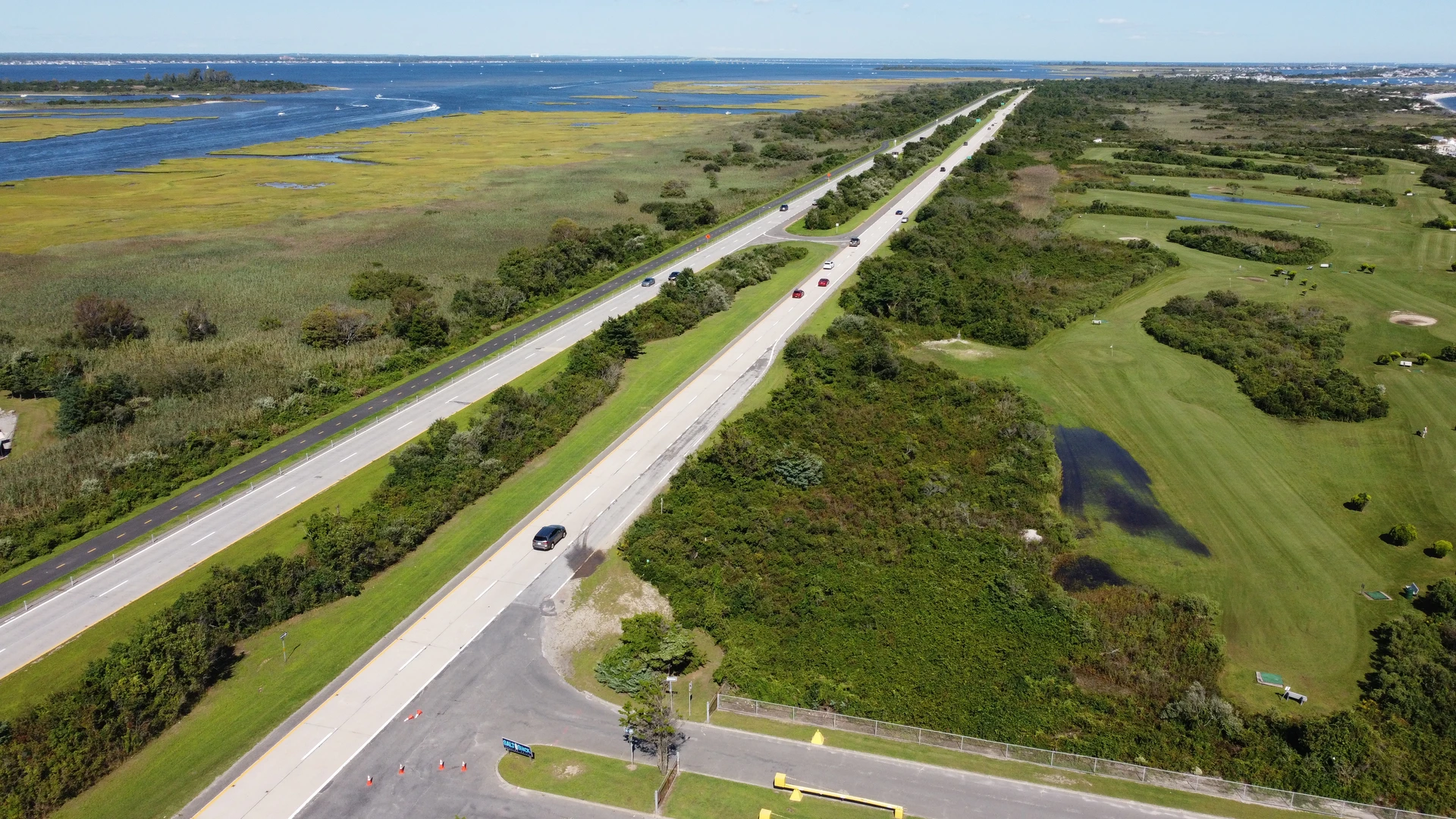
This is a stunning aerial view of a long stretch of Ocean Parkway on Southern Long Island near Gilgo Beach in Suffolk County, New York where the human remains of the original "The Gilgo Four" (Maureen Brainard-Barnes, Melissa Barthelemy, Megan Waterman and Amber Lynn Costello) we
Wikimedia Commons· CC BY-SA 2.0
For the families left behind—children who grew up without mothers, siblings who fielded taunting calls—the sentence in Riverhead offers a measure of finality but not a complete accounting. [1] They now live with a paradox: the confessed killer of eight women locked away forever, and a landscape of cases around Gilgo Beach that may never be fully, neatly solved. [1][3]
Adapted from Wikipedia: Gilgo Beach serial killings.
This case file is an original Bloody Likely narrative synthesis based on the cited sources. Article © Bloody Likely. All rights reserved. Source materials remain the property of their respective owners. Facts, public records, quotations, and cited references are used for reporting, research, commentary, and documentation. Bloody Likely content license
Audio narration © Bloody Likely. All rights reserved. The audio player is provided for personal streaming/listening only.
No recent news articles found for this case. Check back later for updates.
No evidence found for this case. Be the first to submit evidence in the comments below.
Join the discussion
Loading comments...
Sandra Costilla, a sex worker, was last seen in New York City.
Shannan Gilbert makes a 911 call claiming someone is after her before disappearing.
Remains of Melissa Barthelemy are discovered along Ocean Parkway, marking the start of the Gilgo Beach investigation.
Three more bodies, including those of Megan Waterman and Amber Costello, are found near the first victim.
Partial remains of Jessica Taylor are discovered, expanding the investigation.
Architect Rex Heuermann is arrested and charged with the murders of three women linked to the Gilgo Beach case.
Rex Heuermann is indicted for the murder of Maureen Brainard-Barnes.
Heuermann is indicted for the murders of Jessica Taylor and Sandra Costilla, expanding the scope of the case.
Heuermann is charged with the murder of Valerie Mack, bringing the total to seven victims.
Police announce the identification of Tanya Jackson and her daughter Tatiana Dykes as victims.