ANALYZING EVIDENCE
Processing case files...
Processing case files...
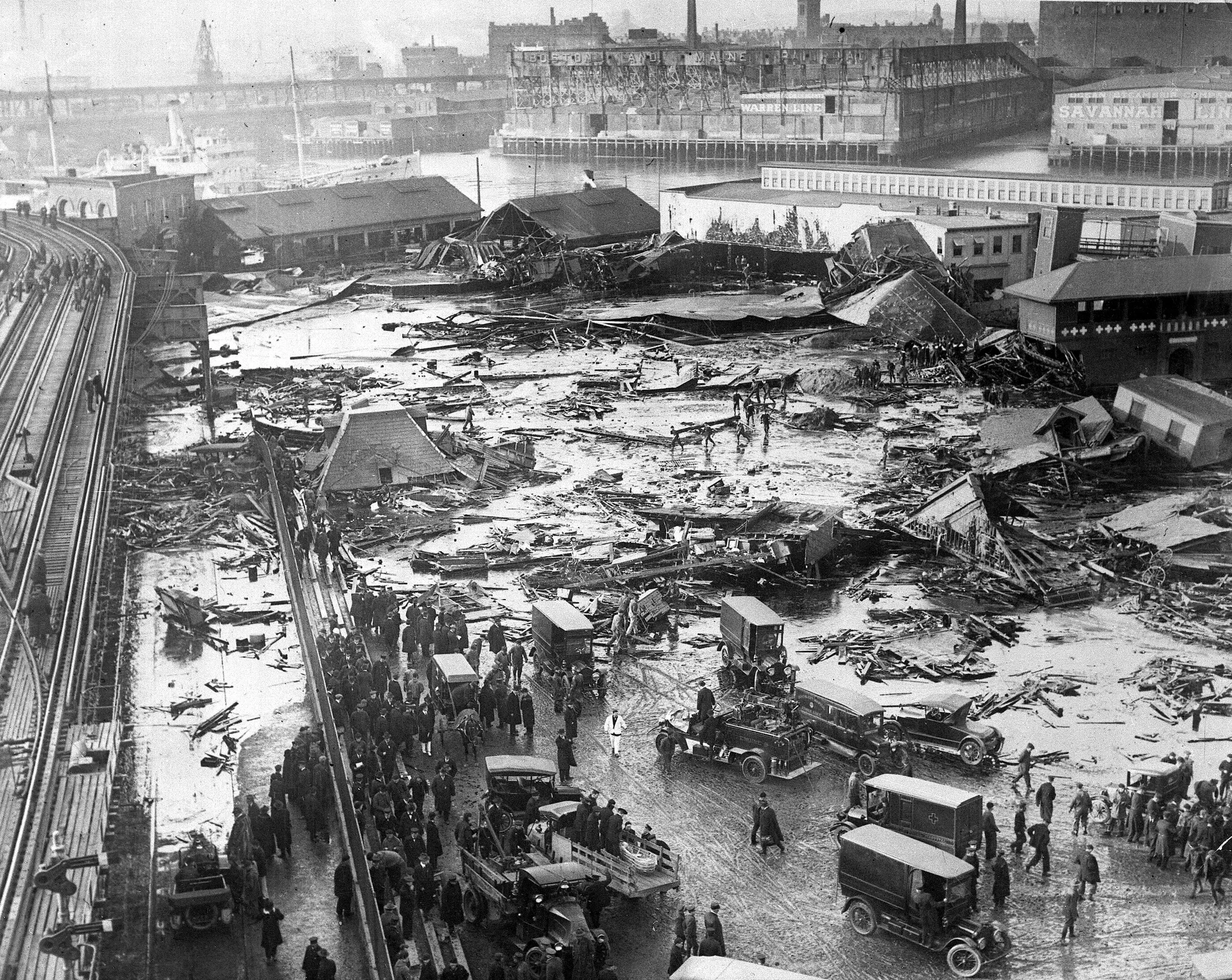
Boston molasses tank disaster
CLASSIFICATION: Unknown
LOCATION
Boston, Massachusetts
TIME PERIOD
January 15, 1919
VICTIMS
21 confirmed
A large molasses storage tank at the Purity Distilling/USIA facility on Commercial Street burst on January 15, 1919, releasing a fast-moving wave of molasses that killed 21 people and injured about 150. The tank failure occurred in Boston's North End after unseasonably warm weather and additions of warmed molasses; rescuers from nearby ships, police, Red Cross and military personnel recovered victims amid viscous, sticky conditions. A class-action suit found the company responsible after multi-year hearings and the company paid damages; the site was later commemorated and modern building-code and oversight changes followed. Key evidence included eyewitness accounts of the rupture, engineering analyses of thin and brittle steel and flawed rivets, and later scientific and engineering studies confirming rapid flow and cooling behaviour.
Some believe the disaster was the inevitable result of negligent construction and shoddy testing—thin, flawed steel and poor rivet work combined with a tank that leaked from the start, producing fatigue cracks that finally gave way. Investigators and locals have long speculated that rising temperatures, thermal expansion, and fermentation‑generated CO2 pressure inside a hastily filled tank (possibly rushed to beat impending Prohibition) contributed to the rupture, while the company's early claim that anarchists blew up the tank is widely seen as a self‑serving cover story. Open questions remain about the precise trigger — a manhole fatigue crack, internal pressure spike, or combination of factors — and about the extent to which corporate negligence and regulatory failures, rather than an isolated engineering fault, should bear ultimate responsibility.
At lunchtime on January 15, 1919, in Boston’s North End, a steel tank looming over Commercial Street suddenly tore open and released more than 2.3 million gallons of molasses.[1][2] In seconds, a wall of brown syrup—about 15 to 25 feet high and racing roughly 35 miles per hour—swept across two city blocks, crushing buildings, buckling an elevated railway, and killing 21 people.[1][3]
The catastrophe would become known, with bitter understatement, as the Great Molasses Flood.[4]
Four years earlier, in 1915, United States Industrial Alcohol (USIA) had thrown up a steel holding tank on Commercial Street in the North End to feed wartime demand for industrial alcohol.[1] The company imported molasses from the Caribbean to Boston, then shipped it to nearby distilleries to be turned into alcohol used in liquor and munitions, including explosives for World War I.[1] The tank, a hulking cylinder roughly 50 feet tall, was designed to hold about 2.3–2.5 million gallons.[1]
From the beginning, the project cut corners. Historian Stephen Puleo and later engineers described the construction as rushed and haphazard.[1][3] USIA’s treasurer, Arthur Jell—the man in charge—had no technical, architectural, or engineering background.[3] Instead of filling the new tank with water to test its integrity, Jell reportedly added only about six inches, then declared it ready.[3]
The consequences showed up almost immediately. Accounts describe the tank starting to leak from day one, sweating molasses down its steel sides.[1][3] Neighborhood children learned they could collect the sweet liquid in cups from the dripping seams.[5][6] Workers and nearby residents grew accustomed to ominous groans and metallic creaks whenever the tank was filled.[1][5][6]
The warnings went higher. At least one USIA employee brought shards of steel from the tank’s walls into the treasurer’s office to show the danger. According to an account later cited by civil engineer Mark Rossow, the response was chilling in its complacency: “I don't know what you want me to do. The tank still stands.”[1][6] Outside of re‑caulking and, eventually, cosmetic fixes, the company did little to address the underlying structural problems.[1]
By 1918, the leaks were so visible that Jell had the tank painted brown, apparently to camouflage the oozing molasses against its steel skin.[3][4]
The tank was rarely kept full. Over its short life it was refilled 29 times, and only four of those fills approached capacity.[6] That changed in January 1919.
Two days before the disaster, a ship arrived from Puerto Rico with about 2.3 million gallons of warm molasses, topping off the tank yet again.[2][6] The cargo had not yet cooled to Boston’s winter temperatures when it was pumped into the tank.[2] A week earlier, another large shipment had been added on a brutally cold day, leaving a mass of cold syrup now capped with warmer liquid.[3]
As the warm and cold layers mixed, gases from fermentation likely increased internal pressure. Modern analysis notes that this process probably generated carbon dioxide inside the tank.[3][7] People nearby described the tank “whining and groaning” in the days before the rupture, worse than usual.[3][6]
By January 15, the air temperature in Boston had climbed into the 40s Fahrenheit after a stretch of frigid days.[1][4] The almost-full tank—holding an estimated 26 million pounds of molasses—stood over Commercial Street, looming over tenements, stables, and the busy waterfront.[1][3]
Shortly after 12:30 p.m., Boston police patrolman Frank McManus stepped to a call box on Commercial Street to make his routine report.[7] He heard a sound like machine-gun fire and a terrible metallic grating, then watched as the five‑story‑high tank split open. Rivets and slivers of steel shot outward.[7]
Boston post-January 16, 1919,.jpg
Wikimedia Commons· Public domain
Grabbing the call box line, he shouted to the operator: “Send all available rescue vehicles and personnel immediately, there’s a wave of molasses coming down Commercial Street!”[3][5][7]
When the tank let go, roughly 2.3 million gallons of molasses—enough to fill several Olympic-size swimming pools—erupted into the street.[2][6] Witnesses later described an initial wave around 15 to 25 feet high and about 160 feet wide, surging at an estimated 35 miles per hour.[1][2][3] Scientific reconstructions a century later would back up the startling speed.[3][4]
Molasses is about one-and-a-half times denser than water.[3] It is also a non‑Newtonian fluid, meaning its viscosity changes with shear and flow—more like mud or lava than water.[6][7] That combination gave the wave enormous momentum. For the first minute or more, inertia dominated; the flood behaved almost like a tsunami of heavy liquid.[3][7]
Commercial Street that afternoon was crowded with workers, teamsters, and children gathering firewood near the tank’s base.[1] Among them were siblings Antonio and Maria di Stasio and their friend Pasquale Iantosca.[1] When the tank burst, the wave swept over them. Maria was suffocated in the molasses.[1] Pasquale was killed when a railroad car, hurled by the force of the flood, struck him.[1] Antonio survived, but with a severe head injury after being flung into a light post.[1]
The syrup hit with the violence of a conventional flood but with far more drag. Freight cars were crushed and flung aside.[7] Trucks were hurled into buildings.[8] Tenement houses and warehouses were reduced to splintered wood.[4][9] Engine 31, the neighborhood firehouse, was ripped from its foundation; its second story collapsed into the first under the pressure.[1]
A segment of the elevated railway on Atlantic Avenue buckled when the wave slammed steel tank panels into its supports, nearly flipping a train off the tracks.[1][4][7]
In the path of the torrent, there was almost no time to react. People were “immediately swallowed, drowned and asphyxiated,” one account later summarized.[3] Survivors pulled from the muck often had broken backs and fractured skulls from being slammed into debris.[3]
For Martin Clougherty, a barman whose house overlooked the tank, the disaster arrived in his sleep. Thrown from his bed into the moving molasses, he nearly drowned before clawing his way onto a floating bed frame.[1] From that precarious raft he managed to rescue his sister Teresa, but his mother and younger brother were killed.[1] The Clougherty home itself was swept away and dashed against the elevated train structure.[1]
Horses fared no better. Animals from nearby stables were trapped where they stood, some killed instantly by the impact, others left flailing helplessly in the syrup. Many had to be shot when rescuers realized they could not be freed.[1][5]
In the first hours, about half of those who would die succumbed to crushing, drowning, or immediate trauma. The rest would die over the following days and weeks from injuries and infections.[7]
Once McManus’s warning went out, the response was swift. Police and firefighters reached the scene within minutes, followed by Red Cross workers, civilian volunteers, and more than a hundred cadets from the Navy training ship USS Nantucket docked nearby.[1][4][6]
They stepped into a landscape that barely made sense. From the base of the ruined tank, a chest‑deep river of molasses stretched roughly 90 meters into the streets before thinning to a sticky layer a half‑meter or more deep across much of the area.[7] In places the brown sea reportedly reached depths of around 15 feet.[1][6]
The winter chill began to work against victims almost immediately. As the mass of warm molasses met 40‑degree air and cold cobblestones, it cooled and thickened.[2][6] First responders found themselves wading through a substance that clutched at their legs and stole their strength.[1] Some firefighters had to lay ladders flat over the surface and crawl out on them to keep from sinking as they tried to reach trapped people.[3]
Rescuers cut survivors from wrecked buildings and from pockets of air under collapsed floors. At Engine 31, men from a lunchtime card game were pinned in a crawlspace partly filled with molasses. It took several hours of sawing through floorboards and hauling debris to reach them.[1] One firefighter, exhausted by the effort and mired in the syrup, lost his strength and drowned.[1]
They worked by hand and by searchlight for days. Bodies were dragged from the mire, others recovered from beneath wreckage. Molasses‑trapped horses were shot when it became clear there was no way to pull them out alive.[1] Some victims had been driven into Boston Harbor by the force of the wave; their remains were not found for months. Wagon driver Cesare Nicolo’s body, for example, was recovered under a pier almost four months later.[1][5]
By the time the search was over, 21 people were dead.[1][2][4] The number of injured varies among accounts—contemporary and modern sources cite figures from around 40 to “hundreds,” but many settle near about 150.[6][7][8]
Once the living and the dead had been pulled from the muck, Boston had to figure out how to remove a neighborhood’s worth of molasses.
More than 300 workers descended on the North End to clear wreckage and debris.[1] Ordinary tools—brooms, shovels, saws—were pressed into service to cut through and push aside the congealed syrup.[1] Street by street, they scraped and swept, but the material clung stubbornly to cobblestones and brick.
Eventually the city turned to the harbor. Firemen directed powerful saltwater streams from a fireboat onto Commercial Street and the surrounding area. Salt water, it turned out, “cut” the molasses more effectively than fresh water, thinning it enough that it could be sluiced away.[4][6] Slowly, the streets reappeared.
The cleanup lasted weeks. Even as most of the syrup was washed off sidewalks and buildings, a thin film remained—tracked onto subway platforms, trains, and into homes on the boots of workers and the shoes of curious onlookers.[4] Boston Harbor itself stayed stained brown until the summer.[1]
© Mapbox © OpenStreetMap
The smell lingered longer. Residents remembered a heavy sweetness in the North End for weeks and, in some accounts, for decades.[1]
USIA never rebuilt the tank. New technology emerging from the war had begun to make large‑scale distillation of molasses for industrial alcohol obsolete, and the ruin on Commercial Street was left as a grim lesson.[3]
In the days after the disaster, people groped for explanations. Early headlines and “experts” favored dramatic theories: that fermentation inside the tank had produced too much gas, or that anarchists—already suspected in a series of bombings during this era—had blown it up.[1][6]
USIA leaned hard into sabotage. In court, the company claimed that anarchist terrorists had climbed the tank and dropped a pipe bomb into a vent, detonating the structure.[1][5] The firm pointed to an anonymous 1918 phone call threatening to destroy the tank with dynamite as proof that enemies were targeting it.[1]
Police did investigate the bombing theory, but accounts agree that no evidence ever substantiated it.[5] Instead, attention increasingly turned to the tank itself.
Contemporary observers and modern engineers built a damning picture:
When materials scientists and structural engineers later examined the design, they found the steel plates were too thin for a tank of that size and had been joined with flawed rivets.[6] Mayville’s 2014 analysis showed that the tank walls ranged from about 0.67 inches at the bottom to only 0.31 inches at the top—insufficient to safely contain a full load of dense molasses.[6] A separate investigation concluded the steel lacked enough manganese, making it significantly more brittle in cold weather and prone to fracture at temperatures below about 59°F.[4][6]
Under these conditions—thin, brittle steel; high internal pressure from gas and liquid; and a near‑capacity fill—the rivet holes became stress concentrators where cracks could start and race.[4][6] Civil engineer Mark Rossow argued that the disaster flowed less from ignorance of science than from ethical failure and negligence by the people in charge.[6]
Fermentation likely played a role in raising pressure, but over time the bombing theory withered. The more the tank was studied, the less it appeared to be a victim and the more it looked like a slow‑motion crime scene of bad decisions.
Nearly a century after the disaster, fluid‑dynamics experts returned to Commercial Street—not to assign blame, but to understand why the flood was so lethal.
A team led by aerospace engineer and science communicator Nicole Sharp worked with Harvard undergraduates to recreate the event in miniature. They built a scale model of the North End and flooded it with cold corn syrup, filming the flow with high‑speed cameras.[2][4][6]
Sharp and her colleagues broke the flood into two stages. In the first 60–90 seconds after the tank failure, inertia dominated: the massive, dense fluid surged outward at high speed, and viscosity hardly mattered.[3] That “tsunami” phase matched historical estimates of a 35‑mph wave and validated skeptical modern questions about whether such a speed was really possible.[2][3][4]
Then the second stage took over. As the molasses spread, its momentum dissipated; viscosity suddenly mattered very much. The syrup cooled rapidly in the winter air and on stone streets, becoming thicker and stickier by the minute.[2][6] Victims and rescuers who might have escaped in water instead found themselves trapped in a medium thousands of times more viscous.[6][7] People, horses, even “burly men,” as one account put it, struggled and sank deeper as they moved.[7]
Sharp noted that at least one person died by asphyxiation hours after the initial wave, unable to get clear of the congealing syrup.[6] Her team’s work, echoed by other researchers, suggested that the frigid January weather turned an already dangerous industrial accident into a mass‑casualty event. Some scientists have even speculated that had the tank failed in warmer months, the thinner molasses might have spread farther but killed fewer people.[2][6]
The human and physical wreckage on Commercial Street quickly gave way to legal battlelines. Victims and their families filed 119 separate lawsuits against USIA.[1][4] The cases were consolidated into a single, sprawling proceeding that would last about five years.[1]
The trial became an epic in its own right. More than 1,500 exhibits were introduced and about 1,000 witnesses testified, from explosives experts and structural engineers to flood survivors and company employees.[1] Closing arguments alone stretched for roughly 11 weeks.[1]
Plaintiffs argued that the tank was too thin and shoddily built to hold its contents safely and that USIA had ignored years of red flags.[1][7] The company clung to the sabotage narrative, insisting that “evilly disposed persons” had deliberately blown up the tank.[1][4]
The ultimate decision fell to state auditor Hugh W. Ogden, acting in a quasi‑judicial role. In April 1925, after years of hearings and review, Ogden ruled that USIA—not anarchists—was to blame.[1] The disaster, he concluded, had been caused by poor planning and lack of oversight in the tank’s construction and maintenance.[1]
Ogden oversaw the distribution of damages. USIA paid a total of $628,000 to victims and their families—a significant sum at the time, roughly equivalent to several million dollars in modern terms.[1][4] Relatives of those killed reportedly received around $6,000–$7,500 per victim, with higher awards for those who suffered before they died.[4][5]
The Great Molasses Flood did more than scar a neighborhood. It helped change how America thought about large structures and corporate responsibility.
In Boston, officials moved quickly to demand more rigor from builders. The city’s building department began requiring that engineers’ and architects’ calculations be filed with plans, and that drawings be stamped and signed—formal accountability on paper.[3] Those practices spread, becoming standard across much of the country in the decades that followed.[5]
Boston 1919 molasses disaster - el train structure.jpg
Wikimedia Commons· Public domain
More broadly, the disaster energized efforts to require oversight by licensed architects and civil engineers for major structures, rather than leaving life‑and‑death infrastructure to unqualified corporate managers.[4]
In that sense, the broken tank on Commercial Street joined a grim lineage of tragedies—like the Cocoanut Grove fire two decades later—that forced regulators and the public to rethink safety standards and the cost of negligence.[5]
Today, the site of the molasses tank is easy to miss. The North End Paving Company yard that once held the massive cylinder has long since been repurposed. The land became a yard for the Boston Elevated Railway, then, eventually, Langone Park—a waterfront recreation area with ballfields and playgrounds.[2]
The concrete slab base of the tank still lies about 20 inches below the surface of one of the baseball diamonds, an unseen foundation for games that unfold over the spot where the steel once stood.[4] A small plaque near the park quietly marks what happened there and names January 15, 1919, as the day the tank exploded.[3]
On the disaster’s 100th anniversary in 2019, people gathered in the North End to remember. Organizers read aloud the names of the 21 dead.[4] Using ground‑penetrating radar, researchers pinpointed the exact footprint of the long-vanished tank beneath the turf.[4] Elsewhere in the city, students recited passages from Stephen Puleo’s Dark Tide: The Great Boston Molasses Flood of 1919, a modern history that has helped fix the event in public memory.[3][10]
A century after Commercial Street drowned in sugar, the Great Molasses Flood is sometimes reduced to a curiosity, a dark punchline in lists of bizarre disasters. But beneath the oddity is a sober story: of workers’ warnings brushed aside, of a community crushed and suffocated in slow‑moving ruin, and of a city forced to admit that even something as seemingly harmless as molasses can become lethal when profit outruns prudence.
This case file is an original Bloody Likely narrative synthesis based on the cited sources. Article © Bloody Likely. All rights reserved. Source materials remain the property of their respective owners. Facts, public records, quotations, and cited references are used for reporting, research, commentary, and documentation. Bloody Likely content license
Audio narration © Bloody Likely. All rights reserved. The audio player is provided for personal streaming/listening only.
No recent news articles found for this case. Check back later for updates.
No evidence found for this case. Be the first to submit evidence in the comments below.
Join the discussion
Loading comments...
The molasses storage tank was built and reportedly leaked from initial fill; it was rarely filled to capacity in subsequent years.
The 2.3 million gallon tank burst at approximately 12:30 p.m., sending a 25-foot wave of molasses through the North End at high speed, crushing buildings and
Crew from USS Nantucket cadets, Boston Police, Red Cross, Army and Navy personnel and others conducted rescue operations amid knee- to waist-deep molasses,
The Eighteenth Amendment was ratified the day after the disaster; contemporaneous accounts linked tank operations to efforts to outrun Prohibition.
Several victims swept into Boston Harbor were recovered three to four months after the disaster.
After roughly three years of hearings, a court-appointed auditor found the United States Industrial Alcohol Company responsible and the company paid
Scientific American and other outlets published analyses explaining the physics of the flood and how shear-thinning and rapid cooling contributed to its
A team from Harvard conducted studies using historical records and scale models, concluding reports of the high-speed wave were credible and demonstrating
A ceremony at the site marked the 100th anniversary; ground-penetrating radar identified the tank base and the 21 victims' names were read aloud.
A designer card game themed on the 1919 event, 'Molassacre: Escape the Flood', was announced, drawing attention and some historian unease.