ANALYZING EVIDENCE
Processing case files...
Processing case files...
Gulf War Highway Massacre
CLASSIFICATION: Mass Murder
LOCATION
Kuwait City, Kuwait
TIME PERIOD
Feb. 25th – 27th 1991
VICTIMS
800 confirmed
Coalition aircraft and ground forces attacked a large, retreating Iraqi military column on Highway 80 between Kuwait City and Basra on the night of February 26–27, 1991, destroying hundreds of vehicles and killing many occupants. The operation involved U.S., British, Canadian and French units using cluster bombs and airstrikes, producing widely circulated images of burned and abandoned vehicles. Estimates of fatalities vary widely; postwar studies and the Project on Defense Alternatives placed likely deaths in the hundreds to around 800 across Highway 80/8. The incident remains controversial and no criminal convictions of coalition personnel followed; primary physical evidence includes extensive wreckage, photographic documentation, and eyewitness and journalist accounts.
Some believe the Highway of Death was not simply a legitimate military engagement but a disproportionate, even punitive, strike on retreating Iraqi forces that included surrendered troops, civilians and Kuwaiti hostages—an allegation amplified by claims that U.S. Bradley crews and later ground units fired on disarmed prisoners. Investigators and critics have also speculated that political calculations—images of mass devastation prompting a rapid ceasefire—helped preserve Saddam’s army and that wartime media controls and limited publication of burial photos amount to a partial cover‑up of the human toll. Responsibility and motive remain contested: postwar military inquiries and commentators dispute eyewitness accounts and casualty estimates, while reports of widespread looting and unguarded weapons point to chaotic post‑strike conduct and questions about coalition stewardship of the battlefield.
In late February 1991, as Iraqi forces fled Kuwait at the end of the Persian Gulf War, a six‑lane highway running from Kuwait City toward Basra turned into something else entirely. [1][2] American, Canadian, British, and French aircraft and ground units attacked retreating Iraqi military personnel along that road on the night of February 26–27, destroying hundreds of vehicles and killing many of the people inside. [1]
By the time the firing stopped, between 1,400 and 2,000 vehicles had been hit or abandoned on the main stretch of Highway 80 north of Al Jahra. [1] Time magazine would describe “mile after mile of burned and shattered vehicles” between Kuwait City and Basra. [1]
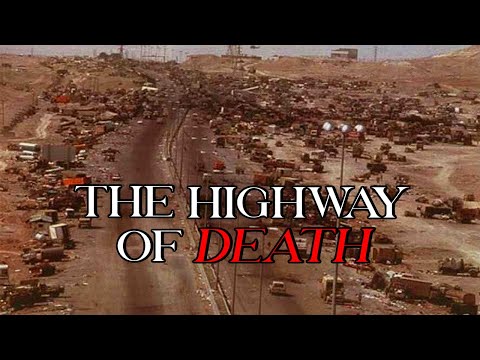
On television and front pages, the shattered convoy became known simply as the “Highway of Death.” [1][2]
For Kuwaitis, the exodus playing out on that road came after months of occupation and terror. Iraqi soldiers and officials detained, beat, and killed civilians, and lower‑ranking troops used the cover of darkness to vandalize, loot, and steal. [3]
In Abdullah al Salim, a wealthy neighborhood nicknamed the “Beverly Hills of Kuwait,” Iraqi looters systematically targeted homes left vacant by people who had fled. [3] On one block, eleven houses were ransacked; in one, the Austrian ambassador’s residence, drawers were emptied onto the floor, books ripped from shelves, and a refrigerator abandoned in the living room after someone tried to haul it away. [3]
© Mapbox © OpenStreetMap
Looting extended beyond appliances. Some troops stole heavy metal strongboxes from homes around Abdullah al Salim, hauling seven of them to a lawyers’ society building used as a command post, where the boxes were forced open and their contents taken. [3]
As Iraqi troops and opportunists stripped Kuwait, resistance members described taxi drivers shuttling from Basra to collect stolen goods. [3] Eventually, resistance fighters resorted to Molotov cocktails against looters’ vehicles to stem the flow. [3]
IrakDesertStorm1991.jpg
Wikimedia Commons· Public domain
By February 1991, with coalition forces advancing, the same routes that had carried invasion forces into Kuwait now filled with soldiers, looters, and whatever civilians could escape, all pushing north toward Iraq.
Highway 80, running from Kuwait City through the border town of Safwan toward Basra, had been the invasion artery for Iraqi armored divisions in August 1990. [1] During the ground offensive in February 1991, it became their main escape route. [1]
South of the border, a section of highway north of Kuwait City that Iraqi authorities had renamed Saddam Hussein Road funneled much of that traffic. [3] Allied warplanes cut off the fleeing columns there, bombarding the road and destroying hundreds of tanks, armored personnel carriers, military trucks, tankers, buses, and cars. [3]
When the highway clogged with flaming wreckage, vehicles trying to drive around the jam sank into soft sand, where they were struck from above by bombs and gunfire. [3] Wrecked cars and trucks spilled out looted Kuwaiti household goods—video recorders, televisions, vacuum cleaners, gold teaspoons, even the gears of a clock—amid twisted metal. [3]
On the main stretch of Highway 80, U.S. Marine Corps A‑6 Intruder attack jets boxed in the convoy on February 26, bombing the front and rear with Rockeye II cluster munitions and trapping the vehicles in a traffic jam. [1] Over the next ten hours, scores of Marine, Air Force, and Navy aircraft attacked the convoy with a variety of weapons, before surviving vehicles were hit again by coalition ground units. [1]
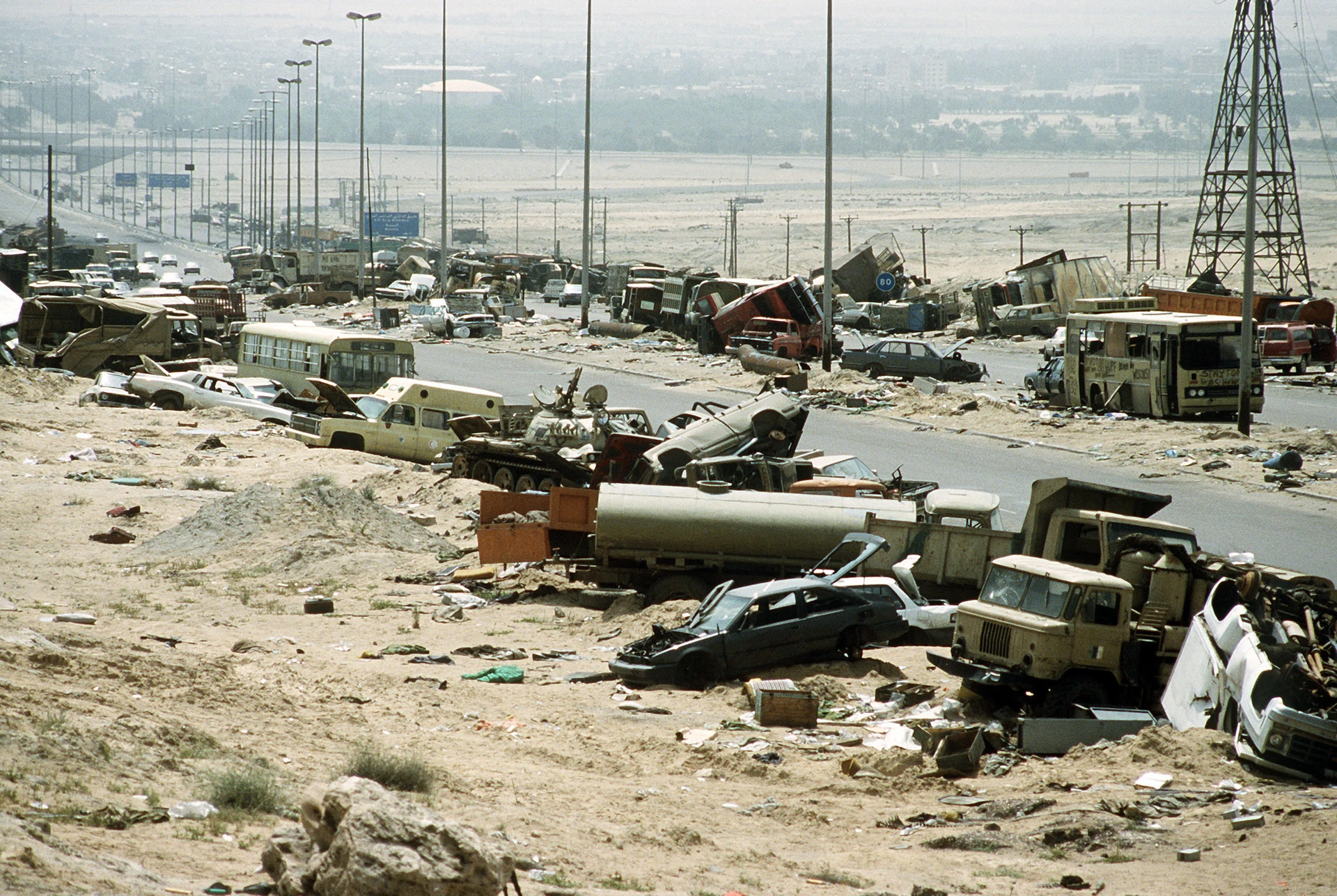
The bottleneck near the Mutla Ridge police station shrank into a line of more than 300 stuck and abandoned vehicles that came to be called “the Mile of Death.” [1] Among the burned-out wrecks journalists later counted at least 28 tanks and armored vehicles, along with commandeered civilian cars and buses stuffed with stolen property from Kuwait. [1]
British journalist Robert Fisk reported seeing hundreds of corpses along the roadway toward the Iraqi border; American reporter Bob Drogin counted “scores” of dead soldiers in and around the vehicles. [1] A 2003 study by the Project on Defense Alternatives later estimated that journalists’ observations of 200–300 dead were plausible, and set a minimum death toll for the trapped main caravan at 500–600. [1]
Photojournalist Peter Turnley had spent weeks in the Gulf as troops built up, but he refused to sign on to the Pentagon’s restrictive media pool system, which barred reporters from battlefields without military escorts. [2][4] He later wrote that the pool was deliberately designed as “a major impediment” to photojournalists trying to show the realities of war, and that many major outlets “more or less bought the program” before the shooting started. [4]
Instead, Turnley “sat out the air war” and flew from Paris to Riyadh as the ground offensive began. [4] When President George H. W. Bush declared a cessation of hostilities on February 28, 1991, [2] Turnley moved quickly toward the shattered highway.
He reached what he called a “mile of death” on the morning the war stopped. [4] There, on a mile‑long stretch of the road, he found cars and trucks still ticking with life—wheels spinning, radios playing—while their occupants lay dead. [4] Bodies were scattered along the pavement. [4]
Turnley photographed a U.S. military “graves detail” burying many of the dead in large graves during those first hours. [1][4] He later said he did not remember seeing many television images or published photographs showing the human consequences of what he had witnessed that morning. [4]
Destroyed Iraqi T-55 on highway between Basra & Kuwait City 1991-04-18 1.JPEG
Wikimedia Commons· Public domain
Postwar analyses suggested that many vehicles on the Basra road had been abandoned before being strafed, and that enemy casualties there were lower than the acres of wreckage might suggest. [1] Yet Turnley’s photographs of mass burials along the “mile of death” pointed to a scale of killing that was impossible to capture precisely. [1]
The next day, farther north and east on an obscure road away from the main highway, Turnley came across a second, smaller horror. [4]
Here, a convoy of lorries carrying Iraqi soldiers back toward Baghdad had been hit. [4] Turnley wrote that “clearly massive fire power had been dropped,” and that “everyone in sight had been carbonized.” [4] He photographed the scene but later said that most of those images have never been published anywhere. [4]
Years later, he would argue that citizens have a right to see such images so they can fully consider “the whole picture and consequences of that war and any war.” [4]
If Turnley’s more intimate images of the dead rarely appeared, the wider devastation on the highway did. Time magazine and other outlets broadcast pictures of endless lines of burned-out cars, buses, and tanks stretching from Kuwait toward Iraq. [1][2]
Demolished_vehicles_line_Highway_80_on_18_Apr_1991.jpg
Wikimedia Commons· Public domain
The spectacle reached Washington. The ground war had lasted just one hundred hours, and American fatalities were held to seventy‑nine, only eight of them from the U.S. Army’s 24th Infantry Division. [2]
On February 28, President Bush declared a unilateral cessation of hostilities. [2] The televised destruction on the “highway of death” was publicly cited as a factor in his decision to stop the war when he did. [1][2]
But for thousands of Iraqis still strung along roads inside their own country, the shooting was not yet over.
The most powerful U.S. ground unit moving north of Kuwait was the 24th Infantry Division (Mechanized), commanded by Major General Barry McCaffrey.
McCaffrey was the son of a distinguished general, a West Point graduate who had served two combat tours in Vietnam, earning two Distinguished Service Crosses, two Silver Stars, and three Purple Hearts. [2] He came home from Vietnam with a shattered left arm that required two years of surgery and rehabilitation. [2]
In June 1990, just weeks before Saddam Hussein invaded Kuwait, McCaffrey—then forty‑seven—took command of the 24th Division at Fort Stewart, Georgia. [2] Within months he had moved its tanks, artillery, and more than 18,000 soldiers to Saudi Arabia; eventually, 26,000 troops deployed under his command. [2]
The division’s mission in the ground war was ambitious: execute a wide “left hook,” drive more than 200 miles into Iraq, and block retreating Iraqi units from escaping north out of Kuwait. [2] The division launched its ground offensive on the afternoon of February 24 and covered nearly 200 miles in two days, reaching the Euphrates River valley more than a full day ahead of schedule. [2]
Even after Bush’s ceasefire announcement on February 28, fighting continued along the roads inside Iraq. West of Basra, Highway 80 fed into Highway 8, a route used by elite formations like the Republican Guard’s 1st Armored Division, Hammurabi, as they tried to redeploy or escape. [1]
Along Highway 8, U.S. artillery units and a battalion of AH‑64 Apache helicopters under McCaffrey’s overall command attacked Iraqi forces, systematically destroying hundreds of mostly military vehicles over a fifty‑mile stretch of road and desert. [1] A later estimate by the Project on Defense Alternatives suggested that 300–400 or more people were killed on Highway 8 alone, bringing the likely combined death toll on both highways to at least 800–1,000. [1]
The most controversial episode came on March 2, near the Rumaila oil field west of Basra. [1][2] That morning, McCaffrey reported that his division had come under attack from a retreating Republican Guard tank division off Highway 8. [2] Overriding a caution from his division operations officer, he ordered an all‑out assault. [2]
Apache helicopters, Bradley fighting vehicles, and artillery units from the 24th Division hit a five‑mile‑long Iraqi column for hours. [2] The attack destroyed roughly 700 Iraqi tanks, armored cars, and trucks, according to later accounts. [2][5] McCaffrey described the resulting scene as “one of the most astounding scenes of destruction I have ever participated in.” [2]
Demolished vehicles line Highway 80 on 18 Apr 1991.jpg
Wikimedia Commons· Public domain
There were no serious American combat casualties reported from the March 2 assault. [2] But the engagement killed Iraqi soldiers and civilians, including children, and many of the dead were buried so quickly that no accurate count of victims could be made. [2]
The action would come to be known by several names: the Battle of the Causeway, the Battle of Rumaila, the Battle of the Junkyard. [2][5] To some, it was a necessary strike on a hostile force that had fired first. To others, it looked like a final, overwhelming blow against an army already in retreat.
Under Pentagon rules, journalists were barred from Gulf War battlefields unless escorted by the military, a policy major media organizations accepted—often reluctantly. [2] A day after the Rumaila assault, a small group of reporters were flown by helicopter to McCaffrey’s headquarters and allowed to see the wreckage and burial details. [2]
When he spoke with them, McCaffrey speculated that some retreating Iraqi units might not have known a ceasefire was in effect. [2] In testimony two months later before the Senate Armed Services Committee, he characterized the area west of Basra in the predawn hours of March 2 as “chaotic,” with many people moving in the dark and engaging his troops with rocket‑propelled grenades. [2] He told senators that from 6:30 a.m. to about noon, one brigade and three tank task forces conducted a “classic attack” supported by five artillery battalions. [2]
In written responses to follow‑up questions, McCaffrey maintained that his actions at Rumaila were appropriate to defend his soldiers against enemy forces whose intentions were unknown. [2]
Not everyone who had been there agreed with his version. Some of McCaffrey’s own subordinates and soldiers on the scene later disputed his claim that the Iraqis attacked first. [2][5] They said most Iraqi tanks were traveling with their main guns reversed and locked in a “travel‑lock” position, a standard posture for movement rather than combat. [2]
Lieutenant General Ronald Griffith added that many of the Iraqi tanks the 24th destroyed on March 2 were being hauled on trailers with their gun barrels facing backward, characterizing the engagement as “making a battle out of a train of tanks.” [2]
Lieutenant General Ronald Griffith added that many of the Iraqi tanks the 24th destroyed on March 2 were being hauled on trailers with their gun barrels facing backward, characterizing the engagement as “making a battle out of a train of tanks.” [2]
From the other side, journalist Joe Galloway of U.S. News & World Report said he regarded the Rumaila fighting as “a righteous shoot” and argued that Iraqi forces should not have opened fire. [2]
Journalist Seymour Hersh later alleged, in a lengthy New Yorker investigation, that the March 2 action was effectively a systematic destruction of Iraqis who were in the process of retreating. [5] Columnist Georgie Anne Geyer summarized his claims in the Chicago Tribune, writing that Hersh portrayed Iraqi resistance by late February as “disorganized and ragged” and the ground war as a rout in which retreating Iraqi units were pounded by American air and ground power as they fled north. [5]
Hersh’s reporting went further, alleging that McCaffrey’s forces shot Iraqis—including women and children—who were attempting to surrender on March 2, and that the general’s assertion that the Iraqis had fired first was contradicted by some of his own subordinates. [5]
Geyer, who called Hersh “talented but always controversial,” emphasized that the U.S. military investigated allegations aired after the war and dismissed them, and that some generals later said they were misquoted in his article. [5] She also noted that at least one soldier Hersh quoted turned out to have been far from the scene that day, and that McCaffrey circulated letters from fellow officers and soldiers denouncing the article as an attempt to defame him. [5]
The dispute over who fired first—and whether some Iraqis were effectively hors de combat—has never been fully reconciled.
A few months after the 24th Division returned to Fort Stewart, an anonymous letter landed at the Pentagon, accusing McCaffrey and his command of war crimes. [2] The letter alleged that the March 2 assault had been launched without Iraqi provocation, that a 24th Division unit had “slaughtered” prisoners of war after a battle, and that McCaffrey had covered up friendly‑fire casualties within his division. [2]
The letter triggered an official investigation. [2] By midsummer 1991, however, the 24th Division’s 1st Brigade had quietly examined two other atrocity complaints at Fort Stewart and concluded that neither had merit. [2] One of those allegations claimed a platoon of Bradley Fighting Vehicles had fired on more than 350 captured and disarmed Iraqi soldiers, including wounded evacuated from a hospital bus. [2] Another said a U.S. combat team had machine‑gunned a group of Iraqis in civilian clothes waving a white sheet of surrender on March 1, a group eyewitnesses put at fifteen to twenty people. [2]
According to later reporting, neither alleged incident was passed up to higher authorities, despite an Army order requiring such reports during the Gulf War. [2]
Meanwhile, the division’s own battlefield record showed how often the fog of war turned deadly in more familiar ways. At least four of the 24th’s eight officially reported deaths were likely from friendly fire, according to a review of available records. [2] Soldiers interviewed afterward said that by the end of the war, they feared being hit by their own side more than the Iraqis. [2]
On February 27, the division’s 2nd Brigade smashed through two fences and stormed Jalibah Airfield, destroying Iraqi tanks and aircraft with only one American wounded. [2] After the airfield was secure, three Bradley vehicles were struck by rockets that, according to one officer, came from another American unit nearly two miles away; two U.S. soldiers were killed and eight or nine wounded. [2] Those friendly‑fire casualties did not appear in the 24th Division’s official history or in the XVIII Corps chronology. [2]
In another incident described by a tanker from the 1st Brigade, an American shell hit a fuel truck, splashing burning gasoline onto a nearby vehicle packed with Iraqis. Twenty or thirty people stumbled out of the flames, and U.S. soldiers opened fire. [2]
An Army article later stated that more than 300 interviews with veterans and investigators suggested the existing inquiries into the 24th Division had missed important parts of the story. [2]
Demolished vehicles line Highway 80, also known as the "Highway of Death", the route fleeing Iraqi forces took as they retreated from Kuwait during Operation Desert Storm. The tank visible in the center of the picture is either a Type 59 or a Type 69 as evidenced by the dome-shap
Wikimedia Commons· Public domain
Yet institutionally, the war ended well for McCaffrey. He was promoted to four‑star general, retired from the Army in January 1996, and soon afterward became the Clinton administration’s director of the White House Office of National Drug Control Policy. [2]
The Highway of Death did not disappear when the last bodies were buried. Its images and arguments have lingered—sometimes sharpened, sometimes blurred—as they passed into art and pop culture.
In 1991, The Guardian commissioned poet Tony Harrison to commemorate the war and the highway, publishing his long poem “A Cold Coming.” [1][6] The poem contains the haunting image of a “charred Iraqi” leaning toward the speaker from a bomb‑blasted screen, [6] and follows a severely burned man whose words the speaker tries to record with a microphone. [6] At one point, the burned man is quoted as saying: “I want to reach the warring nations with my speech.” [6]
In the years since, the Highway of Death has been referenced in music, film, and games. The 2005 film Jarhead includes a scene in which Marines drive through its wreckage, [1] and the industrial metal band Ministry name‑checks it in their 1992 song “Hero.” [1]
Decades later, the shadow of that road reached an entirely different battlefield: the video‑game marketplace. The 2019 title Call of Duty: Modern Warfare includes a mission on a fictional “Highway of Death” in the invented state of Urzikstan, where Russian forces are blamed for an atrocity on a road that bears striking similarities to the real Highway 80. [7]
Russian media and many players denounced the game, arguing it rewrote history and demonized Russia by shifting blame for a well‑known U.S.‑led attack. [7] A BBC report noted that Highway 80, which links Basra with Al Jahra in Kuwait, was dubbed the “Highway of Death” after U.S.-led troops attacked Iraqi forces there in February 1991, leaving hundreds dead. [7]
The arguments echo older ones. Was the destruction of retreating Iraqi units, on both sides of the border, a lawful and necessary use of force? Commentators have argued that hammering columns in full retreat, including vehicles carrying Kuwaiti hostages and civilian refugees, represented a disproportionate use of power. [1] Former U.S. Attorney General Ramsey Clark maintained that the attacks violated the Third Geneva Convention’s ban on killing soldiers who are hors de combat. [1] Other legal analysts countered that under modern law, retreating troops who keep their weapons and attempt to escape—or fire—do not qualify as hors de combat. [1]
Some numbers can be written down. One study put total fatalities along Highways 80 and 8 at perhaps 800 to 1,000. [1] Others, like Geyer, have written of “tens of thousands” dead on the highway out of Kuwait. [5] But for many on those roads, no name or number was ever recorded. Many bodies were hurried into mass graves; [2][4] many more simply vanished into the desert.
McCaffrey would later say that Rumaila was one of the most astounding scenes of destruction he had ever witnessed. [2] Turnley, standing among the burned vehicles and fresh graves, argued that citizens had a right to see what war really looks like. [4] The poem, the photographs, the satellite shots, the contested memoirs and investigations—none can fully reconstruct what each individual endured in those last hours on the road.
This case file is an original Bloody Likely narrative synthesis based on the cited sources. Article © Bloody Likely. All rights reserved. Source materials remain the property of their respective owners. Facts, public records, quotations, and cited references are used for reporting, research, commentary, and documentation. Bloody Likely content license
Audio narration © Bloody Likely. All rights reserved. The audio player is provided for personal streaming/listening only.
No recent news articles found for this case. Check back later for updates.
No evidence found for this case. Be the first to submit evidence in the comments below.
Join the discussion
Loading comments...
Iraqi armed forces used Highway 80 during the 1990 invasion of Kuwait, establishing the road's strategic importance prior to the 1991 retreat.
Large Iraqi military and associated civilian vehicle columns moved north along Highway 80 attempting to withdraw toward Iraq as Coalition ground offensive
A-6 Intruder attack jets blocked the head and tail of the main convoy on Highway 80, using cluster munitions to box in vehicles and create targets for
Over approximately ten hours, U.S. Marine, Air Force and Navy aircraft (and other Coalition units) carried out repeated strikes on the immobilized column,
Stragglers and surviving vehicles were engaged individually; journalists later reported scenes of hundreds of corpses and extensive wreckage along the road.
A large withdrawing column composed of remnants of Iraqi Hammurabi Division was engaged and largely destroyed inside Iraqi territory in a related post-war
Journalists reported and photographed the devastated highway, publishing images that became emblematic of the Gulf War and influenced public perception of the
Interviews with Iraqi survivors and postwar studies, including by the Project on Defense Alternatives, estimated fatalities and assessed the circumstances of