ANALYZING EVIDENCE
Processing case files...
Processing case files...
Penn State Child Sex Abuse
CLASSIFICATION: Unknown
LOCATION
State College, Pennsylvania
TIME PERIOD
1994 6-2009 (abuse); 2011-2012 (investigation and trial)
VICTIMS
10 confirmed
Multiple young boys were sexually abused by a longtime Penn State assistant coach through his charity and access to university facilities between the mid-1990s and 2009. A grand jury and state prosecutors investigated beginning in 2008, leading to indictments and the 2012 trial that produced testimony from several victims and a key eyewitness who reported seeing an assault in a campus locker-room shower. The defendant was convicted on dozens of counts in June 2012 and sentenced to 30 to 60 years in prison in October 2012; he remains incarcerated and was designated a sexually violent predator. Investigative evidence included victim testimony, contemporaneous emails and institutional records, and the testimony of a campus coach who reported observing an assault.
Some believe senior Penn State officials and boosters knew about Jerry Sandusky’s abuses for years and took steps to protect the university’s football program, fueling allegations of an institutional cover-up and disputed responsibility for failing to report crimes to police. Investigators and commentators have speculated about missing Second Mile records, possible political and donor influence, and whether key witnesses—most notably Mike McQueary and Joe Paterno—accurately reported or were complicit in concealing earlier abuse; others dispute those claims and question the reliability of certain testimonies. Conspiracy-minded voices have pushed further theories that Sandusky may have been exploiting his charity to access boys for powerful benefactors, though these claims remain contested and unproven.
On a June night in 2012, a Centre County jury filed back into a small Bellefonte courtroom and dismantled one of college football’s enduring myths. Jerry Sandusky—longtime Penn State defensive coordinator, architect of “Linebacker U,” and founder of a celebrated youth charity—was found guilty on 45 of 48 counts of child sexual abuse involving boys he had met over a span of years. [1][2] He was later sentenced to 30 to 60 years in prison, a term even his own lawyers acknowledged amounted to a life sentence for the 68‑year‑old retiree. [2][3][4]
The verdict didn’t just send a former coach to prison. It exposed how abuse had flourished in the shadow of a football program treated as a civic religion and raised enduring questions about who knew what—and when—inside Penn State’s powerful athletic machine. [5]
Gerald Arthur “Jerry” Sandusky was born on January 26, 1944, in Washington, Pennsylvania. [2] His childhood revolved around the Brownson House, a local recreation center his father managed for nearly two decades, where the family also lived. [6] Decades later, that same building would appear in an investigative file: a 57‑year‑old man told state investigators he had been raped there by Sandusky in the late 1960s, and authorities interviewed additional men with similar allegations from that era. [6]
Joe Paterno - Penn State - Outback Bowl pep rally 123110.jpg
By 1969, Sandusky was on staff at Penn State, starting what would become a three‑decade run as an assistant coach. [2] He eventually spent 22 years as defensive coordinator under Joe Paterno. [2] Along the way he collected awards, including national “Assistant Coach of the Year” honors in 1986 and 1999, and wrote books about coaching. [2]
In 1977, Sandusky founded The Second Mile, a nonprofit charity for underprivileged and at‑risk youth in Pennsylvania. [2] The program offered camps, mentoring, and access to Penn State football—a pipeline that would later be described in court as his primary means of meeting boys. [2][4][5] Even after he retired from coaching in 1999, he kept working with The Second Mile and maintained an office on the Penn State campus until 2011. [2]
The public story was straightforward: a decorated coach who had translated football success into service for disadvantaged kids. [2] The story laid out by prosecutors was very different.
A statewide grand jury eventually concluded that Sandusky had “singled out” eight boys for sexual advances or assaults between 1994 and 2009, many of them through The Second Mile. [2] At least 20 of the alleged incidents occurred while he was still employed at Penn State. [2] The boys were often pre‑teens or young teenagers. [2][8]
In trial testimony, eight accusers—referred to by numbers, not names—described how they met Sandusky through the charity in the mid‑1990s and 2000s and were gradually drawn into increasingly intimate contact. [2][5] They spoke of showers and wrestling in Penn State locker rooms, sleepovers in the basement of his State College home, and trips to bowl games. [1][3][5] Several said he groped them in football facility showers or assaulted them in his basement; one said the abuse left him bleeding. [3][5] Another described Sandusky sending “creepy love letters” and using gifts and travel to ensure his silence. [3]
Victim 1, the boy whose disclosure sparked the formal investigation, met Sandusky through The Second Mile after a school referral around 2005 or 2006. [9] He testified that over 20 incidents of sexual abuse occurred in 2007 and 2008, beginning when he was about 11 or 12. [2][9] The contact started with Sandusky’s hand resting on his knee while driving and escalated during frequent overnight stays at the Sandusky house. [9] According to his testimony, the “routine” of abuse happened the vast majority of times he visited. [9]
Prosecutors argued that this was the design, not an accident: that Sandusky used The Second Mile and his stature as a local coaching hero to identify vulnerable boys, then “target and violate” them under the cover of charity. [1][3][4]
One episode became the flashpoint of the entire scandal: a late‑night scene in the Lasch Football Building showers.
In early charging documents, a 2002 date appeared next to the allegation that graduate assistant Mike McQueary had walked in on Sandusky “anally raping” a 10‑year‑old boy in a Penn State locker‑room shower. [2] On the stand years later, McQueary said the incident actually occurred in 2001. [8][10] He acknowledged that in earlier statements and grand jury testimony he had placed it in 2002 and that he’d been uncertain about the exact year. [8][10]
Joe Paterno wishes good luck to opponent.jpg
What he said he saw did not change. McQueary testified that as a 28‑year‑old graduate assistant, he went into the Lasch Building locker room one night to drop off sneakers and retrieve recruiting tapes. [8] He heard what he described as a “skin‑on‑skin smacking sound” coming from the coaches’ shower. [8][10] Looking first in a mirror and then directly into the shower, he said he saw a naked Sandusky standing directly behind a naked boy, the child’s hands braced on the wall, with Sandusky’s arms around his midsection. [8][10] The boy, later dubbed Victim 2 in court papers, appeared to be about 10 to 12 years old. [8]
McQueary said he was “alarmed” and left after slamming his locker door, then called his father for advice and, the next morning, reported what he’d witnessed to head coach Joe Paterno. [8][10] According to later accounts, Paterno told him he had done what he needed to do and that it was Paterno’s job to decide the next steps. [2]
Within days, McQueary brought the report to athletic director Tim Curley. [2] Curley and senior vice president Gary Schultz, who oversaw campus police, met with him about a week and a half later. [2] A decade later, both men would be charged with failing to report suspected child abuse and with lying to the grand jury about what McQueary had told them. [2][3][5]
Prosecutors alleged that instead of alerting outside authorities, university leaders quietly handled the complaint and allowed Sandusky to retain access to Penn State facilities and to The Second Mile’s pipeline of children. [2][5][11] Years later, a statewide investigation led by former FBI Director Louis Freeh would conclude that Paterno, Curley, Schultz, and president Graham Spanier “repeatedly concealed critical facts” about Sandusky’s abuse from law enforcement, the board, and the public, even after earlier concerns in 1998. [2] That conclusion was fiercely disputed by Paterno’s family and Spanier, and alumni groups attacked the report as flawed, arguing it should not have been the basis for NCAA sanctions. [11]
The criminal case that finally caught up to Sandusky began with a single complaint. In 2008, the Pennsylvania Attorney General’s Office opened an investigation into allegations that he had abused a boy he met through The Second Mile. [2] A grand jury was convened by September 2009. [2]
Over nearly three years, investigators uncovered accounts from at least eight boys dating back to the mid‑1990s, and the grand jury presentment alleged dozens of incidents, many on Penn State property. [2][11] By the time charges were filed, prosecutors publicly accused Sandusky of sexually abusing at least nine boys, all participants in The Second Mile. [12]
On November 4, 2011, the grand jury indicted him on 40 counts of sex crimes, including involuntary deviate sexual intercourse, corruption of minors, endangering the welfare of children, and indecent assault. [2] He was arrested the following day. [2] The next night, someone hurled two cinder blocks through a bedroom window of the Sandusky home in State College; police said no one was hurt and they did not know who was responsible. [12] Penn State promptly banned him from campus. [2]
© Mapbox © OpenStreetMap
In December, a second grand jury presentment added two more alleged victims, identified as Victims 9 and 10, both boys aged roughly 10 to 12 who had been involved in The Second Mile. [2] Sandusky was arrested again on December 7 and released on $250,000 bail under monitored house arrest. [2]
As the allegations ricocheted nationally, Sandusky went on television. In a November 14 phone interview with NBC’s Rock Center, he admitted that he had showered with boys and touched their bodies but insisted the contact had no sexual intent. [2] He told NBC and other outlets that he had “horsed around with kids,” hugged them, and touched their legs in the shower, and that he should not have showered with them—but denied being a pedophile or being sexually attracted to young boys. [13]
His lawyer, Joe Amendola, described him publicly as a “big overgrown kid” and said they had “an answer for every allegation.” [13] Behind the scenes, though, it was already clear the case was sprawling. Court filings later revealed that Sandusky’s defense team had sought information on potential accusers numbered into the teens and beyond—an indication, experts said, that they knew there might be “more than 20” alleged victims. [6]
Sandusky’s criminal trial opened on June 11, 2012, at the Centre County Courthouse in Bellefonte, about 10 miles from the Penn State campus. [2] He faced 52 counts of sexual crimes against children, though the judge would later dismiss four of them during the proceedings. [2][3] Senior Judge John Cleland presided, with Deputy Attorney General Joseph McGettigan III leading the prosecution and Amendola spearheading the defense. [2]
Over eight days, jurors heard from eight men who said they had been abused as boys by Sandusky. [2][5] Their accounts spanned from the mid‑1990s until 2009 and traced a consistent arc: a meeting through The Second Mile, special attention from the famous coach, then escalating physical contact. [2][5] They described abuse in Penn State locker rooms, at Sandusky’s State College home, and in hotel rooms on football trips. [1][3][5] Prosecutors also relied on testimony from a university janitor and from McQueary to describe two additional alleged victims who did not testify themselves. [1][3]
Some testimony was searing. One man said Sandusky molested him in showers and hotel rooms and tried to keep him quiet with gifts and bowl‑game trips. [3] Another described years of rape, including during team trips to Texas and Florida. [3][4] A foster child said Sandusky warned he would never see his family again if he told anyone. [3]
Joe Paterno runs out with team crop.jpg
Victim 1, now a young adult, took the stand and walked jurors through how a relationship that began with games in the basement and “fun” interactions evolved into frequent sexual abuse. [9] He testified that the pattern occurred on “80 or 90 percent” of his visits. [9] A child‑services case manager recounted an earlier interview with Sandusky in which he denied any sexual contact with Victim 1 but acknowledged he might have kissed the boy on the forehead or cheek. [10]
McQueary, one of the few adult eyewitnesses, again described the locker‑room shower scene, saying there was “no way” Sandusky’s genitals were not touching the boy’s rear end given their positions. [10] Defense attorneys highlighted inconsistencies over the years in his description of how many times he looked into the shower and whether the incident occurred in 2001 or 2002, seeking to chip away at his credibility. [8][10]
The defense attacked not just memories but motives. Attorneys suggested accusers had been coached by police, that they were motivated by potential civil settlements with Penn State, and that Sandusky was the victim of a grand conspiracy involving investigators, civil lawyers, the media, and the university itself. [3][5][14] They underscored that early statements from some victims had been less explicit than their trial testimony. [8][10]
They also put on character witnesses, including Sandusky’s wife, to emphasize his long‑standing reputation for philanthropy with children. [2][3]
Sandusky did not testify. [3] Amendola later said his client had expected to take the stand, but that strategy changed when his adopted son Matt—already an adult—told authorities that his father had sexually abused him as a child and was prepared to testify for the prosecution. [1][3] Amendola said that, although Jerry and other family members denied Matt’s claims, they feared his testimony “would destroy any chance of acquittal.” [1][3]
On June 22, 2012, after about 20 to 21 hours of deliberations over two days, a jury of seven women and five men returned its verdicts. [1][3][5] They convicted Sandusky on 45 of the 48 counts before them and acquitted him on three. [2][3][5] The convictions included multiple counts of involuntary deviate sexual intercourse, indecent assault, unlawful contact with minors, corruption of minors, and endangering the welfare of children. [2]
At that moment, he faced a theoretical maximum of 442 years behind bars. [1][2][3] Judge Cleland immediately revoked his bail and ordered him taken to the Centre County jail. [1][2][3] Sandusky, in a brown blazer, showed little visible emotion as the counts were read, then gave a small wave toward his family as deputies led him away in handcuffs. [1][3]
Outside, several hundred people had gathered on the courthouse steps; cheers erupted as word spread that the jury had found him guilty. [1][3] One victim, known as Victim 6, wept uncontrollably in the courtroom when he heard the verdicts. [1][3] Neighbors in Sandusky’s State College community, some of whom had initially doubted the allegations, later described feeling relief and allowing anti‑abuse signs to be posted in their yards. [5]
From the beginning, the case had never been just about Sandusky. The indictments and trial had already toppled head coach Joe Paterno and university president Graham Spanier, and put Curley and Schultz under criminal indictment for failing to report suspected abuse and lying to the grand jury—charges they denied and fought in court. [1][3][13]
In October 2012, Judge Cleland scheduled Sandusky’s sentencing in Bellefonte and set an initial hearing to determine whether he should be classified as a sexually violent predator under Pennsylvania law. [11] A state assessment board recommended the designation, which carries strict reporting requirements after release. [11] Given his age and the serious nature of the crimes, even commentators who expected a long term said it would likely amount to a life sentence. [11]
The night before sentencing, from his jail cell, Sandusky recorded a three‑minute monologue that aired on Penn State’s student radio station. [4][14] In it, he denied committing the crimes, accused investigators, Penn State, civil attorneys, psychologists, the media, and other accusers of orchestrating a campaign against him, and vowed: “We will continue to fight.” [14] He insisted that in his heart he knew he had not done “these alleged disgusting acts” and said his wife had been his only sexual partner since marriage. [14]
Joe Paterno Sideline PSU-Illinois 2006.jpg
Wikimedia Commons· Public domain
On October 9, 2012, after a brief hearing, Cleland formally designated him a sexually violent predator and then imposed a sentence of 30 to 60 years in state prison. [2][4] Under Pennsylvania law, he will not be eligible for parole until he has served the full 30‑year minimum; reports placed his earliest possible release date at October 9, 2042. [2][15] Cleland said from the bench that Sandusky had betrayed children and abused their trust, called him dangerous, and remarked that he expected him to die in prison. [4]
Three victims spoke at the hearing, describing how the abuse had shaped their lives. [4] Sandusky, for his part, delivered a 15‑minute statement maintaining his innocence and suggesting he was the target of a conspiracy. [4]
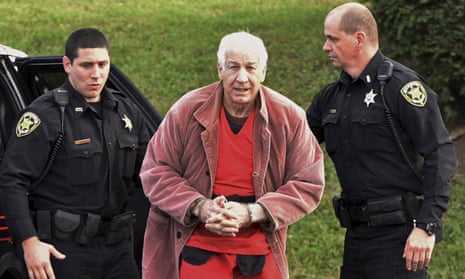
Afterward, he was transferred from county jail to Camp Hill state prison for evaluation, then moved to SCI Greene to serve his sentence, initially in protective custody. [2][3][15] In March 2017, he was transferred again, to SCI Somerset. [2]
His lawyers quickly filed a motion for a new trial, arguing that the defense had not had adequate time to prepare. [2] Judge Cleland denied that request in January 2013. [2]
Years later, Sandusky continued to pursue post‑conviction relief, maintaining his innocence. [7][11] In March 2023, his attorneys sought another new trial based on what they described as newly discovered evidence related to a civil attorney’s work with other accusers. The court denied the motion. [2]
The Sandusky case did not just engulf one man; it tore through one of the country’s marquee public universities.
Within days of his initial arrest in November 2011, the Penn State Board of Trustees forced out president Graham Spanier and fired Joe Paterno, the winningest coach in major college football history. [3][5][13] The scandal would ultimately topple four of the school’s top administrators. [4][5][16]
Trustees hired former FBI Director Louis Freeh to conduct an independent investigation into how the university had handled years of complaints about Sandusky. [2][5] Released on July 12, 2012, the Freeh Report concluded that Spanier, Paterno, Curley, and Schultz had concealed critical facts about Sandusky’s abuse—dating back at least to a 1998 police inquiry and the 2001 McQueary incident—to avoid bad publicity, and that they had never restricted his access to university facilities. [2][11]
The findings landed like a bomb. Penn State’s famed “Grand Experiment” under Paterno—where football and integrity were supposed to go hand in hand—collapsed in the span of months. [16] The NCAA imposed unprecedented sanctions: a $60 million fine, a multiyear postseason ban, and sharp reductions in football scholarships. [4] It also erased 14 years of victories from Paterno’s record. [4]
The Freeh conclusions remain bitterly contested. Paterno’s family and Spanier publicly rejected the idea of a deliberate cover‑up, and some alumni groups argued the report was rushed and overly reliant on inference. [11] But in the legal and public arenas, its narrative of institutional failure has largely held.
Civil litigation followed swiftly. By October 2012, at least four young men had sued Penn State over its response to complaints about Sandusky, and eight legal teams representing at least 20 men had surfaced, with the university announcing a push to settle as many claims as possible. [4] Penn State released statements accepting responsibility for addressing child sexual abuse and promising to compensate those harmed, and later said it would invite victims into a private program to address their concerns. [1][3]
The scandal’s emotional impact in and around State College was harder to quantify but no less real. At St. Paul’s United Methodist Church, where Sandusky had been a member, pastors described a community “rocked to the core” and invited congregants to write messages of support to abuse survivors. [16] A former trustee compared the crisis to “9/11 for Happy Valley,” predicting it would shape local consciousness for years. [16]
Even as Jerry Sandusky settled into life as inmate rather than coach, his family continued to orbit the case.
The location where the statue of Joe Paterno once stood.jpg
Matt Sandusky, the former foster child the couple had adopted, released a statement through attorney Andrew Shubin during the 2012 trial, alleging that his father had sexually molested him as a child. [2] Lawyers said he had been prepared to testify for the prosecution if called, though he ultimately did not. [1][3]
In 2017, another adopted son, Jeffrey, appeared in a Pennsylvania courtroom on his own charges. He had been arrested that February on allegations including sexual assault of a child and possession of child pornography. [2] That September, on the eve of his trial, he pleaded guilty to 14 counts—including solicitation of statutory sexual assault and solicitation of involuntary deviate sexual intercourse—stemming from efforts to pressure a teenage girl to send nude photos and to ask her younger sister to perform a sex act. [2][7] In December 2017, he was sentenced to three and a half to seven years in prison, plus a year of probation. [2][7]
Jeffrey, one of the six children adopted by Jerry and Dottie, had been a corrections officer and a visible supporter at his father’s court proceedings. [7] By the time of his sentencing, the Department of Corrections said he had been fired from his job as a Rockview State Prison guard. [7]
Those convictions were legally separate from Jerry Sandusky’s case. Still, taken together with Matt’s allegations and the criminal verdicts against Jerry himself, they underscored how completely the family name had become entangled with sexual abuse and betrayal. [7]
Even today, the full scope of Sandusky’s abuse remains uncertain.
In criminal court, jurors were told he had sexually assaulted 10 boys over 15 years, though the indictment and presentments named some victims and referred to others only obliquely. [1][3][8] The initial grand jury identified eight boys; subsequent filings added at least two more. [2] Prosecutors and reporters have variously cited figures from nine to “more than 20” alleged victims, and civil lawyers have said they represent at least 20 men. [4][12]
Documents obtained by investigative reporters showed that even before trial, Sandusky’s attorneys were asking for information about potential accusers numbered past 18—suggesting that, inside the case, everyone understood the list might be long. [6] Allegations from the Brownson House in Washington, involving men who said they were abused in the late 1960s, pushed the possible timeline of misconduct back decades before his peak fame at Penn State. [6]
What is clear is that for years, boys were hurt in places that were supposed to be safe: university locker rooms, a family basement, hotel rooms on football trips, and a charity created “for” them. [1][5][8] Some adults saw pieces of what was happening—a shower, a suspicious noise, a boy pulled out of class by a revered coach—and did too little or nothing at all. [2][5][9]
The legal system has rendered its judgment on Jerry Sandusky: 45 convictions, a sexually violent predator designation, and a prison term so long that even the sentencing judge said he expected him to die there. [2][4] The deeper reckoning—for Penn State, for the culture that insulated a powerful man, and for survivors whose lives were reshaped in the shadows of stadiums and charity banquets—continues long after the final whistle.
This case file is an original Bloody Likely narrative synthesis based on the cited sources. Article © Bloody Likely. All rights reserved. Source materials remain the property of their respective owners. Facts, public records, quotations, and cited references are used for reporting, research, commentary, and documentation. Bloody Likely content license
Audio narration © Bloody Likely. All rights reserved. The audio player is provided for personal streaming/listening only.
No recent news articles found for this case. Check back later for updates.
No evidence found for this case. Be the first to submit evidence in the comments below.
Join the discussion
Loading comments...
Grand jury and trial records identify the start of the period in which assaults by the defendant occurred around 1994.
The Pennsylvania Attorney General's Office initiated an investigation into sexual abuse allegations involving the defendant.
The grand jury identified alleged assaults continuing through 2009, marking the end of the abuse period under indictment.
A grand jury returned an indictment charging the defendant with dozens of counts of sexual crimes against young boys.
The defendant was arrested and charged with multiple counts including involuntary deviate sexual intercourse and corruption of minors.
The state trial opened at the Centre County Courthouse with multiple victims testifying about assaults linked to the defendant.
A jury found the defendant guilty on 45 of 48 counts related to the sexual abuse of young boys.
An independent investigation concluded senior university leaders concealed critical facts about the defendant's abuse for years.
The judge sentenced the defendant to 30 to 60 years in prison and declared him a sexually violent predator.
The defendant was transferred into the state prison system to begin serving the imposed sentence.