ANALYZING EVIDENCE
Processing case files...
Processing case files...
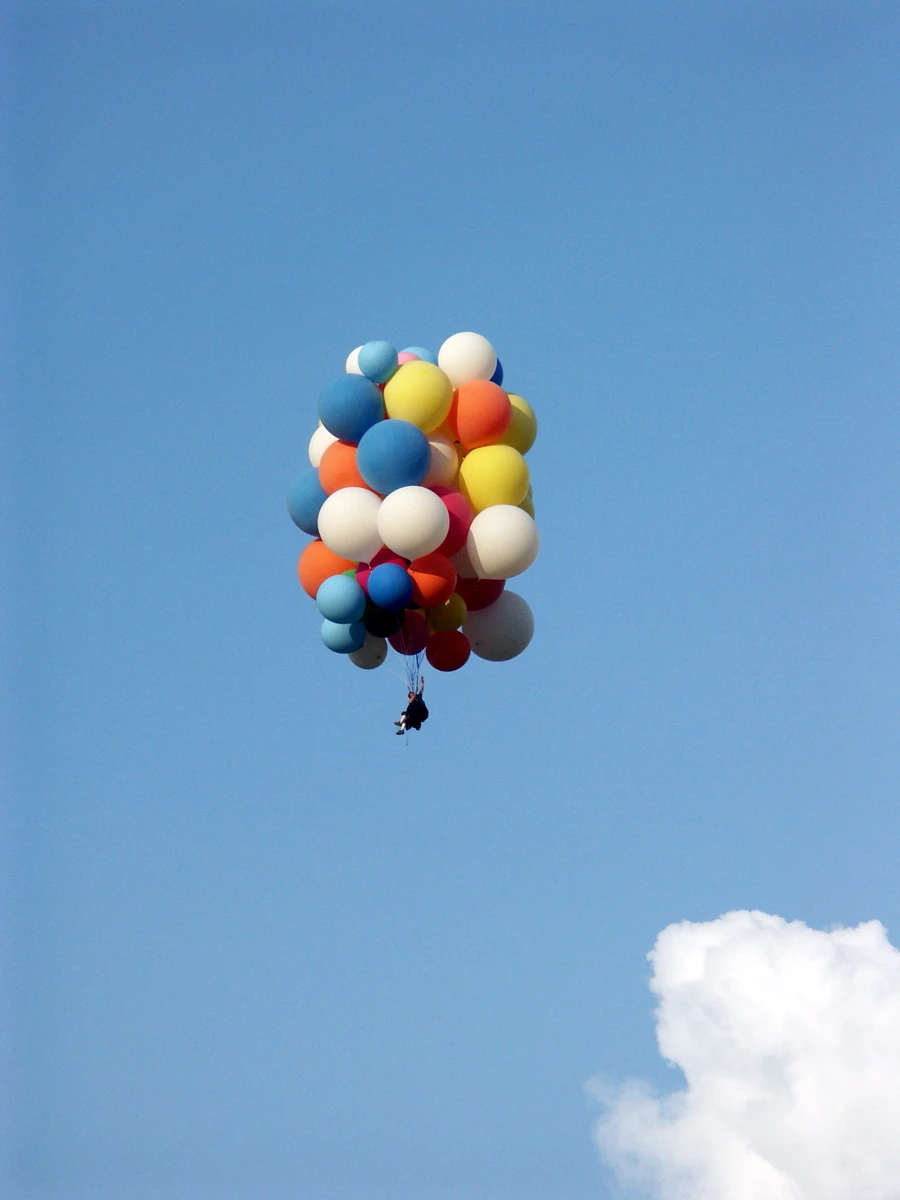
Unauthorized lawn chair flight
CLASSIFICATION: Unknown
LOCATION
San Pedro, Los Angeles, California
TIME PERIOD
July 2, 1982
VICTIMS
0 confirmed
A man launched himself in a lawn chair attached to dozens of helium weather balloons on July 2, 1982, rising to about 16,000 feet above San Pedro, Los Angeles and drifting into controlled airspace near Long Beach Airport. The pilot, Larry Walters, shot some balloons to descend and landed after his tethering cables became caught in Long Beach power lines; he was arrested on landing and later fined for Federal Aviation Regulation violations. The incident drew worldwide media attention, the lawn chair was preserved and later exhibited at air museums, and the regulatory matter was resolved. Walters died by suicide in 1993; the flight itself is a closed, resolved incident with documented communications, eyewitnesses, and official fines as key evidence.
Some believe Walters’s flight was less a stunt than the fulfillment of a decades‑long compulsion — supporters argue he needed to achieve a lifelong dream and may have been driven by unresolved psychological issues, a theory often raised in discussions of his later suicide. Others have pointed to the deception used to purchase surplus weather balloons (posing as advertisers) and argue this premeditated misrepresentation heightens questions about legal and moral responsibility; critics likewise debated whether the FAA’s initial $4,000 fine (later reduced) and the dropping of certain charges reflected undue leniency. Finally, investigators and commentators have speculated that Walters’s feat directly inspired a wave of imitators and the informal sport of cluster ballooning, a contested legacy given subsequent accidents and fatalities by copycats.
On a summer morning in 1982, airline pilots lining up for Los Angeles saw something that should not have been there: a man in an aluminum lawn chair, drifting at 16,000 feet, a bank of helium weather balloons holding him in the sky. [1][2]
The man was 33-year-old Larry Walters, a Vietnam veteran and North Hollywood truck driver with no pilot or balloon training. [1][2][3]
He had launched from a backyard in San Pedro, aiming to float over Long Beach and on toward the Mojave Desert. [2][3]
He would end his trip entangled in Long Beach power lines, blacking out part of the city and stepping down, miraculously unhurt, into instant notoriety and federal trouble. [1][3][4]
For the rest of his short life, he would never quite escape the shadow of that lawn chair.
Lawrence Richard Walters was born on April 19, 1949, in Los Angeles, California. [2]
As a boy, he walked into a military surplus store, looked up, and saw weather balloons hanging from the ceiling. The idea lodged hard. According to later accounts, he first thought of using balloons for flight at around 13. [2]
He dreamed of becoming a pilot in the U.S. Air Force, but bad eyesight shut that door. [2][4]
Instead, he served in the Army in Vietnam, then came home and worked as a truck driver in North Hollywood. [2][3][5]
The dream, he said later, never left. He told reporters he had “dreamed of the flight for 20 years,” and that if he hadn’t done it, he thought he would have ended up in “the funny farm.” [3][5]
“Since I was 13 years old,” he said, “I’ve dreamed of going up into the clear blue sky in a weather balloon.” [1]
After his 1982 flight, he was matter-of-fact about the compulsion behind it.
“It was something I had to do,” he told the Los Angeles Times. [3]
By 1982, Walters was a 33‑year‑old truck driver with no formal aviation training but years of private scheming about how to get himself into the sky. [2][3][4]
He enlisted the help of his girlfriend, Carol, for the plan. [2]
They posed as representatives of an advertising company to buy surplus weather balloons—dozens of them—from a supplier. [2]
One account describes the balloons as eight feet in diameter and 33 cubic feet in volume. [2]
Walters and Carol chose their launch site: the small backyard of her home in San Pedro, at the southern edge of Los Angeles. [2]
Friends helped attach the balloons to an ordinary aluminum lawn chair. [2][4]
He christened it Inspiration—sometimes reported as Inspiration I. [2][3][5]
© Mapbox © OpenStreetMap
He did not build a cockpit or control surfaces. He built a bundle: more than forty helium-filled balloons arranged in four tiers above the chair, all tethered to a jeep to hold the contraption down before liftoff. [2]
For the flight, Walters packed with a strange mixture of caution and naiveté. He strapped on a parachute and took a camera, a Citizens Band radio, a bottle of beer, and a few sandwiches. [2]
He also carried a pellet or BB gun, planning to shoot individual balloons to control his descent. [1][2]
Thirteen plastic jugs of water hung from the chair as ballast, meant to be dumped if he descended too fast. [1][2][4]
He brought along a large bottle of soda and an altimeter as well. [3][6]
The plan, as he told people around him, sounded almost modest. He wanted to rise about thirty feet above the backyard; if everything looked stable, the tethers would be cut and he would drift gently east, over Long Beach and toward the Mojave Desert, easing his way down by shooting balloons one by one. [2]
This was not how it went.
On a Thursday night in early July 1982, Walters went to a friend’s house in San Pedro and inflated his stock of weather balloons, attaching them to the aluminum lawn chair tethered to the ground. [1]
By late morning the next day—around 11 a.m., according to one detailed aviation account—Walters sat strapped into the chair in Carol’s backyard. [2]
About half a dozen friends held the tethers as he donned his parachute and readied himself to go up “slowly.” [1]
Instead, the moment they released the craft, the lawn chair leapt for the sky.
One source describes it shooting upward at roughly 800 feet per minute. [2]
As the mass of balloons strained against their single lifeline, the tether rope reached its limit and snapped, freeing Walters to climb uncontrollably away from San Pedro. [2][5]
He had meant to hover over a backyard. He rocketed into controlled airspace.
Within minutes of takeoff, Walters realized he had lost control of the flight.
Cluster Ballooning.jpg
Doug Dixon, a member of an Orange County CB radio club, later recalled that Walters “broke into our channel with a mayday” and described what was happening. [1]
Walters said he had shot up “like an elevator” to 16,000 feet and was getting numb before he began shooting out some of the balloons. [1]
At that altitude, the risks were real. Some reports put his peak height around 16,000 feet above ground level, others at about the same altitude above sea level. [1][2][3]
Above 10,000 feet, supplemental oxygen is typically required to avoid hypoxia; Walters had brought none. [2]
He was not dressed for high flight. One account notes that he shivered in the cold as he hung in the thin air. [3]
Another says that at around three miles up he felt cold and dizzy. [5][6]
At some point in the climb, he lost a pair of glasses overboard. [4]
His improvised aircraft drifted across the approach lanes to major airports, a speck of backyard hardware floating through the domain of jetliners.
It didn’t take long for commercial pilots to notice.
At least two airline crews—Trans World Airlines and Delta pilots among them—spotted the flying lawn chair at roughly 16,000 feet and radioed word to authorities. [1][2][4]
The captain of one airliner approaching Los Angeles International Airport reported that he was passing “a man in a chair” at that altitude, holding what appeared to be a pistol. [2]
An air traffic controller obtained a radar fix and began tracking the strange target as it drifted through controlled airspace over Los Angeles and toward Long Beach. [2][5]
On the ground, the Federal Aviation Administration did not see the humor. One New York Times account noted dryly that the agency was “not amused.” [1]
A regional safety inspector, Neal Savoy, told reporters that the pilots’ sightings placed the lawn chair at about 16,000 feet and that “some type of charge will be filed.” [1]
“If he had a pilot’s license, we’d suspend that,” Savoy added. “But he doesn’t.” [1]
As the radar blip and the CB signal moved together over Long Beach, Walters tried to warn air traffic control of his presence. [2]
Up in the chair, Walters had a decision to make.
He had always planned to descend by shooting balloons, but once aloft he hesitated. According to one account, he feared that popping the wrong balloons could unbalance the rig and pitch him out of the chair. [2]
Eventually, cold and altitude forced his hand. Walters began popping balloons, using his pellet gun to shot them out one by one. [2][3][4]
The BBC later reported that he managed to shoot out seven before something went wrong. [4]
While he was reading his altimeter, he set the gun on his lap. A gust tilted the chair; the gun slipped and went over the side, disappearing into the air below. [1][2][5]
Without the weapon, fine‑tuning his descent became impossible. Helium slowly leaked from the balloons and the chair began to sag toward the ground on its own schedule. [2]
The only remaining control he had came from his water jugs, which served as crude ballast as the chair drifted downward. [1][2][4]
How long he remained aloft is one of the enduring small mysteries of the flight.
Some reports, including The New York Times and later summaries, describe a ride of about 45 minutes. [1][4][5]
Others, including an early Los Angeles Times piece, say he spent about two hours in the air. [3]
Either way, he had been in the sky far longer than planned by the time the ground finally rose up to meet him.
Walters’s improbable journey ended above Long Beach.
As the leaking balloons let him down, the cluster of cables and lines hanging from the chair snagged in a high‑tension power line not far from Long Beach Airport, in a residential area later reported as 423 E. 44th Way. [2][3][5]
Plastic tethers between the chair and the balloons turned out to be a life‑saving detail. They insulated him from the live lines and kept the sudden stop from killing him. [2][6]
To free him, utility crews cut power to the line. In the process, they briefly blacked out part of Long Beach; some accounts put the outage at roughly twenty minutes. [1][3][6]
The lawn chair ended up dangling just a few feet above the ground. [1][2]
Firefighters and utility workers got him down safely. [1][2][4]
He had traveled from a backyard to the edge of controlled airspace and back without suffering a physical scratch.
The rescue was not the end of the story. Walters was taken into custody almost immediately; Long Beach police arrested him as soon as he was safely on the ground. [2][5]
He was quickly identified as Larry Walters of North Hollywood, 33 years old, a truck driver who had strapped himself into a lawn chair and ridden 16,000 feet into the sky. [1][2][6]
Police officers struggled between disbelief and duty. Lieutenant Rod Mickelson, speaking to The New York Times, first had to stop laughing before he could tell a reporter, “I know it sounds strange, but it’s true.” [1]
The press dubbed Walters “Lawnchair Larry,” a nickname that stuck for the rest of his life and well beyond it. [2][4]
In the days after the flight, Walters tried to put his motives into words.
“It was something I had to do,” he told The Times. [3]
He said he had dreamed of such a flight for twenty years, adding that not doing it would have put him in “the funny farm.” [3][5]
When asked more bluntly why he had undertaken the stunt, one aviation account quotes him answering: “A guy has to do something, he can’t just sit around in his backyard all day.” [2]
The backyard, of course, was where it had all started.
Almost as soon as Walters’s chair came down, regulators began deciding what to do with him.
Before formal charges were filed, Neal Savoy of the FAA told reporters, “We know he broke some part of the Federal Aviation Act, and as soon as we decide which part it is, some type of charge will be filed.” [1][6]
On December 17, 1982, the FAA announced that it was fining Walters $4,000 for violating four federal aviation regulations. [6]
The violations included operating “a civil aircraft for which there is no airworthiness certificate,” creating a collision danger to other aircraft, entering an airport traffic area without establishing and maintaining two‑way communication with the control tower, and failing to take sufficient care to prevent hazards to the lives and property of others. [2][6]
Walters did not accept the fines quietly. He indicated he would challenge them and was quoted saying that if the FAA had existed in 1903, it would have prevented the Wright brothers’ first flight. [6]
In April 1983, the agency dropped one of the charges and lowered the fine to $3,000. [6]
Negotiations continued. Eventually, the FAA accepted $1,500 from Walters to settle the case, and other accounts describe the penalty being reduced to that amount on appeal. [2][3][6]
He kept his record in the sky. He also kept a federal paper trail.
For a brief moment, the man in the lawn chair became a fixture of American pop culture.
The strange anarchy of his flight—reckless, funny, undeniably dangerous—made Walters a national curiosity. The Los Angeles Times later noted that he achieved “widespread public attention” from the stunt. [3]
He received the top prize from the Bonehead Club of Dallas, a tongue‑in‑cheek award that recognized the ludicrous side of his accomplishment. [3]
Television loved him. Walters appeared on The Tonight Show with Johnny Carson and on Late Night With David Letterman; one account notes he was flown to New York to sit across from Letterman and explain himself. [3][4][6]
The BBC later described how, during that appearance, his earnest references to his “craft” and “ground crew”—really a garden chair and a few friends in a cramped backyard—couldn’t quite stop the audience from laughing. [4]
Walters would later call appearing on Letterman “the most fun I’ve ever had.” [3]
He won small sums from TV appearances and speaking engagements. [6]
In 1992, Timex paid him $1,000 to appear in a print advertisement built around his flight. [6]
Almost everyone in America seemed to know the outline of the story: a man, a lawn chair, and some balloons.
For a while, Walters tried to turn that outline into a livelihood.
After his initial burst of fame, he quit his job as a truck driver and tried to work as a motivational speaker, taking to the lecture circuit and running seminars. [3]
By his own account, it never paid particularly well. [2][3][6]
“He never made much money from the flight,” the Times reported later, adding that he preferred to keep a simple lifestyle. [3]
He also made a decision on landing that he would come to regret. In the immediate chaos after his rescue, Walters gave his aluminum lawn chair “aircraft” to neighborhood children. [3][6]
Years later he said he wished he had kept it. [3]
Decades afterward, an Arizona pilot and simulator engineer named Mark Barry tracked the real chair down. [4]
It was still in the possession of the boy Walters had handed it to, complete with some of the original tethers and water jugs. [4][5]
Today, that same garden chair—battered, ordinary, and famous—sits in the National Air and Space Museum at the Smithsonian Institution in Washington, D.C. [4]
In the years that followed, Walter’s life drifted into quieter patterns.
He never married and had no children. [3]
Relatives later said he did not make a fortune or settle into any single, steady career. [3][6]
Instead, he hiked. He spent time in the San Gabriel Mountains and did volunteer work for the U.S. Forest Service. [3][5]
“I love the peace and quiet,” he told the Los Angeles Times in 1988. “Nature and I get along real well.” [3]
The man who had once shared airspace with jetliners seemed to find his comfort back on the ground, on steep trails and among trees.
Yet the lawn chair never fully left him. He remained, in the public imagination and in many introductions, “Lawnchair Larry”—a label that carried both awe and ridicule. [2][4]
“I didn’t think that by fulfilling my goal in life, my dream, that would create such a stir—and make people laugh,” he reflected. [4]
Cluster ballooning
Wikimedia Commons· CC BY-SA 2.0
On October 6, 1993, eleven years after his flight, Larry Walters hiked into Angeles National Forest northeast of Los Angeles. [2][3][4]
There, at a remote spot he favored, he shot himself and died at age 44. [2][3]
His mother, Hazel Dunham, told the Los Angeles Times that he had shot himself in the heart after hiking into the forest, and authorities ruled his death a suicide. [3][4]
Relatives said they knew of no motive. [3]
He was survived by his mother and two sisters. [3]
For many years, that seemed to be the end of the story: an impulsive backyard aviator who became a folk hero, struggled to build a life around one day in the sky, and died by his own hand.
Later, though, doubts emerged from within his own family. In comments cited by the BBC, Hazel Dunham later told The New Yorker there were “suspicious circumstances.” She pointed to drug smugglers in the area where his body was found and said he was discovered with the gun in his right hand, though she insisted he was left‑handed. [4]
A family friend and researcher, Mark Barry, has gone further, saying he believes Walters did not die by suicide and claiming to have uncovered evidence to support that belief—though he has declined to share specifics, saying he is holding details back for a book about Walters’s life and death. [4]
At the same time, other family members have dismissed the idea of foul play. [4]
The official record still lists his death as a suicide, and no alternative theory has been tested in court. [3][4]
The end of Larry Walters’s life is thus as unsettled, in its way, as parts of his famous flight.
Even during his lifetime, the details of Walters’s day in the sky began to blur in retelling.
Basic facts don’t entirely line up.
Some contemporary accounts place the flight on July 2, 1982, with a path from San Pedro to Long Beach. [2][3][5]
Others say it happened on July 3, with a launch sequence spread over Thursday night and Friday morning. [1]
The number of balloons varies from source to source—42, 45, or simply “more than 40” weather balloons tethered to the chair. [1][2][4]
After 1997, the story took on an even stranger life online. A widely circulated email version of the tale, often forwarded as a kind of urban‑legend morality play, added invented dialogue, sharpened punchlines, and outright fabrications. [6]
Fact‑checking site Snopes would later mark the core claim—that a man had indeed soared above Los Angeles in a lawn chair attached to weather balloons—as true, while noting that many of the details in popular retellings were made up or greatly embellished. [6]
In reality, Walters did set an altitude mark for gas‑filled clustered balloons, though it was never officially recognized. He was unlicensed and unsanctioned, and he did not carry proper recording equipment for a record attempt. [3][6]
What has endured is not the fine print of his equipment but the image itself: a man in a Sears‑type lawn chair, riding over Los Angeles like an accidental astronaut.
Walters never flew under balloons again. [6]
But his one flight cast a long shadow.
Cluster ballooning as a niche pursuit grew partly in response to his story, with later adventurers attempting similar feats using improved gear and actual flight plans. [4]
His tale inspired fictionalized versions, including the Australian comedy film Danny Deckchair and a stage musical The Flight of the Lawn Chair Man. [5][6]
In pop culture, the image of a house or chair borne aloft by balloons appeared again and again, most famously in Pixar’s 2009 film Up. [4]
Walters himself has been reexamined more recently. A new British stage musical, 42 Balloons, written by Jack Godfrey, seeks to reclaim him as something closer to a hero than a punchline. [4]
The show leans on his own repeated insistence in interviews: “I knew what I was doing.” [4]
In the end, it is perhaps fitting that the most concrete artifact of his story is not an official record or a legal ruling but the object that carried him there.
The lawn chair from Carol’s San Pedro backyard—once just a piece of garden furniture, briefly a dangerous aircraft, later a child’s toy—now rests behind glass in one of the world’s great aviation museums. [4]
Larry Walters did not become the Air Force pilot he dreamed of being. [2]
Instead, in a single morning suspended under a canopy of weather balloons, he stepped sideways into a different kind of aviation history: reckless, improvised, impossible to forget.
This case file is an original Bloody Likely narrative synthesis based on the cited sources. Article © Bloody Likely. All rights reserved. Source materials remain the property of their respective owners. Facts, public records, quotations, and cited references are used for reporting, research, commentary, and documentation. Bloody Likely content license
Audio narration © Bloody Likely. All rights reserved. The audio player is provided for personal streaming/listening only.
No recent news articles found for this case. Check back later for updates.
No evidence found for this case. Be the first to submit evidence in the comments below.
Join the discussion
Loading comments...
Larry Walters launched in a lawn chair attached to 42 helium weather balloons from San Pedro and rose to about 16,000 feet.
Walters descended and became entangled in Long Beach power lines, causing a short blackout, then was arrested by Long Beach police.
Ten days after the flight Walters appeared on Late Night with David Letterman following widespread media attention.
Larry Walters died by suicide after shooting himself in Angeles National Forest at age 44.
The lawn chair used in the flight was placed on loan and exhibited at the San Diego Air and Space Museum.