ANALYZING EVIDENCE
Processing case files...
Processing case files...
2017 Celebrity Misconduct Allegations
CLASSIFICATION: Unknown
LOCATION
Aspen, Colorado
TIME PERIOD
2002–2019
VICTIMS
5 confirmed
Multiple women accused comedian Louis C.K. of sexual misconduct, alleging incidents including an encounter in a hotel room during the 2002 US Comedy Arts Festival. The allegations were publicly reported in The New York Times on 2017-11-09, after which Louis C.K. issued a statement admitting the behavior and apologizing. The revelations triggered industry fallout — film distribution canceled, networks and studios cut ties — but no criminal conviction is recorded and the matter remains unresolved in court. Key elements include the accusers' accounts, contemporaneous reporting to industry figures, and Louis C.K.'s public admission.
Some believe that Louis C.K.’s 2017 admission of sexual misconduct was as much damage control as contrition, with debate over whether his apology and limited accountability reflected genuine remorse or a strategic pivot to preserve his career. Investigators and commentators have speculated that industry players and distributors quietly protected or distanced themselves at various times—evidenced by the pulling of his film from release and the uneven professional consequences—feeding claims of a cover-up and preferential treatment. Others argue that his subsequent return to stand‑up, tours and awards signals either industry forgiveness or a troubling failure of lasting accountability, leaving motive, responsibility and the true extent of institutional complicity unresolved.
Louis C.K. was at the height of a singular career—Emmys, a Peabody, a formally daring FX series he controlled top to bottom—when, on November 9, 2017, the New York Times published allegations of sexual misconduct from five women. [1][2][3]
Within a day, he issued a statement: “These stories are true,” he wrote, acknowledging that he had wielded his power over women “irresponsibly” and saying he would “step back and take a long time to listen.” [2]
The admission detonated the public image of a comedian long praised for honesty and self-laceration onstage. It also forced a reckoning with the way his rise—shaped by unusual creative freedom and financial innovation—intersected with how he treated women offstage. [1][2]
Louis C.K. was born Louis Székely in Washington, D.C. in 1967. [4] The Atlantic gives his birth date as September 12, 1967, a detail echoed in other reporting. [2][5]
Louis C.K. performing in New Delhi, India (3-15-26).jpg
His father, a Harvard-educated economist from Mexico with Hungarian and Mexican heritage, moved the family to Mexico City when Louis was about a year old, to be near his father’s side of the family. [1][4][6] C.K. has said he “started life in Spanish” there, then had to reject his Spanish and Mexican past later to adopt an American identity. [4]
Around age six or seven, the family returned to the United States and settled on the East Coast. [4][6] After a year in Framingham, Massachusetts, where he remembers being teased, they moved to nearby Newton. [4][6] He has described growing up “on the wrong side of the tracks” in a three-story double-decker house in Newton. [4]
© Mapbox © OpenStreetMap
His father moved out shortly after Louis’s tenth birthday, and money became a concern. [3][4] His mother worked as a computer programmer and raised Louis and his three sisters on her paycheck. [3] As a teenager in the Boston suburbs, he cleaned pools, fixed cars, worked as a Kentucky Fried Chicken cook—at one point bringing home KFC turkey dinners for Thanksgiving two years in a row—and took an auto mechanic job to earn money. [3][4]
C.K. has called himself a “depressive kid” who turned early to drugs; by his own account, eighth and ninth grade involved heavy use of LSD, cocaine, Quaaludes, marijuana, and mescaline. [3][4] He has said that by the time he reached high school, he was a “recovered drug addict,” though he later relapsed before quitting again. [3][4][6]
A homeroom teacher intervened, arranging a meeting with his mother and steering him toward an internship at a local-access cable-TV station, where he learned to shoot and edit video. [6] At 17, he filmed his first short, “Trash Day.” [4]
Despite a C average, an NYU film-school interviewer told him he would be accepted if he applied. C.K. never submitted the paperwork, though he also “impressed recruiters” there. [3][4] Instead, he headed for the Boston comedy scene. [4]
His first attempt at stand-up was brutal. After hearing a radio ad for an open-mic night at the Boston club Stitches, he prepared five minutes of material and went onstage—only to bomb so badly he did less than two minutes. [3] Even so, he stayed with stand-up. Boston comics like Greg Fitzsimmons later remembered him as admired early on, with material that was “conceptual and loud.” [3]
By the late 1980s and early 1990s, C.K. was appearing on televised comedy showcases such as Caroline’s Comedy Hour and MTV’s Half Hour Comedy Hour. [4] After drawing attention in Boston, he moved to New York sometime between 1989 and 1993; he has said he “settled in New York as a struggling comic” in 1989. [1][4]
In New York, he ground out sets in clubs across the city, sometimes gigging up to ten times a night for about $50 a show. [4] He rode a Honda Super Sport 750 motorcycle between gigs, racing up and down Manhattan’s FDR Drive at 100 miles per hour. [3][4] At one point, he crashed on Second Avenue after hitting a car that ran a red light, waking up bruised and noticing he was balding. [3][4]
During the stand-up boom of the early 1990s, he auditioned for Saturday Night Live while he was going broke. [4] In 1993, he says, SNL rejected him. [1] That audition also produced a small humiliation: club booker Louis Faranda, worried C.K. might bomb in front of SNL scouts, ordered him onstage before they arrived. [3]
SNL’s head writer Jim Downey instead referred C.K. to Robert Smigel, who was helping Conan O’Brien prepare for a new late-night show. [4] Smigel called with a job offer in 1993, and C.K. joined the original writing staff of NBC’s Late Night With Conan O’Brien, earning $2,500 a week and opening his first bank account. [1][3]
From there, he found consistent work writing for late-night television and appearing in sketches on Conan’s Late Night and David Letterman’s Late Show. [4] Between 1995 and 1996, he served as head writer of The Dana Carvey Show and made on-camera cameos. [4] When that show ended, Smigel brought him onto Saturday Night Live to write the “TV Funhouse” animated vignettes. [4]
He also helmed the writers’ room for The Chris Rock Show and won an Emmy for his work there—a turning point that pushed him from cult comic to an in-demand writer. [3][4]
By the mid-1990s, C.K. was also building a presence on premium cable. In 1996 he recorded his first HBO comedy half-hour. [4] He took a recurring role as a deadpan animated version of himself on Comedy Central’s Dr. Katz, Professional Therapist. [4]
Louis C.K. sign.jpg
He began pushing into filmmaking with his own scripts. He wrote and directed the black-and-white feature Tomorrow Night, which aired at Sundance and was later widely reported as a 1998 film. [2][4]
Next came Pootie Tang, a feature he wrote and directed with Chris Rock. [4] C.K. has said he was taken off the project by the studio just before editing and was later fired from it; Paramount removed the film and recut it without him after being unhappy with his work. [1][3][4] Executives reportedly labeled the movie “unreleasable,” and early viewers disliked it, though it eventually developed a small cult following. [4]
On television, HBO gave him a shot at a traditional sitcom with Lucky Louie, a working-class, multi-camera comedy built around his persona. [1] The show was canceled after a dozen episodes, even as critics responded warmly. [4] Actress Pamela Adlon collaborated with him on Lucky Louie—a partnership that would carry into his later work. [4]
The pattern was already clear: C.K. kept getting chances to build vehicles around his sensibility, and just as often he clashed with the structures around them, losing control of projects he’d created.
Offscreen, his stand-up was becoming more ambitious and more visible. In the mid-2000s he released a run of specials—Shameless (2007), Chewed Up (2008), Hilarious (2010), Live at the Beacon Theater (2011), and Word: Live at Carnegie Hall (2012). [2][4]
Hilarious was nominated for two Emmys, and the album taken from it won a Grammy, confirming that his act had crossed from club favorite to awards-stage recognition. [5] By the end of the 2006–2012 period, critics and fellow comedians were calling him one of the leading stand-up comics in the United States. [4]
C.K. was also experimenting with how to finance and sell his work. As early as 2001, he released his debut comedy album Live in Houston directly through his website. [2] He later became one of the first performers to offer direct-to-fan ticket sales and DRM-free video downloads of his concerts online. [2]
The experiment hit a new scale with Live at the Beacon Theater. He financed, directed, and distributed the special himself, releasing it on his website in December for $5. [3][5] He was meticulous enough to “self-bootleg” performances on his iPhone so he could review them later. [6] Within ten days, sales had cleared $1 million, and by December 21, 2011, total sales from his site had earned him over $1 million. [2][5]
The Hollywood Reporter later wrote that C.K. had “redefined the business of stand-up” by selling recordings directly to fans through his site. [1] Comedians including Aziz Ansari and Jim Gaffigan followed his model. [1]
On tour in those years, the money was substantial. He described earning between $25,000 and $100,000 a night, saying he would pocket $200,000 for four shows in New York. [3] He told Rolling Stone that his act at the time contained “about four raucous laughs” over the course of a two-hour set, an indication of how he thought about pacing and build. [3]
C.K. built that scale, in part, by forcing himself to discard material. He said he scrapped his act every year and started again from zero, a self-imposed rule that led him to abandon his current hour forever once his HBO special Oh My God aired on April 13. [3][6] In practice, that meant he was constantly writing; at one performance described in 2013, he opened with nearly 20 minutes of entirely new material, much of it ideas he had simply emailed himself under the subject line “joke.” [6]
He avoided scripting his sets. “It’s all in my head,” he said, explaining that he did not write them down and preferred to vary wording from show to show. [3][6] He described his creative approach as “deconstruction to a point where you’re left with a fucking mess of unanswered questions.” [3]
By late 2011, he was taping back-to-back performances at Manhattan’s Beacon Theatre for an upcoming special, working the room while actress Pamela Adlon sat nearby in the dressing room. [3] The same period saw him selling out rooms so quickly that a Carolines booker who once wouldn’t book him now delivered hefty checks for sold-out showcases. [3]
The next phase of his career turned on one unusually generous offer. John Landgraf, the president of FX, offered C.K. $250,000 to create “a series about his life.” [4] That became Louie, an FX half-hour that mixed cringe comedy, drama, bathroom humor, slapstick gore, and surreal flourishes into a loose, semi-autobiographical portrait of a divorced comedian raising two daughters in New York. [3]
C.K. negotiated a remarkable degree of freedom. Under his deal with FX, he received $300,000 per episode to spend as he liked, and he retained absolute creative control—writing, directing, and editing each episode himself, with no network interference in scripts, casting, or shooting. [3]
Louie debuted as what some critics called an “anti-sitcom” and quickly became a critical darling. [4] New York magazine’s Matt Zoller Seitz described its form as “revolutionary” in 2012. [4] Ricky Gervais praised C.K. and called Louie “the most interesting and most important comedy of the year.” [4]
Awards followed. The Atlantic noted that Louie was nominated for two Emmys in a single year. [5] The Hollywood Reporter counted 16 Emmy nominations and three wins for his FX comedy by 2015, while Wikipedia credits him with six Emmys overall and two Primetime Emmy Awards specifically for Outstanding Writing in a Comedy Series for Louie. [1][2] He also earned a Peabody Award. [1]
His stand-up accrued its own hardware: Hilarious’s album brought a Grammy, and other reports would later credit him with three Grammys in total. [2][5]
By 2012, he was named one of Time magazine’s 100 Most Influential People. [2] In 2017, Rolling Stone ranked him fourth on its list of the 50 best stand-up comics of all time. [2]
At the same time, he expanded his reach behind the camera. He co-created the FX shows Baskets and Better Things, planning to co-write and produce both under a multiyear development deal with the network. [1][2] He later created and starred in the self-funded web series Horace and Pete in 2016. [2]
His acting résumé grew, too. He appeared in films and shows including Role Models (2008), The Invention of Lying (2009), Parks & Recreation, American Hustle (2013), Comedians in Cars Getting Coffee (2014), Blue Jasmine (2013), Trumbo (2015), and the animated hit The Secret Life of Pets (2016). [1][2][4] He hosted Saturday Night Live several times, including an appearance that earned him an Emmy nomination for Outstanding Guest Actor in a Comedy Series. [2][4]
Louis C.K. (8895919355).jpg
By the mid-2010s, he was not simply a working comic; he was selling out Madison Square Garden, becoming, according to The Hollywood Reporter, the first comedian to do so three times in a single tour. [1] The same profile noted that he was running a company that produced Louie and other shows, while managing a relentless road schedule. [1]
Part of C.K.’s appeal lay in his willingness to drag uncomfortable subjects onto the stage. The Atlantic, in a profile centered on his show Louie, highlighted a Season Two storyline where his character is confronted by a young Christian anti-masturbation activist and argues with her—a plotline built literally around sexual self-gratification. [5]
In the same piece, the writer quoted him joking, “You can figure out how bad a person you are by how soon after September 11 you masturbated.” [5] Another Louie scene described in that article stages a vision of urban decay: a violinist playing on a New York subway platform while, in the background, a homeless man strips and rinses his torso with bottled water. [5]
Rolling Stone documented the even darker edges of his stand-up. One 2011 feature noted that, on a given fall evening at the Beacon Theatre, he was scheduled to riff about “receiving impatient hand jobs from Jewish girls, letting deviants fuck his corpse and watching bears eat his daughters.” [3] Another profile had him warning hecklers not to yell things out, adding, “If you have something to say… then you go home and you kill yourself.” [3]
Offstage, he discussed therapy and compulsion in ways that, later, would take on a different resonance. He told Rolling Stone that therapy had taught him his compulsive behaviors—eating and sex among them—were ways of self-medicating anxiety. [6] He also remarked, in the same period, that in 30 years he had “never had a woman show up at [his] dressing room.” [6]
His personal life was comparatively private. He had changed the spelling of his last name in grade school so people could pronounce it—“C.K.” standing in for “Székely.” [1][2][4] In 1995 he married artist Alix Bailey; they divorced in 2008 and have two daughters together. [2] A Rolling Stone profile described photographs of his girls, Mary Lou and Kitty (then six and nine years old), in his Manhattan apartment, and noted that he and his ex-wife, “a painter he doesn’t discuss,” shared custody. [3]
By 2013 he was 45, and he said he had only been successful for about four years—a reminder of the long stretch of near-obscurity before Louie hit. [6] Despite the success, he told Rolling Stone he was still in debt. [6]
On November 9, 2017, the New York Times published an investigation detailing allegations from five women who said Louis C.K. had engaged in sexual misconduct with them. [2] The article marked the first time these stories, long whispered within parts of the comedy world, were laid out in national print.
Louis Armstrong in Color (restored).jpg
Wikimedia Commons· Public domain
Two of the women, comedians Dana Min Goodman and Julia Wolov, alleged that in 2002 C.K. invited them up to his hotel room after a show and masturbated in front of them. [2]
Another comedian, Rebecca Corry, alleged that in 2005, while they were working on the set of a television pilot, C.K. asked if he could masturbate in front of her. She said she declined. [2]
A fourth woman, Abby Schachner, alleged that C.K. masturbated while they were on the phone together. [2] Both Corry and Schachner later said that C.K. privately apologized to them for his past behavior years after the incidents. [2]
In his written response to the Times story, C.K. did not dispute the accounts. Instead, he issued a statement acknowledging that “These stories are true” and apologizing. [2] In that statement, he wrote that he had used his power over women “irresponsibly” and said he would step back and listen for a long time. [2] Reporting at the time summarized his response as an admission of several incidents of sexual misconduct following the publication of the Times article. [2]
The behavior he admitted to echoed, in a blunt and uncomfortable way, themes he had long treated as material onstage: masturbation, power, guilt.
The professional consequences were swift and sweeping. His 2017 film I Love You, Daddy—which he had written, directed, and starred in—had its release and distribution cancelled before it reached theaters. [2]
FX Networks, the home of Louie and his development deal, cut ties with him in November 2017. [2] Netflix severed its relationship as well, scrapping plans for an upcoming stand-up special. [2] HBO dropped his appearance from an upcoming Night of Too Many Stars benefit and removed his work from its on-demand platforms. [2]
TBS suspended production of The Cops, an animated series he had co-created, and ultimately cancelled it. [2] His longtime manager Dave Becky dropped him as a client amid public criticism. [2]
Studios and networks adjusted ongoing and future projects. His voice was removed or replaced in family and animated properties, including The Secret Life of Pets 2 and Gravity Falls. [2]
C.K. later said that in the year after the scandal broke, he lost approximately $35 million in income. [2]
The combination of his public admission and the rapid unwinding of his projects made him one of the most prominent entertainers to face career-altering consequences for his own conduct.
For much of the following year, C.K. stayed out of public view as a performer. Then, on August 26, 2018, he appeared without announcement at the Comedy Cellar in Manhattan, doing a surprise set. [2] The club, a cornerstone of his career since his early days in New York, instantly became the focal point of debate over when—and on what terms—someone who had admitted to sexual misconduct should be welcomed back onstage.
He continued to rebuild his career largely outside traditional network systems, returning to the direct-to-fan model he had helped popularize earlier in the decade. On April 4, 2020, he self-released a new special, Sincerely Louis C.K., on his website. [2] In December 2021, he released another special, Sorry, the same way. [2]
In April 2022, Sincerely Louis C.K. won the Grammy Award for Best Comedy Album. [2] That same year, he co-wrote and directed the independent film Fourth of July, which premiered in June 2022. [2]
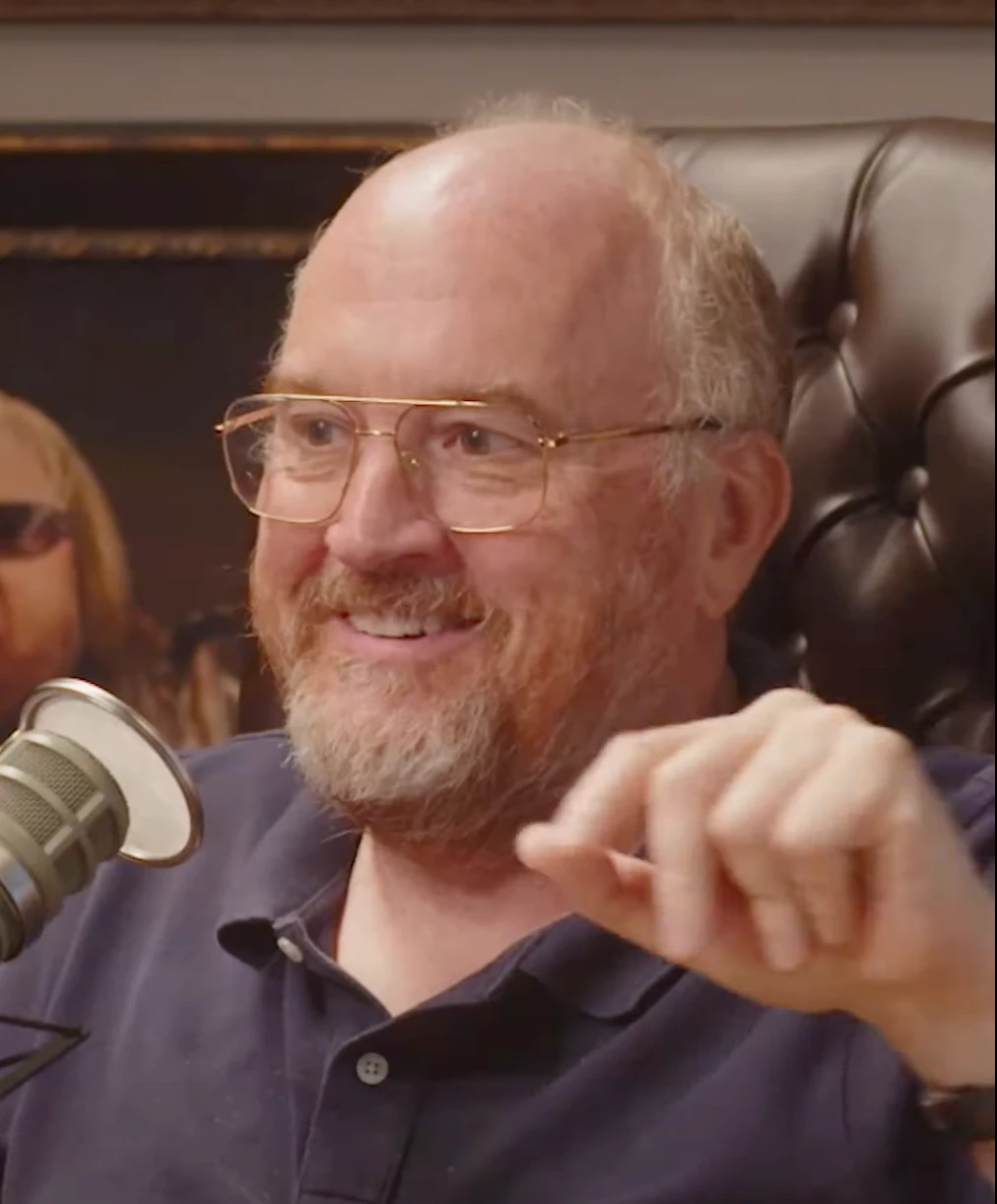
Louis C.K. on Your Moms House Podcast 2022
Wikimedia Commons· CC BY 3.0
During this period, his personal life shifted in quieter ways. His mother, Mary Louise Székely, died on June 3, 2019. [2] In 2018, he confirmed he was dating French comedian Blanche Gardin; by August 2022, he said the relationship had ended. [2]
Professionally, he remained a draw and a flashpoint: a comedian once positioned as a moralist of middle-aged male failure, now performing in the shadow of misconduct he had himself acknowledged.
Across three decades, Louis C.K. helped reshape modern stand-up and television comedy. He pushed toward more personal, uncomfortable material; he fought for and won near-total creative control on Louie; he reimagined how a comic could finance and distribute their own work, and watched peers adopt his model. [1][3]
He also admitted to behavior with women who worked in his orbit that mirrored some of his darkest jokes—using his professional status to corner them into witnessing or declining his sexual acts. [2]
Awards and lists continue to bear his name: Emmys, Grammys, a Peabody, spots on Time 100 and “greatest comics” rankings. [1][2] So do accounts from women who say working with him meant navigating a private reality very different from the public admiration that once surrounded him. [2]
For audiences and the industry, what remains is a divided legacy: a body of work that altered the form and business of comedy, and a set of acknowledged actions that altered the way his name is spoken whenever that work is discussed.
This case file is an original Bloody Likely narrative synthesis based on the cited sources. Article © Bloody Likely. All rights reserved. Source materials remain the property of their respective owners. Facts, public records, quotations, and cited references are used for reporting, research, commentary, and documentation. Bloody Likely content license
Audio narration © Bloody Likely. All rights reserved. The audio player is provided for personal streaming/listening only.
No recent news articles found for this case. Check back later for updates.
No evidence found for this case. Be the first to submit evidence in the comments below.
Join the discussion
Loading comments...
Two comedians (Dana Min Goodman and Julia Wolov) say Louis C.K. invited them to his hotel room during the US Comedy Arts Festival and masturbated in front of
Public rumors and comments about Louis C.K.'s behavior toward women began to appear, cited by figures such as Roseanne Barr, Tig Notaro and Jen Kirkman.
In a Vanity Fair interview Tig Notaro cut ties with Louis C.K. and said he should address rumors of sexual impropriety, alluding to an unspecified incident.
The New York Times published allegations from five women alleging Louis C.K. engaged in sexual misconduct over several years.
Distributor The Orchard canceled the New York premiere and release of Louis C.K.'s film I Love You, Daddy amid the emergence of the allegations.
Louis C.K. released a statement saying 'These stories are true,' admitting guilt and apologizing while announcing he would step back.
Networks, distributors and collaborators (including FX, Netflix, HBO and others) cut ties, removed content, and projects were suspended or scrapped.
Louis C.K. made an unannounced appearance at the Comedy Cellar in Manhattan, his first public performance since the allegations, drawing both support and
An audience recording of a new Louis C.K. set was posted online, including jokes about school shootings that sparked further media and peer reaction.
Louis C.K. announced an international tour of new material in an email to subscribers, continuing his return to performing despite ongoing controversy.