ANALYZING EVIDENCE
Processing case files...
Processing case files...
1912 North Atlantic shipwreck
CLASSIFICATION: Unknown
LOCATION
North Atlantic Ocean
TIME PERIOD
Apr. 14th – 15th 1912
VICTIMS
1491 confirmed
The RMS Titanic struck an iceberg on 1912-04-14 while four days into her maiden voyage from Southampton to New York and sank in the North Atlantic Ocean in the early hours of 1912-04-15. Over 2,200 people were aboard; approximately 1,491 died and 710 survived after nearby RMS Carpathia rescued survivors. Key issues documented in inquiries included ignored ice warnings, excessive speed in ice, inadequate lifeboat capacity and poorly executed evacuation procedures. Physical evidence from the wreck and subsequent surveys confirmed six narrow hull openings and the ship’s break-up during final moments.
Investigators and researchers have debated whether brittle iron rivets and weak hull seams caused the series of narrow punctures rather than a single large gash. There is also long-standing discussion over the ship’s breakup sequence (top-down vs. bottom-up/Mengot models) and controversy over the SS Californian's failure to respond to rockets and radio calls.
In the early hours of Monday, April 15, 1912, the RMS Titanic was dying in the dark. After striking an iceberg in the North Atlantic, the great liner foundered and slipped under the surface at 2:20 a.m., taking with her some 1,500 lives. [1][2]
On her inaugural voyage, the ship’s loss was immediately described as the worst maritime disaster of its day, a catastrophe that seemed to defy engineering, pride, and belief. [2] The wreck came to rest off Newfoundland in water roughly two and a half miles deep, far beyond the reach of contemporary technology and investigation. [2]
1912 Titanic itinerary atlantic EN.svg
For more than a century, the story of that night has been told and retold—hundreds of books, countless theories, all circling the same questions: How could this ship sink so fast, and what, exactly, did that iceberg do to her hull? [2]
From the beginning, one idea took hold and refused to let go. A persistent theory claimed that the iceberg had torn open a 300‑foot gash in the starboard side of the 900‑foot‑long ship, a wound worthy of the scale of the tragedy. [2]
It sounded plausible, and for decades no one could prove otherwise. The wreck lay inaccessible; no diver or investigator could swim along the buried flank of the ship and measure the damage. [2]
Even after the Titanic was finally located in 1985, expeditions tended to focus on the eerie spectacle of the “ghost ship”—the grand staircase, the scattered china, the iconic bow—rather than the exact nature of the wounds that sent it to the bottom. [2] The bow itself was mired in mud, hiding the critical damage from view and preserving the mystery of what the iceberg had really done. [2]
The central question—what kind of breach could sink such a ship so quickly—remained frustratingly out of reach. [2]
The discovery of the wreck in the mid‑’80s changed the Titanic from legend into a physical crime scene, but it was an underwater crime scene buried, broken, and half‑hidden. [2]
After midnight April 17, 1912, and still selling extras. There were many of these groups of young news-boys selling very late these nights. Youngest boy in the group is Israel Spril (9 yrs. LOC cph.3b08442.jpg
Wikimedia Commons· Public domain
Researchers could photograph fallen chandeliers and twisted railings, yet the most important evidence remained locked away beneath layers of silt. The bow, where the iceberg had struck, was literally stuck in the seabed, its hull plating and rivets sealed under mud that masked the very “wound pattern” investigators most wanted to see. [2]
The stalemate broke only when technology caught up with the wreck. An international team of scientists and engineers returned to the Titanic and repeatedly dove to the remains, intent not on spectacle but on forensics. [2]
Amerika14April1912.JPG
Wikimedia Commons· Public domain
Confronted with a bow still buried in mud, they turned to sound. Using acoustic methods, the team sent sound waves through the sediment, effectively “seeing” through the mud that had long concealed the crucial sections of the hull. [2]
What they found did not look anything like a 300‑foot gash. Instead, the investigators identified a series of six thin openings running across the ship’s starboard hull. [2] Measured together, the total area of the breaches was astonishingly small: about 12 to 13 square feet—less than the area of two ordinary sidewalk squares. [2]
The findings were unveiled as a surprise answer intended to finally end the long debate about the nature of the damage. [2] After decades of speculation, the picture that emerged was not one gigantic tear, but several narrow, fatal slits. [2]
The mystery of how the Titanic’s hull was opened was closer to resolution than it had ever been. [2]
While acoustic mapping probed the mud, another effort set out to reconstruct the entire wreck in unprecedented detail. Scientists created the most detailed 3D scan to date of the Titanic, a project that aimed to capture the ship’s broken body from bow to stern. [1]
RMS Titanic sea trials April 2, 1912 (cropped).jpg
Wikimedia Commons· Public domain
Using cutting‑edge underwater scanning technology, the team gathered some 715,000 digital images of the wreckage over nearly two years. [1] Those images were transformed into a full‑scale digital twin of the Titanic, a virtual reconstruction accurate down to individual rivets. [1]
Project experts described this digital mapping of the Titanic’s final resting place as a major breakthrough in marine archaeology. [1] The level of detail, they said, allows investigators to examine the wreckage “as if we were walking through the ship itself,” roaming its corridors and decks in a way no diver safely could. [1]
The scans did more than produce haunting imagery. Scientists reported that the digital model revealed new evidence that could rewrite elements of the narrative of the ship’s final moments on April 15, 1912. [1]
National Geographic framed this work for a wider audience in a documentary special, Titanic: The Digital Resurrection, described as presenting the most detailed digital reconstruction of the wreck ever created. [1]
The Titanic’s impact with the iceberg was both brief and catastrophic. Modern simulations, cited by a naval architecture expert, estimate that the collision itself took roughly 6.3 seconds—barely enough time for anyone on the bridge to register what was happening before the damage was done. [1]
Within that compressed window and the chaotic hours that followed, reputations were made and shattered. One of the most enduring controversies centers on First Officer William Murdoch. Historical accounts have long suggested that Murdoch abandoned his post during the crisis, a charge that cast him as a symbol of failure in the midst of disaster. [1]
The new digital model, however, has complicated that narrative. Project findings include evidence that may clear Murdoch’s name, shifting the image of his final actions on the ship. [1]
Investigators studying the wreck noted the positioning of a lifeboat davit—part of the mechanism used to lower boats into the water. Its location and angle in the debris field support Second Officer Charles Lightoller’s testimony that Murdoch was preparing to launch a lifeboat when he was swept away by the sea. [1]
Taken together, the reconstructed ship and the physical clues embedded in the wreck suggest a scene far removed from simple cowardice: an officer still at work amid the sinking, rather than one who had deserted his duty. [1] Yet the historical accounts that painted him otherwise have not disappeared, and the debate over his legacy continues in light of the new evidence. [1]
Everyone agrees on one thing: an iceberg was the proximate cause of the Titanic’s loss. [2] The ship struck ice in the North Atlantic on April 15, 1912, and by 2:20 a.m. it was gone, leaving behind some 1,500 dead and a wound in the public imagination that never fully healed. [1][2]
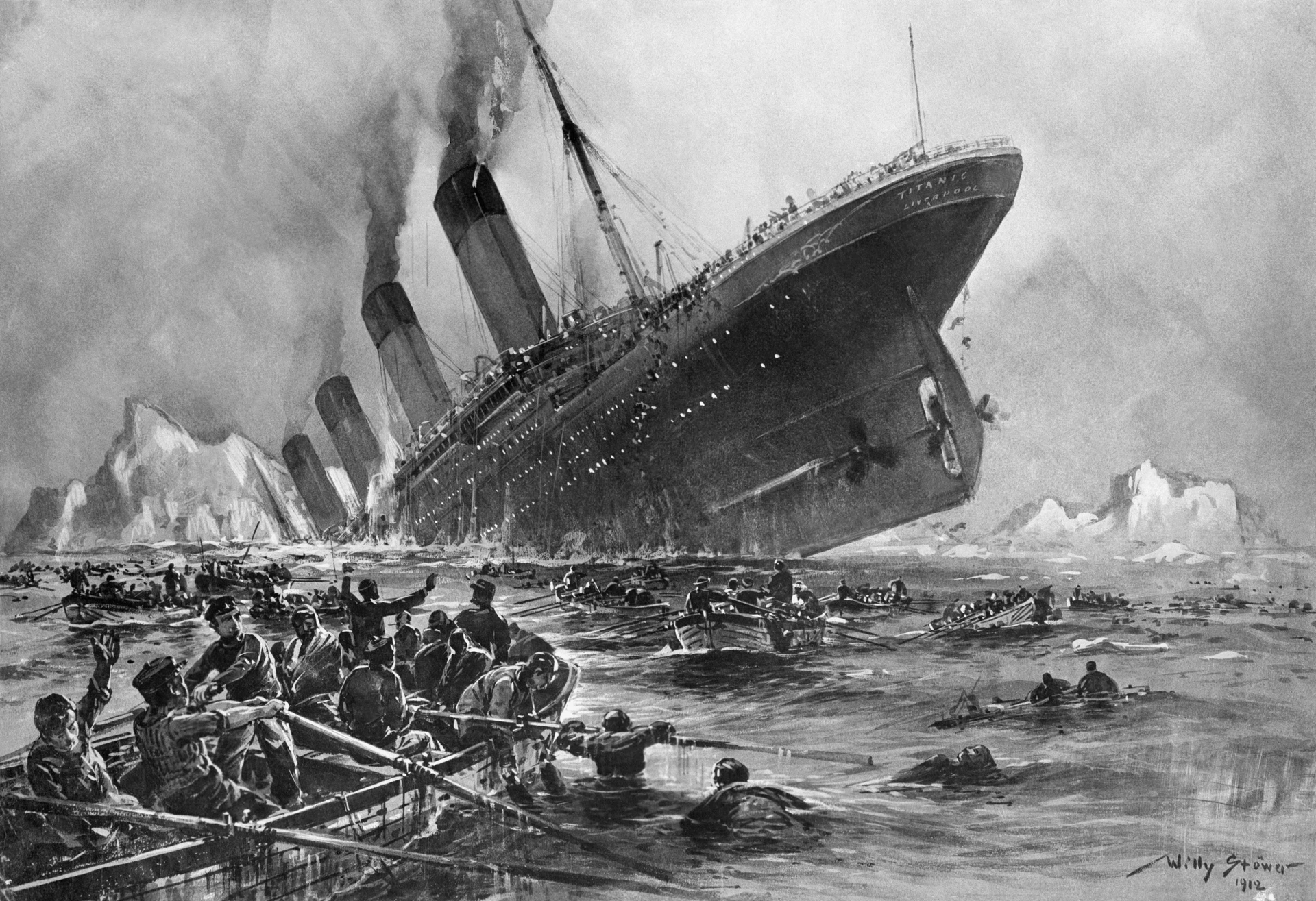
Titanic Sinking, engraving by Willy Stöwer.
Wikimedia Commons· Public domain
But the details—the size and shape of the hull damage, the exact sequence of flooding, the choices and actions of specific officers in those final minutes—have remained fiercely contested. [1][2]
The recent acoustic surveys and 3D digital twin do not turn the disaster into a solved puzzle. Instead, they pull the wreckage into sharper focus. Six slender openings where many expected one enormous gash. [2] A davit lying just so on the seafloor, hinting that a maligned officer may have died trying to get another boat away. [1]
More than a century after the Titanic went down off Newfoundland, the ship is still giving up its secrets from two and a half miles beneath the Atlantic. [2] The technology has changed; the questions—about failure, responsibility, and how a few terrible minutes can rewrite so many lives—remain the same.
Adapted from Wikipedia: Sinking of the Titanic.
This case file is an original Bloody Likely narrative synthesis based on the cited sources. Article © Bloody Likely. All rights reserved. Source materials remain the property of their respective owners. Facts, public records, quotations, and cited references are used for reporting, research, commentary, and documentation. Bloody Likely content license
Audio narration © Bloody Likely. All rights reserved. The audio player is provided for personal streaming/listening only.
No recent news articles found for this case. Check back later for updates.
No evidence found for this case. Be the first to submit evidence in the comments below.
Join the discussion
Loading comments...
Titanic departs Southampton on her maiden voyage bound for New York.
Titanic's wireless operators receive an ice warning from SS La Touraine.
Several ships send ice reports to Titanic throughout the day; Captain Smith acknowledges some warnings but speed is not reduced.
At 23:40 ship's time Titanic strikes an iceberg on her starboard side, opening multiple forward compartments to the sea.
Lifeboats are uncovered and launched beginning around 00:20; many boats are launched under-capacity and third-class passengers face barriers to reaching the
At approximately 02:20 ship breaks up and sinks two hours and forty minutes after striking the iceberg.
RMS Carpathia arrives and rescues survivors from lifeboats; all 710 survivors are aboard by about 09:15.
United States Senate inquiry into the sinking commences under Senator William Alden Smith.
British Wreck Commissioner's inquiry into the sinking begins under Lord Mersey.
Maritime safety regulations are overhauled internationally, leading to the International Convention for the Safety of Life at Sea (SOLAS) in 1914.